Across street from my house, there is a flat-top, square-ish building, looking rather modern. If it were not for the sign in front of it, I wouldn’t have thought it a Christian church. For the ten years since I moved to this quiet suburb, I had never set foot in it.
Now I’m taking a journalism class, one of the assignments is to establish a “listening post.” The idea is to visit a community you are less familiar with, so as to increase the understanding of diversity. Since I never knew what this church across street was doing, I decided to pay a visit to it this morning. That is, a Sunday morning when it’s running a service.
At 10 am sharp I walked into the church. On a desk in the hall lay some handouts. I picked one up; it’s titled “Values Voter Guide for 2008 Presidential Candidates.” It highlights issues debated between McCain and Obama, 21 of them all. A simple “Yes” or “No” column indicating each candidate’s position on each issue. Not surprisingly, on 16 of the issues listed, the two candidates take opposite positions. They agreed on three of them, while the remaining two issues were alternately addressed by only one of the candidates.
At first glance, this list is quite impartial. It does not spell out a recommendation, and the issues listed are quite informative. The Guide only asks you to compare the candidates. I was impressed.
Walking into the nave, for a moment I suspected I was in the wrong place, or at a wrong time. The stage looked ready to start a musical, or some Broadway performance. A glass room located on the left side of the stage housed a man with a full set of shining silver percussion instruments. In the center of the stage were a pianist, two guitarists, and a row of seven men and women waiting to start singing.
And singing they began soon after I took my seat. The choirmaster, a black man with beautiful voice, called for the audience to stand and sing with them. A large pull-down screen hanging above the stage, showed colorful moving pictures with the lyrics. People raised their arms and sang enthusiastically and repeatedly: “I’m desperate for you, I’m lost without you…We live to glorify your name.”
They stood and sang for 40 minutes. When they finally finished, the priest took the place of the choirmaster and explained the voting guide. He called his audience to “vote for our values, not by the party line.” He then went on to say “we don’t want the government to redefine the values of our families; God defines it, Jesus defines it.” And he said he puts his hope in God to place the right man in the government.
As he continued, I read the handout again and realized that he was calling for people to vote for McCain and Palin, mostly for Palin, who was viewed by some people as representing American family values.
During the next hour the priest preached Revelation 12 to 14, and he emphasized diversity.
Later, on the way home, I wondered how diverse the church members actually are. Will all, or most of them, listen to the priest and vote for McCain? Do most Christian churches want McCain and Palin to lead America? If the result turns out to be the opposite, is God wrong, or are the churches wrong?
Sunday, November 2, 2008


Friday, October 31, 2008
Testing Your Unconscious Biases
A fellow writer discovered a Harvard webpage presenting tools for testing unconscious biases. You can find many tests there, the featured one on Election 2008. I had thought I knew all my own biases and didn't even need a test, but I took the "Asian American" test just for the sake of it. I chose the answer to the first question as "I like Asian Americans and European Americans equally." And to another I chose "I consider … descent equally American." After going through some image selections, this was what I got:
Your Result
That was a surprise! Because consciously, for me, it is the opposite. It seems the test reaches its conclusions based on the number of mistakes you make. If you don't make any mistake, it probably won't let you finish. I am not sure how reliable the interpretation is, but it's kind of interesting.
Thursday, October 30, 2008
Absentee Voting
Because I’ll be out of town next week, I went to cast my absentee ballot this afternoon. Several people were already there doing the same. When asked by a voter, the town clerk who handled our ballots said this year the early voting is especially heavy. And she believes this is because the general participation is going to be a lot higher.
I think all the talk about early voting contributed to the higher participation. I was surprised at how easy it was. I have never had to wait in line to vote in my small suburban town, but I can understand the charm of an absentee ballot to those that have.
I think all the talk about early voting contributed to the higher participation. I was surprised at how easy it was. I have never had to wait in line to vote in my small suburban town, but I can understand the charm of an absentee ballot to those that have.
Letter from Harvard China Care
(This letter reached me through my web contact page. - Xujun)


On behalf of Harvard China Care, I cordially invite you to The Harvard China Care Third Annual Benefit Dinner and Silent Auction on November 12th, 7 – 9:30 pm at the Lenox Hotel in Boston.

Harvard China Care is a student group on campus that raises money and awareness for orphans in China both through Boston-area programs and by coordinating summer volunteers to orphanages in China. I became involved with HCC after an amazing volunteering experience in a foster home in Beijing last summer.

This year, we are proud to announce our Third Annual Fall Benefit and Silent Auction. We'll be featuring award-winning documentary producer Thomas Lennon and his Oscar-winning film, "The Blood of Yingzhou District."  Mr. Lennon's groundbreaking and powerful work focuses around raising awareness and education efforts of AIDS in China.  It is a cause close to our hearts at Harvard China Care, and we are proud and honored to feature Mr. Lennon as the centerpiece of the event.

We would be delighted if you could join us for the evening! To reserve seats, simply fill out the order form (http://www.hcs.harvard.edu/care/2008.HCC.Benefit.Order.Form.Update.pdf) and email it back to me. You may also purchase tickets online at http://www.hcs.harvard.edu/~care/08dinner.html or by sending a check to our mailing address: Harvard China Care, c/o Sherri Geng, 179 Kirkland Mail Center, Cambridge, MA  02138.

Thank you very much for helping us to improve the lives of Chinese orphans! Please let me know if you have any questions.

We hope to see you in November, and look forward to hearing from you soon.

Warmest wishes,

Shuang Annie Yao
Wednesday, October 29, 2008
"Comrades To Consumers: Advertisements In Chinese Media"
An interesting research - read about it here.
Monday, October 27, 2008
Spider Web in Tiananmen
 (photo from info.yqie.com)
Last week, many Chinese websites reprinted an article from China Newsweek titled "How the Tiananmen Incident was Redressed." This title is a bit eye-shocking because the term "Tiananmen Incident" in Chinese has also been used to refer to the 1989's June 4th massacre. This article, however, is talking about an earlier "Tiananmen Incident" that took place on
I was in the countryside then as an urban "sent-down youth." Some of the best Tiananmen poems and essays, hand copied on notebook paper, circulated through the grapevine to my hand. I still remember the excitement I had in reading those beautifully written poems. After Mao's death and the Gang of Four fell out of power, people began to demand a redressing of the incident. But that did not happen right away.
The China Newsweek article now cites a "thorough redressing" that came two years later. I don't remember the timeline of the redressing exactly, however my own experience contradicts this conclusion. After the Cultural Revolution I was a first-batch undergraduate student at
I mention this to say by the end of the 1970s or early 1980s, there still hadn't been a "thorough redress" of the 4/5 incident, at least that was the situation at
There are many similarities between the two Tiananmen Incidents that occurred 13 years apart. For example, in both incidents, people demanded political change. In the first one Deng Xiaoping was accused as the "behind-the-scenes backer" of the demonstrators, while 13 years later he made the same accusation against Zhao Ziyang. The surface difference is the lack of tanks in the first crackdown; guns were enough that time. It is a big irony that, in 1976 people called for Deng Xiaoping to return to
All the above is nothing new to my Chinese readers. However the purpose of this post is actually not a mere review of history. My question is, why does the sensitive term "Tiananmen Incident" - 天安门事件 - (instead of using the term "4/5 incident," for instance) appear in such a prominent way in an official magazine? Why has the report been published now, a time that has no relation to April 5th? Is this a foreshadow to the redressing of the second Tiananmen Incident?
Of course I might be fussing over nothing that has any actual significance. However one thing I learned growing up during the Cultural Revolution is to follow the thread of a spider and tracks of a horse in political weather change. Call it PCRPD (Post-CR Political Disorder). I rather hope I'm right this time though.
Friday, October 24, 2008
Doctor Olaf van Schuler's Brain
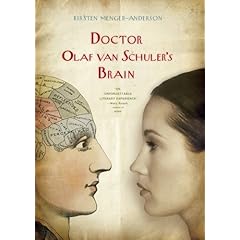 My friend Kirsten Menger-Anderson's debut story collection, Doctor Olaf van Schuler's Brain, is reviewed in the Washington Post. I have the book on my shelf and I look forward to reading it!
Monday, October 20, 2008
How Can China Support America
by Larry Mongoss, guest blogger
WhenChina China Europe and the United States
 (photograph by Maple Xu, ©2008, all rights reserved)
Regardless of the motivation, however, there was some negative reaction insideChina China US
When
 (photograph by Maple Xu, ©2008, all rights reserved)
Regardless of the motivation, however, there was some negative reaction inside
More to the point, though, people started asking the question what
The most prevalent answer, if you are curious, is no, the Chinese should not be worrying about the rest of the world. Not a big surprise, most concerns are closer to home, quite literally. There is more interest in figuring out whether the experience in the
What is really interesting about all this though is that the real lesson may be exactly the other way around. The US, and European governments responded loudly, and hopefully effectively, panic stricken that the financial markets would collapse and leave everyone jobless. To look at the Shanghai Stock Exchange Index, which dropped from 6000 last October to 2000 this October, you would definitely conclude that
Though many people are calling for the Chinese government to do something about the stock market, it has not been quick to take drastic action. I have no doubt though, that should producers find demand dropping away for their product, the government would step in. Certainly such steps would be clumsy, the norm for a command economy, but they would be strong. The knowledge that this would be done might very well be enough to mean the action never needs to be taken. McCain and Obama talk about hatchets and scalpels. What the Chinese government holds in reserve is more like a bulldozer. That level of control is often problematic, but at times like this it comes in handy.
Friday, October 17, 2008
No Internet Regulation on Human Flesh Searches
New America Media, News analysis, Xujun Eberlein, Published: Oct 17, 2008
Vicious online gossip was blamed for pushing South Korean film star Choi Jin Sil to hang herself in her bathroom. The news that the Korean government now plans to enforce a “Choi Jin Sil law” to regulate the Internet has triggered another wave of debate on internet regulation in Chinese cyberspace.
Cyber rumors, apparently, were a direct cause of Choi's suicide, and Korean police have arrested a rumor spreader involved in the case. Even long before this event, cyber violence prompted the Korean government to implement the so-called "real name system." This system requires all commercial websites with 30,000 or more users, and all media websites with 20,000 or more users, to verify a user's real ID before allowing them to post any message. The "Choi Jin Sil law" extends the real-name system to any website with 10,000 or more users.
Now some Chinese netizens are wondering if China needs to follow suit. China has been rocked by stories of “human flesh searches” which are basically Internet vigilantes unleashing a cyber equivalent of lynching.
More people, however, are worried that such regulation would heavily restrict freedom of speech. Their worries are not without basis. Read the complete article>>
Vicious online gossip was blamed for pushing South Korean film star Choi Jin Sil to hang herself in her bathroom. The news that the Korean government now plans to enforce a “Choi Jin Sil law” to regulate the Internet has triggered another wave of debate on internet regulation in Chinese cyberspace.
Cyber rumors, apparently, were a direct cause of Choi's suicide, and Korean police have arrested a rumor spreader involved in the case. Even long before this event, cyber violence prompted the Korean government to implement the so-called "real name system." This system requires all commercial websites with 30,000 or more users, and all media websites with 20,000 or more users, to verify a user's real ID before allowing them to post any message. The "Choi Jin Sil law" extends the real-name system to any website with 10,000 or more users.
Now some Chinese netizens are wondering if China needs to follow suit. China has been rocked by stories of “human flesh searches” which are basically Internet vigilantes unleashing a cyber equivalent of lynching.
More people, however, are worried that such regulation would heavily restrict freedom of speech. Their worries are not without basis. Read the complete article>>
Wednesday, October 15, 2008
Sushidog's Review
I'm very moved that someone who lives as far away as Tokyo has read Apologies Forthcoming. Thank you, Sushidog!
By the way - this is not a big deal - I've never been a tech writer, though several reviewers have assumed that. My previous career was in algorithm development. It seems the misunderstanding was stemmed from a line in my bio, "I gave up tech for writing," which could easily be read as "I gave up tech writing." For clarification I've just changed that line to "I gave up algorithms for writing."
By the way - this is not a big deal - I've never been a tech writer, though several reviewers have assumed that. My previous career was in algorithm development. It seems the misunderstanding was stemmed from a line in my bio, "I gave up tech for writing," which could easily be read as "I gave up tech writing." For clarification I've just changed that line to "I gave up algorithms for writing."
Thursday, October 9, 2008
James Wood Words Palin
Read this in the New Yorker and get some good laughs. James Wood, by the way, is my favorite literary critic.
Sunday, October 5, 2008
Mischievous Dubbing (恶搞): US and China
Saturday Night Live's latest, 7-minute parody is an excellent and uproarious summary of Thursday's vice presidential debate. The best performer is Tina Fey, who looks totally like the real Palin, to the turn of her hair, or lip. CNN has a good comment on this – "It's starting to feel like Tina Fey is running for vice president."
Considering that Fey's normal picture is quite easily distinguished, I'd say she has the talent of an Oscar actress. She parodied Palin's body language and facial expressions extremely true to form; I had a very hard time telling her from Palin. But what made me laugh the most was how she captures Palin's incoherent and evasive speaking style. At one point the Fey-Palin says, "We are not afraid to get mavericky in there, and not got to allow that, and also to the great Ronald Regan." This way of randomly throwing together words and phrases without regard to grammar or meaning, was exactly my impression of Palin's speaking when I watched the debate Thursday night. Palin is worse than George Bush in this regard – though both appear uncultured, and Bush probably more often pronounces words incorrectly, he at least seems to genuinely mean what he says, even when I am almost sure he does not. Given how old McCain is, I would be extremely worried if McCain got sick and this lady became our president. Apparently this is also a main reason that many of my Chinese friends won't vote for McCain. Call it a shallow and intuitive way of reasoning. But what more can common voters do if not judge based on impression? I think McCain made his biggest mistake by choosing such a (...) running mate.
Now let's return to entertainment, and
Apparently, in China the first notable "mischievous dub" occurred in December 2005, when an as yet unknown man named Hu Ge parodied the reputed director Chen Kaige's new movie, "The Promise," changing the story of an ancient Chinese prince to a modern murder case. Hu's short dub film spread apace, receiving more applause than the original movie. Chen Kaige, who apparently was unfamiliar with parody culture, bristled with anger and threatened to bring a copyright lawsuit against Hu. In February 2006, at the Berlin International Film Festival, where he was about to launch "The Promise" for Europe, director Chen said in indignation to reporters, "To be a man one can't be so shameless!"
The case attracted attention from lawyers nationwide, most predicted Hu would lose the lawsuit. From outside however, Richard Stallman, the founder of Free Software Foundation, concluded in an interview with a Chinese blogger that "Parodies like this one are legally considered 'fair use'. Courts have ruled that you don't need to get someone's permission before you make fun of him by parodying his work. It is lawful, pure and simple." The Chinese neitizens, meanwhile, were split. Supporters of each side argued noisily online.
In the end, there wasn't a lawsuit after all. The public debate calmed down after Hu made an apology to director Chen. But the damage was done: Hu's dub film started
Mischievously or not, despite the regulation, Chinese parodies did not simply go away. As recent as last month, a new one surfaced on YouTube mocking the
What I'm hoping though is to see political parodies like those on SNL begin to appear in
Saturday, October 4, 2008
Simmons International Chinese Poetry Festival
I attended one of the sessions today. One thing I found interesting was that, given China's morality crisis and the lack of a dominant belief system, some poets proposed having poetry as a replacement for religion. Poetry can purify the soul, they argued, and popularizing poetry education might improve morality. Perhaps I'm too cynical - I doubt that's a feasible solution. It seems we are getting fewer, not more, readers of poetry these days. And those who have engaged in the recent scandals are most unlikely poetry readers.
Another Interview
Donna George Storey, author of Amorous Woman and a writer friend, interviewed me for Eclectica, a cool literary magazine. Donna begins the interview with this question:
DGS The first work of fiction I read about the Cultural Revolution was back in my grad school days—Wang Anyi's A Lapse of Time. This author wrote from the perspective of a privileged member of the generation who had already reached young adulthood in 1968. Thus, this ten-year period was like a long night of insanity sandwiched between two periods of "normal" life. Some of your older characters have similar experiences, like the father in "Men Don't Apologize." But many of the protagonists in Apologies Forthcoming were children and thus barely remembered any different life. Later they have to struggle with the death of the ideals they were taught. One narrator asks herself, "Which is better: to have a false belief and be content or to break the false belief and feel empty?" Do you have an answer to her question?Read the complete interview here.
Thursday, October 2, 2008
Americans don't like to read translation?
Following yesterday's link to the report about the top Nobel judge's unfavorable comment on American literature and the reactions it stirred up, there is heated discussion on a writer's online forum I frequent. It's understandable that many American writers are angered by Engdahl's words, and they return fire by bombasting the Nobel committee's ignorance, which is quite effective.
Personally, however, I'm more interested in how much truth is contained in this particular statement:
"The
In the discussion on the aforementioned online forum, at least one writer agrees that most American publishers shun translations due to the assumption that Americans don't like to read stories set outside the US, not even stories written in English set elsewhere.
As I noted in a book review earlier, Howard Goldblatt,
I hope some of you will offer insights into this: is it true that Americans are much less interested in literary translation than works written by Americans about
Wednesday, October 1, 2008
Bad news for American writers...
Nobel judge: U.S. too ignorant to compete
09/30/08 04:18 PM, EDT
Bad news for American writers hoping for a Nobel Prize next week: the top member of the award jury believes the United States is too insular and ignorant to compete with Europe when it comes to great writing.
FULL STORY
09/30/08 04:18 PM, EDT
Bad news for American writers hoping for a Nobel Prize next week: the top member of the award jury believes the United States is too insular and ignorant to compete with Europe when it comes to great writing.
FULL STORY
Tuesday, September 30, 2008
Interview on Writing Neuroses
Kay Sexton, a talented British writer, interviewed me for her blog Writing Neuroses ... mine are rare, yours may be legion, and also wrote a thoughtful review of my book. Kay asked very good questions which I enjoyed answering. Her first question is:
Apologies Forthcoming has a central theme, or perhaps a central reef onto which all the stories are somehow driven - and that theme is the Cultural Revolution and its effects on Chinese society. Many Westerners, myself included, have had a one-sided view of this amazing social phenomenon. How much did it affect you, growing up in China?Read the complete interview here.
"Five Star Literary Stories"
If you are interested in reading short stories, there is a very good website that you can turn to. The Five Star Literary Stories website, hosted by T. J. Forrester, puts a selection of stories together in a comprehensive and continuous manner. It not only reprints excellent stories recommended by editors of on-line literary magazines, but accompanying each story are also comments from the recommending editor and a detailed review from another writer. So far the site has published 25 stories and reviews, and the number will continue to grow. Because the stories are selected from a variety of magazines and reviewed by a variety of writers, the selection has a rare breadth of taste. I'm sure you can find something to your own liking. Enjoy the latest post on Five Star Literary Stories.
Monday, September 29, 2008
Bailing Out the Leaky Boat
 by Larry Mongoss, guest blogger
(Photo by nikok)
Everyone keeps talking about the bailout, but it is interesting to me that nobody continues with the analogy to talk about the leaks in the boat. On the water, when you bail out a boat because something has gone wrong, it only makes sense to do so if you can get the water out faster than it is coming in. If that is the case, you get to keep bailing until the boat gets to shore, or it can be repaired. So, if we are going to have to keep bailing in order to forestall catastrophe, the real question people should be asking is how long that 700 billion will last.
On and off over my lifetime I, like many other people with a background in economics, have spent a great deal of time thinking about the great depression, its causes and ways it might have been avoided, even the desirability of avoiding it. On the financial side, some of these are obvious and fairly well understood. Large scale insider trading, which was business as usual at the time, loose credit, and a general adolescent feeling of invulnerability caused a remarkable run up in stock prices that eventually collapsed. On the real side – what politicians are calling
The bailout is, to my mind, an absolutely fascinating, and incredibly expensive, test of the theory that there was not enough money. A long time ago, back when Paul Volker was heading the Fed, there was a great headline in the wall street journal that read something like “What happens if you throw a credit crunch and nobody comes?” The reigning assumption then, as now, was that easing credit will allow people and businesses to borrow money and get things moving. But really, beyond a few anecdotal assertions, there has not been much evidence presented that those who want to borrow money can’t. Just listening to the radio, and the ads from banks that want to lend me money, seems to suggest otherwise to my simple mind. If credit is eased, and still nobody borrows, what then?
While people in
Stepping out of slavery, all this boils down to less going into the hands of those that do the work. While this effect can be lessened, potentially even avoided, by rapid changes in technology, there is no guarantee, or evidence, that this will be sustained. In fact, if you look at the last 20 years in
So perhaps the bailout can be paid for by the Chinese who are now rich because land, in fixed supply, is getting progressively more expensive while labor, with unlimited supply, is relatively cheaper and thus Wall Street can keep itself intact while the residents on
A postscript on this. After reading through the proposed bailout bill, the whole activity is being put under the acronym TARP for Troubled Asset Recovery Program. I am not sure if the new metaphor is intentional. But if it is, apparently those in the know think all of this is simply the result of too much rain, and has nothing to do with a leaking boat. Funny though, I did not see anyone named Noah involved in writing the bill.
Saturday, September 27, 2008
On Dark Matter
Orville Schell's essay "China: Humiliation & the Olympics" in the New York Review of Books is well-researched, informative, and insightful, one with rare high quality. However, it is a pity that even such a serious China China
What was surprising was that many of the most indignant counterdemonstrators were young Chinese, born during the post-Mao era. Better educated and more worldly than older Chinese, one might have expected them to have been exempt from the
Then, as if an after-thought, Schell hesitantly adds a footnote:
[*] Daniel A. Bell's China's New Confucianism, an account of teaching at elite
While I must give him credit for including this footnote, Schell's convenient presumption that today's students in
Of course, Schell is not alone. As recent as last week, during the Q&A session of a book event, a woman asked me, "Do the Chinese know about things outside their country?" "Oh yeah," I replied. Such a question came often, and it is understandable, and reasonable, when it comes from someone who doesn't follow
Which reminds me last summer when I toured a mountain in
If you skip this small disappointing spot, Schell's essay is well worth reading. I was particularly drawn to his analysis of the Chinese people's cultural insecurity caused by the continuous "large-scale, but never definitive, makeovers" occurring in
By the way, Schell's article makes me really want to see Dark Matter. If any of you have seen the movie, would you please tell me what you think of it?
Friday, September 26, 2008
Another Review of "The Man on Mao's Right"
This review, "China's Tell-Nothing Ethos" by Foster Winans, made some reasonable points in his rebuttal to Nathan. I also found it amusing that a "reader" who did not read the book nonetheless chose to criticize it. One of those weird things.
"Books for Barack"
A writer's innovative, and successful, approach to fundraising for Obama through other writers' donation of books: "Books for Barack."
A review of "The Man on Mao's Right"
From Memory Writers Network by Jerry Waxler: "Seeing History Through The Eyes of One Man."
Tuesday, September 23, 2008
Ideology or Not?
In response to my Friday post "Why Does China Have a Morality Crisis?" a blogger named Demin says in "What do we need? A new ideology?":
But what I know is that, you can take hold of an ideology, but you can't take hold of people's inner conscience. I would say, conscience is the last area of a living soul. It is always free. All we need to do is to choose: honestly accept this freedom, or pretend that we can control it.
He obviously does not think people in
I am not sure the lack of a dominant ideology is a bad thing at all. The last 30 years of
Well said. I must say Wuming's comment resonates with me on the personal level. I had been a sincere believer in communism during my childhood and youth – not much different than the way an American child from a devout Christian family becomes a sincere church goer. But my re-education in the countryside after high school changed all that. For a number of years after I abandoned communism, I felt a sort of spiritual barrenness, as if my soul no longer had a settling place. On the other hand the breach of a deep belief was like the most effective vaccination – nothing could make me a believer again. And after a while I got used to my incorrigible soul.
But, away from the personal, what about at the society level? Does a society need an ideology or not?
Recently, after my book was published, I found it interesting many interviewers took notice on the following passage, a question asked by a character in one of my stories:
"Which is better: to have a false belief and be content, or to break the false belief and be empty?"
And readers too. People asked me about this passage on various occasions. Evidently, this character's question touched on a common concern. Yet I don't think as the author I have a sure answer to it.
A novel I read years ago, The White Mandarin by Dan Sherman, made interesting observations on what had led to the defeat of the Chinese Nationalists (or KMT) by the Communists in 1949. Among other things, one reason identified was that the Communists provided Chinese intellectuals an ideology that was lacking in the Nationalist's appeal. I think this is a pertinent point. The experience of my parents and their friends who joined the eastern
On a related note, a few years ago in an on-line writing forum I posted a question, or a hypothesis: what if no one believed a religion? What would the world be like then? Some American writers took offense and accused me of wanting to suppress religions. But, I asked again, what if no one wanted to believe in a religion? Then a writer pointed me to a book of academic research – the title of it now escapes me – which I did find and read. Based on biologic research, the book concluded that the need for a religion exists in human genes, which effectively destroyed the basis of my hypothesis.
Perhaps people like Wuming, Demin and I don't need a belief or religion to live well. But we are probably a small minority; many others do. Without a dominant and "legal" (I find this word very ironical here but nonetheless necessary) ideology or religion to hold a society's spirit, many will either get lost or seek refuge in a foolish cult like FLG.
More thoughts from you wise people?
Monday, September 22, 2008
Chinese Black Humor
中国人在食品中完成了化学扫盲:从大米里我们认识了石蜡,从火腿里我们认识了敌敌畏,从咸鸭蛋、辣椒酱里我们认识了苏丹红,从火锅里我们认识了福尔马林, 从银耳、蜜枣里我们认识了硫磺,木耳中认识了硫酸铜,今天三鹿又让同胞知道了三聚氰胺的化学作用。 How do Chinese learn chemistry? We study our food:
We learn to recognize paraffin in rice,
to recognize DDVP (dichlorvos - an insecticide) in ham,
to recognize Sudan Red in salted duck eggs and hot pepper sauce,
to recognize formaldehyde in hot pot,
to recognize sulphur in tremella (yin er) and candied dates,
to recognize copper sulphate in edible fungus (mu er).
Today we learn the chemical effect of melamine from Sanlu milk.
Chinese drink cow milk to have stones.
中国人口号:一天一杯牛奶,震惊一个民族!
Japanese slogan: a cup of milk a day, invigorate a nation;
Chinese slogan: a cup of milk a day, eviscerate a nation!
(Note: I'm not satisfied with the last translation. Improvement anyone?)
We learn to recognize paraffin in rice,
to recognize DDVP (dichlorvos - an insecticide) in ham,
to recognize Sudan Red in salted duck eggs and hot pepper sauce,
to recognize formaldehyde in hot pot,
to recognize sulphur in tremella (yin er) and candied dates,
to recognize copper sulphate in edible fungus (mu er).
Today we learn the chemical effect of melamine from Sanlu milk.
Chinese drink cow milk to have stones.
日本人口号: 一天一杯牛奶,振兴一个民族;
中国人口号:一天一杯牛奶,震惊一个民族!
Japanese slogan: a cup of milk a day, invigorate a nation;
Chinese slogan: a cup of milk a day, eviscerate a nation!
(Note: I'm not satisfied with the last translation. Improvement anyone?)
Friday, September 19, 2008
Why Does China Have a Morality Crisis?
In the wake of the Sanlu melamine milk powder crisis, I can't help but recall the “dark-heart milk powder” incident four years ago. In a commentary published in January titled "China Has a Morality Crisis" I wrote:
A fundamental question begs to be answered: why isChina
China’s moral crisis exists not only in marriage, but also in business practices. A representative case is the so-called “dark-heart milk powder” incident. In April 2004, the media exposed an infant food business in Anhui Province that had been selling counterfeit milk powder causing the deaths of 13 babies and permanent illness in 171 others. The incident enraged the entire nation, but unfortunately it was not an isolated case.
Given the public outrage at the time, to be honest I did not expect the same calamity to repeat itself so soon and on an even bigger scale. While I'm glad to see a thorough investigation on China
A fundamental question begs to be answered: why is
The Chinese expression “quede” (缺德) , meaning “short of virtue,” used to be one of the most vicious insults in verbal arguments. Nowadays, the expression seems to have lost its admonishing power and has simply become a portrait of reality. Last year, a Chinese blogger cyber-named “David” attempted to analyze this. In his widely read article “Why have Chinese become ‘quede’ now?” he lists a few representative views on the Chinese moral sphere: all citizens worship money; no more baselines exist for minimal morality; today is the worst time of moral degeneration in China’s history; China should return to its traditional values.
“David” has his own ideas on the reasons behind the moral degeneration: while China imports the Western-style market economy, it fails to establish corresponding ethics, and the traditional Chinese moral principles no longer apply in the completely new economy. He recommends Adam Smith’s “The Theory of Moral Sentiments,” but fails to suggest how to carry out such a theory.
An influential contemporary Confucian, Jiang Qing, has a more appealing proposal. To him the essential problem is the lack of state ideology and a corresponding political system. Since the Cultural Revolution led to the self-destruction of Communism, that once ideological monopoly has lost its past aureole, and common Chinese have been unable to find the ultimate meaning and value for their individual lives.
“The problem isn’t that people don’t follow moral standards; the problem is that there no longer exist moral standards,” says Jiang Qing. He attributes the loss of morality to five decades of atrophy under Communist political power, plus two decades of corrosion under the money and wealth brought by the Western market economy.
After many years of research and various attempts at commitment to promising ideologies, including Christianity and Buddhism, Jiang Qing concludes that Confucianism is the only ideological solution for Chinese people. He and his followers are pushing to restore Confucianism as China’s state ideology. There are signs that China’s national leaders are also increasingly promoting Confucianism, albeit for considerations different from Jiang Qing’s. How far the government is willing to go in this direction remains a big question.
My question remains: to reestablish moral standards that have binding power, does China
Saturday, September 13, 2008
"When masses cast the classics"
An interesting discussion on the new, 50-episode TV serial adaptation of the Chinese classic A Dream of Red Mansions (红楼梦):
"Sometimes producers are too literal and don't bother with originality and respectful updating. Sometimes they don't show enough respect to the originals and create parodies." Read the English report in Shanghai Daily.
"Sometimes producers are too literal and don't bother with originality and respectful updating. Sometimes they don't show enough respect to the originals and create parodies." Read the English report in Shanghai Daily.
Chinese Classic Now a Game
Cool. This is the first time I've ever heard that Three Kingdoms is made into a game, let alone in the West -- read Romance of the Three Kingdoms XI review (PC).
Friday, September 12, 2008
Olympics Aftermath: Food Animosity
 After that remarkable description of the wonders of Olympic Beijing in my sister's letter, it was a bit of a shock to hear a medalist calling the Chinese people "sh*ts." The latest gripe came from a departing athlete. Wind surfing bronze medalist Shahar Zubari from
 I don't know about the Olympic food, but last time when I brought my American-born daughter to
In
Once, a dish of meatless, egg-fried rice came garnished with chopped pork. To our inquiry the waitress replied, "Our chef said it won't taste good without any pork." Another time our daughter ordered an olive-and-pineapple pizza in a Pizza Hut in
Shahar Zubari's small-minded animosity notwithstanding, if
Just another ironic twist. The Israeli Olympic Committee Chair promised an apology, but the Chinese Embassy in
Monday, September 8, 2008
Funny Business in China
Book review by Larry Mongoss, guest blogger
 Business Republic of China
Tales from the front line of China’s new revolution
by Jack Leblanc
Blacksmith Books, 248 pages, HK$118 / US$14.95
What do an academically oriented young man fromBelgium China China
 Business Republic of China
Tales from the front line of China’s new revolution
by Jack Leblanc
Blacksmith Books, 248 pages, HK$118 / US$14.95
What do an academically oriented young man from
Jack Leblanc’s book
There are two threads that run through Leblanc’s book. One is very intentional and in the forefront, and that is the vast cultural and practical differences that exist between business in
Of course it never hurts to have both of these, but there is enough variety in the stories Leblanc tells that in most cases the dominance of one over the other does come out. Mr. Li, the motorcycle magnate, presumably the same person that Ted Koppel interviewed in The People's Republic of Capitalism, stands out as superbly capable. So does Mr. Zhang, the widget maker, who manages to buy the brand of the German make previously dominant in his market. On the other side, Ms. Luan, the party secretary turned public relations head mentioned above, and Smile, who got Leblanc into all of this in the first place demonstrate that connections can be enough.
The book itself is written up almost as a series of informal case studies. While the writing is not quite what could be called literary, several of the cases could belong to the mystery genre and I enjoyed greatly watching the cases unfold. Leblanc is called in to troubleshoot a number of joint ventures that have not worked out as expected. He typically starts by trying to get to know the management team on the Chinese half of the joint venture. He seems to be surprisingly successful in doing this, so I suspect he understates his own personal charm in the telling of his stories. Whether from frank conversation, or just checking to see how the numbers add up, he uncovers some interesting activities. The great delight is just how varied these activities are. I won’t spoil the endings by reveling them here, but the pipe factory, and a bottled water factory are especially interesting.
Still, my favorite chapter was actually the first, in which Leblanc goes to
His drift into business is unplanned, and does not seem particularly well executed. But that is the beauty of the story. Leblanc, like most Chinese at the time, did not really know what made sense, and just hoped for a good outcome. In this case he got one, making a big sale of European glass for a new hotel. From all appearances the result was largely luck, but may have been related to Leblanc’s own likability. Either because he did not have a real preconceptions of business, or because of a natural empathy, Leblanc learned early on to simply go along with the way people around him did things. That is an important lesson.
Not all of the mysteries facing a person doing business in
My biggest complaint about the book is the continual reference to those from outside
All in all, I would have to say this book is both entertaining, and informative. It is not a complete guide to doing business in
Saturday, September 6, 2008
Red Cliff (赤壁) Does Laughter
 There is a Chinese expression, 搞笑,whose direct translation is "do laughter." This expression, an infection from
 Directed by John Woo, Red Cliff reportedly cost US$80 million. As a fan of the classic novel Three Kingdoms, I was very eager to see what a difference such a big budget could make on a repeatedly filmed story. Adding to my eagerness was the fact that one of my favorite actors, Tony Leung, plays a starring role, Zhou Yu.
Because (a shortened version of) the movie for the
I couldn't connect the notion of "do laughter" with the grand war scenes of Red Cliff. On the other hand, I have seen how some
Impatient, I ended up buying the DVD from a Chinese online store in the
Yet copying
I of course have no objection to jocular treatment of any subject. The problem is that the director (and playwright) obviously did not mean to make the movie as a joke. The money, intent and effort were dead serious. Why it has resulted in such a laughable effect can only be explained by two things: one, the director and actors were unfamiliar with the history (I wonder if they have read any books about it other than the screenplay); two, with a long oral story-telling tradition of the Three Kingdoms, we Chinese audience can no longer accept a stupidification of historical figures. At least not Zhu Geliang!
I suppose the silliness in dialogues will be less a problem to American audiences. After all, the unintended effect might be lost in translation. Further, someone has made a wise decision to cut the length of the original film from 4 hours to 2½ for American theaters. I hope this will help improve the attractiveness of the battle scenes and also eliminate some "do-laughter" elements.
To be fair, there are also some creative and fun details in the movie, for example the association between a turtle's shell and Zhu Geliang's "eight trigram" battle formation. Zhou Yu, who was known in history to be proficient in music, stopped in the middle of training his army to tune a flute for a village boy. Still a bit overdone, but at least for a reason. And IMO Tony Leung did a better job acting Zhou Yu than Takeshi Kaneshiro acting Zhu Geliang, though my impression is that, judging by the two actors' appearances, switching their roles would better match our images of the historical figures. I heard that Tony was originally assigned the role of Zhu Geliang, but he refused, citing that he was not familiar with the role.
Overall I felt director John Woo had a tendency toward overkill, which resulted in humorless exaggeration in the acting. He needs to exercise a bit more control and incorporate a bit more subtlety next time.
Wednesday, September 3, 2008
Two Sidneys in China
 Read this interesting article (thanks to Aaron Gardiner who pointed me to it) about the two Sidneys (and two rivals) who had both participated in
 Three years ago, after reading Rittenberg’s book The Man Who Stayed Behind, I posted a review on Amazon. To my surprise, three months later, just before Christmas, I received an email – in Chinese – from Rittenberg, who not only read my review but also one of my short stories online. In his email with the subject "谢谢" (thank you), he called my review 公正 ("fair-minded") and generously praised my story "Second Encounter" as 诚实而深刻 ("honest and profound"). Rittenberg compared the story to He Dong’s Ask the Sun, also about the Cultural Revolution.
From our correspondence I learned that Rittenberg, already 84 years old in 2005, and his wife of 50 years, Wang Yulin, had been working as business and cultural consultants for several
And again I highly recommend The Man Who Stayed Behind for anyone who’s interested in learning about
Monday, September 1, 2008
"Is this Beijing?"
My husband W and a friend H went to see the closing ceremony of the Olympics, and their conclusions were unusually uniform: it was fun and playful.
Zhang Yimou had put word out early on that the closing ceremony wouldn't have many performances; the goal was simply to delight and cheer the athletes, like throwing a huge party. So from the beginning W and H did not hold hope of seeing splendid performances. They just wanted to be there in person, to feel the ambience.
They say the Olympic Village is big and beautiful, where one can spend days to tour around.
Though the closing ceremony was broadcast at

As soon as W and H entered [the Bird's Nest], they were given a big bag of things: red-silk fan, rattle-drum, light-torch, national and Olympic flags, etc. Volunteers taught them how and when to use those things. After the ceremony began, volunteers led the audience play those props. One moment they shook the rattle-drum, the next they waved the toy torch. They even used the red-silk fan to form big waves. In short all the audience were kept busy, not sure if they were watching others perform, or others watching them.
Two days before W's trip, he had a leg problem. He boarded the plane with a bandaged leg. Unexpectedly, as soon as he boarded, he was invited to the first class cabin. After he landed in Beijing Beijing
And H the American Shanghaier even wondered "Is this China Beijing
They both said that if you want to visit Beijing
Friday, August 29, 2008
On "London Eight Minutes"
 A British cyber friend, Paul Armstrong Taylor, wrote me from
 Consider this quote from an article about Sebastian Coe, Chairman of the London Olympic Organizing Committee:
Coe kept mentioning two words -- creativity and fun. Both, he claimed, are representations of
As far as the fun part goes,
Citing the famous string of British pop music and
This fills me with foreboding. After
If they continue down this route, it will be a complete disaster for at least two fundamental reasons:
a) Pop culture is shallow, temporary and very much subject to fashion. It is a flimsy foundation on which to build a presentation to the world. Every country has pop stars and they all change with the whims of teenagers (which change often). The Olympic opening ceremony is about presenting what is unique and fundamental to the culture of the host (as well as the obligatory spirit of world unity). Pop culture can simply not achieve this.
b) Politicians and Olympic committees can not be creative and fun by their nature. Even the
Subscribe to:
Posts (Atom)