Showing posts with label On "Apologies Forthcoming". Show all posts

Thursday, November 10, 2016

An Amazon Review

I was surprised and very touched today by an Amazon review of my book, Apologies Forthcoming. This is a good time to be touched by something nice, so let me share it with you:

The kind of literature that makes you stop and feel
By M  on November 2, 2016
Format: Paperback|Verified Purchase

This is a genuine work of literature. The two stories I remember most are "Feathers" and "Pivot Point." The former is a devastating portrait of family loss, the latter, a haunting illustration of longing. In several of these stories is a protagonist who really establishes herself as a sort of feminist hero, a young woman at once happier as "just one of the guys" and critical of the way they treat women, including herself. An additional pleasure is the way the stories get the cognitive faculties working: suddenly the reader will come across two characters debating a mathematician's theorem, or a substantive quote by Confucius. Eberlein has a poet's eye, giving us the image of two birds on a wire when we don't expect it, and it's these unexpected moments--many of them image-based, some of them dramatic--which the reader remembers vividly. At the heart of Eberlein's craft is a finely tuned and inimitable sense of language. "I want to travel with you to every mountain, every water, I told him," and that use of "water" is le mot juste. To read these powerful works by Eberlein is a great privilege.

Monday, March 21, 2011

Glass Magazine Interviews Writers

Glass, a handsome quarterly published in UK, interviews several international writers in their spring issue.  In an article titled "Women Hold Up Half the Sky," the journalist, Samantha Kuok Leese, says about my writing:
Contemporary author Xujun Eberlein is a native of Chongqing, one of China's major south-western cities, who moved to the United States in 1988. Her first book, Apologies Forthcoming, won the 2007 Tartts Fiction Award and established her as one of the most refreshing new voices in Chinese women's writing.
            The collection of eight stories is a moving remembrance of the Cultural Revolution at an individual level, through which Eberlein gives voices to a variety of characters in a range of times and settings. The book's subtitle is pointedly Stories not about Mao. (Note: this refers to the Hong Kong edition – Xujun) Her time outside China encouraged her to present the historical calamity of the Cultural Revolution in small but deeply absorbing episodes.
            "Having lived in two countries of political opposites, I am no longer easily excited by “-ist” labels, be it Communist, capitalist, imperialist, or terrorist. I have learned there are people’s faces behind all those “-ists,” with human commonalities and differences, human weaknesses and biases.  I've seen similarities in national and international politics and propaganda, and the information disparity that exists on both sides of the earth. 
"It is easy for people in each country to see the other in a rather abstract and presumptive manner, instead of as fully fleshed fellow human beings.  My intention was thus to return to the basics of human nature, to portray the characters as realistically human as I could."
There's more about my writing in the article, which also talks about another writer I admire, Xu Xi.  Other writers you will read in this issue are Junot Díaz, Isabel Allende, Russell Hoban, and Liz Calder.  Though the content is not available from their website, you will probably be able to find the magazine on newsstands and in large bookstores. See more information below.

Here's the Glass newsletter that arrived in my inbox:

Thursday, January 28, 2010

Past and Present Significance of the Cultural Revolution

by Michael Geracie  

[Introduction: I am very impressed and touched by this essay, written by a college senior in Physics. Not only is it well-written, but it demonstrates the discerning eyes of a thoughtful reader.  It gives me hope for the young generation. In addition to Michael's carefully laid-out analysis of the stories and characters, which is very interesting, please pay special attention to his conclusion, which catches the nuance of one of the book's main themes. Posted with permission. -- Xujun]

In Apologies Forthcoming, Xujun Eberlein presents a number of perspectives on the Cultural Revolution. In “Disciple of the Masses,” the reader observes the changing personal meaning of the Cultural Revolution in Shanzi as she realizes a more sophisticated view of her place in China’s political and economic framework. Belatedly, “She saw a reality that would never be taught in school. Sorrow overtook her, and she whispered to no one, ‘I’m sorry…’”. In “Disciple,” this new insight is lost forever, but in “Second Encounter,” the reader is shown how this realization of shame creates both tentative hope and enduring difficulties for all who live with its memory. The author explores the Cultural Revolution’s significance not only across social and gender boundaries, but also across time, illustrating a dynamic picture of meaning that helps the reader understand the Cultural Revolution both as an immediate experience, and as a shared historical tragedy with current and future implications.
In the closing of the book, Wei Dong notes “only those who survive the waste can understand”, and indeed, in “Disciple of the Masses,” Eberlein presents a detailed and messy picture of understanding in transformation, catalyzed by an environment of unremitting tragedy. In the course of the chapter, Shanzi’s confident commitment to revolution develops into a more sophisticated appreciation of the social, political, and economic conflicts within China. However, her story is also characterized by a singular resistance to this change, as Shanzi becomes an unwitting perpetrator of tragedy before recognizing it in the lives of those around her.
Interestingly, Shanzi is portrayed as a highly observant individual. She repeatedly notes the telling details of life in Lily Village, the evidence of suffering. However, her capacity for observation is neutralized by her inability or unwillingness to analyze her environment. When Shanzi first encounters Secretary Xia, she can immediately tell he “had never worked in the fields”. Yet, late into the chapter, she’s still hesitant to view his treatment of the villagers as unfair. Even after nearly a year of observation, “she needed more time to think” before accepting the existence of the social conflict she’s beginning to see.
This superficial nature is immediately apparent in the reader’s introduction to Shanzi. When Mr. Tan asks her why she is being sent to the countryside, he effectively probes her understanding of her role in current events. Again, Shanzi’s interpretation is shallow; she doesn’t even understand the point of asking, as the movement is “mandatory”. While certainly aware of her situation, she does not question or analyze, simply accepting what she’s told to do. Once in Lily Village, her initial ignorance, though understandable, is highly reluctant to give way. Eberlein’s division of the chapter into “seasons” reminds the reader of the sheer amount of time passed, and Shanzi’s delay comes across as even more striking. As soon as the “Summer” marker passes, the reader is aware Shanzi has spent at least two full seasons immersed in peasant life, yet is asking for expensive delicacies and wildly inappropriate questions such as, “do you always have watery gruel?” When Zhou Sixth mentions “public rice eaters” affinity for lotus root, Shanzi’s response “I like them too” shows she does not yet view herself as part of the crisis of want surrounding her.

"Youth" (oil paining by my friend He Duoling)

Shanzi’s eventual realization of the social and economic conflicts surrounding her is thus accompanied by the shock that she’s been a part of them all along. When “the caveman” begins to breach Shanzi’s carefully constructed worldview, she initially refers to an enemy “they,” responsible for China’s deterioration. The correction to “us” profoundly disturbs Shanzi. For her, as with many of the characters in Apologies Forthcoming, the lessons of the Cultural Revolution do not only change their view of the times, or of China, but bear deep personal significance and abiding pain. In the end, “I’m sorry” apologizes not only for informing Secretary Xia of Lily Village’s grain production, but for being part of oppression she didn’t understand.
In “Disciple of the Masses,” Shanzi’s experience is a tragic example of not only loss of potential, symbolized by the unsolved Goldbach’s Conjecture, but loss of memory and learning. However, Wei Dong carries a similar realization to the present, giving him the opportunity to consider the meaning of the Cultural Revolution to both himself and future generations with no direct memory of it. In particular, Wei Dong’s experience in “Second Encounter” shows the enduring difficulties of those that survived the Cultural Revolution. Even before Wei Dong encounters Zhang, he expresses fear of a “mainlander who would not hesitate to lay ambush for a fellow Chinese”. Though Wei Dong seems a model of forgiveness and change, his memory of the Cultural Revolution haunts him with anxiety and mistrust.
In light of Wei Dong’s concerns over future generations repeating the catastrophe of the Cultural Revolution, his difficulty in discussing the past is quite threatening. In his final ruminations, Wei Dong mentions how passing through the Cultural Revolution may have been necessary to understand his own ignorance. However, shortly thereafter, he decides to stop thinking about it. Though he recognizes the necessity of remembering his shame, he is nonetheless quite resistant to actually doing so. This is more powerfully demonstrated throughout his discussions with Zhang. Despite Zhang’s openness, Wei Dong is reluctant to share any information, or even partake in the meal. When Zhang asks Wei Dong for his motivation in freeing him, Wei Dong deflects the question.
Thus, though Apologies Forthcoming shows hope for the future, that hope is portrayed dubiously, as the understanding requisite for future progress is necessarily accompanied by shame. While the shame itself may be a positive influence, the magnitude of the crimes of the Cultural Revolution enhances it to such an extent so as to choke Wei Dong’s attempts to discuss it. When current events remind Wei Dong of his own crimes, “his hands sweat cold”. As distant as the Cultural Revolution may be in place and time, its memory still bears acute significance, enough so to elicit a physical reaction.
At the same time, Wei Dong possesses a remarkable ability to examine his experience. When Zhang recounts the armed fight ‘8.31’, Wei Dong is clearly tense, checking nearby tables, goosebumps rising from the details. Though his emotions are heightened, his thoughts and questions show him approaching the situation with outward detachment. He patiently waits out Zhang’s dramatic presentation of events, carefully confirming the details. Repeatedly, Wei Dong nonverbally verifies Zhang’s account: his superstition, his numerical accuracy. In a number of instances, Wei Dong assesses the motivations of himself and his team. He also attempts to reevaluate the story’s personal significance, asking Zhang if his team killed others after he was freed. Eberlein takes care to note that through all this, Wei Dong holds his cup steadily.
Both “Second Encounter” and “Disciple of the Masses” are stories about realizing the painful realities of the Cultural Revolution. The opening quote connects the stories in this way. Between the two, Eberlein presents the Cultural Revolution as a continuing learning process, viewed from two different times. One story is looking back on the Cultural Revolution while the other lives in it, but both reflect on it. For Shanzi, her newfound awareness is a personal shock,not only upending her scholastic paradigm but elucidating her involvement in the structure of social and economic oppression surrounding her. Even as the surrounding catastrophe enables this realization, it consumes her. However, Wei Dong’s story explores the unique opportunity survivors of the Cultural Revolution have to put these lessons to use. His recognition of his own learning and of the necessity of its continuance show how the Cultural Revolution will and should remain a part of the public consciousness. However, the difficulty with which he endures it exposes lasting challenges to present and future generations. By considering the Cultural Revolution from both perspectives, Eberlein shows its lasting significance and more completely probes its complex meaning to a variety of audiences.

Sunday, December 13, 2009

"What Does the Chinese Signboard on Your Book Cover Say?"

[Note: In the past a few months, I've had the pleasure to answer questions from a number of university and high school teachers about my book Apologies Forthcoming. The following dialogue, in chronological order, is compiled from my email exchanges with a teacher at a midwest public university, who is teaching the book in a senior honors course. These are great questions, ranging from particular translation of Chinese terms, to how educated women fared in the 1980s, to the present effects of the way the Cultural Revolution is addressed in China, that I thought both the questions and answers may be of interest to broad readers. Posted with permission. – Xujun]

October 18-19

Q. Would you please comment on why you use the Japanese term 'sensei' in your stories? I'm teaching this book, and Chinese colleagues say they are quite puzzled by the use of the term, especially in stories set during the Cultural Revolution.

A.  The Japanese term "sensei" originated from – and is equivalent to – the Chinese term "xian-sheng" (先生). It is the same term in two different languages, with the same characters and very similar pronunciation. However, if I use "xian-sheng," few English readers would understand. On the other hand, "sensei" is widely known in English.

"Xian-sheng" is a traditional way of addressing a teacher; it has an old-fashioned and more reverent flavor. It was not commonly used during the Cultural Revolution, however even in that fanatic time there existed old-fashioned people who preferred the traditional way, especially in remote areas. My story "Disciple of the Masses" takes place in a rural area, where village people still have lots of reverence for teachers, and old traditions are better preserved than in the cities. That's why they are calling a teacher "xian-sheng" instead of "lao-shi" (老师).   In short, I use "sensei" instead of "teacher" in order to better reflect the local characterization. Part of the story is based on my own experience as an "insert" (a sent-down city youth) in the countryside.

Q. Why did you choose to start the book with Snow Line and Pivot Point and to place The Randomness of Love next to the end?  For me, the other five stories (Feathers, Men Don't Apologize, Watch the Thrill, Discipline of the Masses, and Second Encounter) would make a solid collection on their own. For you, what is most important to convey to readers through Snow Line, Pivot Point and The Randomness of Love?

A. I agree with you that, if the book is only set in the Cultural Revolution, then the five stories you mentioned make a more concrete selection. However I also wanted to depict the years immediately after the CR, because that period was, and still is, largely unknown to the broad English audience, while in my opinion that transitional period is historically very important. Mostly though, I chose to write about the period from early 1970s to mid 1980s because I grew up from a child to an adult in that period, and those where the years that molded me and my generation. There have been many books written in English set in the CR or much later, but the 1980s China seemed to be nonexistent in literature.

From the subject and theme point of view, the choice of the opening story for the US edition doesn't seem to be the best one, and in the book's Hong Kong edition it has been changed to "Men Don't Apologize."  I chose "Snow Line" to open the US edition mainly because of the artwork. As you have seen, several pieces of artwork by Wu Fan, a well-known old-generation artist in Sichuan, are used as illustrations in the book. I have tremendous respect for Wu Fan and his art. Because not every story has an accompanying piece of art, I thought "Snow Line" would make an attractive opening because the story cites its companion art piece "Dandelion." In this way it blurs the boundary of fiction and nonfiction. As it turns out, "Snow Line" seems to get polarized reactions from readers: it was either loved enthusiastically, especially by poetry lovers, or it put off the reader. None of the other stories have had such a divided reaction.

December 4-7

Q. What do you think are the present effects in China of people not being able to openly discuss what happened during the Cultural Revolution, that is, of not being able to assess for themselves what happened, how and why? Friends we have known in China for 25 years say the CR is not a subject they ever expect to be addressed publicly, except in terms of the government deciding Mao was X% right and X% wrong (and he will always be more right than wrong officially).  

A. The current situation is more like this: though the official media largely avoid addressing the CR, the topic is not as sensitive as some others (such as the 1989 massacre). Many books that realistically reflect the time have been published in China, both fiction and nonfiction. One thing comes to mind is Yu Hua's very popular novel "To Live," which was first published in 1994. The movie that based on the novel and won international prizes did not pass the censors and consequently was not shown in China, but a similar TV series based on the book was made and shown in 2006. Many Party seniors have written memoirs about that period. There is no danger associated with talking about the CR among ordinary people.

However, because the memory of the time is very painful to the victims and shameful to those who participated, which include entire generations born in the early 1950s or before, few like to talk about it today. This is more a voluntary silence than one that is forced upon people. Parents don't pass their knowledge of the time to children. This, coupled with the void in textbooks, results in the ignorance of the younger generations. This is where the danger lies: because the lesson has not been learned by the later generation, the same disaster might be repeated in the future.

Q. Can a day ever come in China when people will be honored who spoke out *during the CR* against the violence and madness of the times? Some ordinary people tried to stop the madness, but they are not named and respected today, much less praised. People praise Zhou En Lai, but forget Liu Shao Qi. Is that partly because Mao must forever be honored, no matter how many people died because of his policies?   

A. In the 1980s and 90s, there have been names officially honored in China, such as Zhang Zhixing and Yu Luoke, who spoke with a rational voice and were executed because of it during the CR. However, the more remote the CR becomes, the less we hear about it. It seems that now there always are more urgent and current issues to care about, both to the government and the people. Most seem to have taken the attitude of not dwelling on the past. The history of the CR faces the danger of being forgotten in China.

Zhou Enlai and Liu Shaoqi are both complex figures, about whom I don’t have the space to discuss here. Mao is actually mentioned less and less by the government today, but many Chinese, especially old peasants and factory workers, still love him, so it is unlikely Mao's image will disappear any time soon. This is another very complicated topic.

Q. In the "parameters" of Chinese society as it modernizes in the 1980's, opportunities for people to be happy seem very limited, even in (perhaps esp in) marriage and family relationships. What to you is hopeful in the lives of people during the 1980's, when "love" itself becomes a highly contested possibility?    

A. The 1980s was a transitional period. Though it's true that "opportunities for people to be happy seem very limited," political and life style control by the Party had become less rigid compared to the 1970s. We – the younger generation at the time – saw the hope for more freedom from all perspectives. Since then, freedom has indeed increased, but not as fast, or as broadly, as the economy has grown.

Q. Are Chinese women in the 1980's unhappy because they are "prisoners of their bodies," no matter how highly educated they are?
 
A. I think in the 80s highly-educated women were even more unhappy than their less-educated counterparts, because Chinese men generally didn't want their wives to be intelligent. But this situation is changing now.

Q. Is one reason for the instability of Chinese marriage and family relationships in the 1980's the reality that gender roles have become confused after the severe equality of the CR, or the reality that gender roles are becoming more rigid than ever as society modernizes, or possibly both at once?  In the book, the "independent" women seem emotionally needy to an extreme that suggests their self-worth is shaky. At the same time, the men seem to be seething with anger that comes out in all kinds of ways. What do you see as necessary for marriage and family relationships in the 1980's to become repaired?  

A. This is a very good question. I think it's true that intelligent women had a harder time in the 1980s than, say, 1950s or 2000s. One important reason is that the CR, especially the "up to the mountains and down to the countryside" movement, had caused a disproportionate number of marrying-age women to return to the city from the countryside and have difficulties finding suitors. Another reason may be that intellectuals suffered more during the CR and, for a period of time afterward, many men subconsciously disdained highly-educated women. It was an abnormal time that would eventually pass.

December 11-13

Q. Can you tell us what the Chinese signboard on the book cover says?

A.  The Chinese words on the signboard are: "Ardent acclaim the publication of the New Year editorial!"  This was a popular slogan during the Cultural Revolution. The "New Year editorial" was a joint editorial from People's Daily, The Liberation Army Daily, and Red Flag magazine, the three most authoritative publications of the time. It had become a ritual that, on each New Year's Day, the three of them published a joint editorial to convey Mao's new instructions for the year. Such an editorial often contained Mao's own writing. We used to parade on New Year's Day to acclaim the publication of the editorial.

Q. Do you use "insert" in somewhat the same way you use "sensei" (that is, making up a term of your own for a general audience)? Chinese colleagues say "insert" is an unfamiliar term to them.

PS. Our favorite stories as a class are "Second Encounters,"  "Men Don't Apologize" and "Watch the Thrill." For us, "Watch the Thrill" is a classic of world literature, true of many times and places, even now.

A. The Chinese term for "insert" is 插队知青, which literally means "educated (city) youth who are inserted into a (rural) production team." A more commonly seen English translation for this term is "sent-down youth."  When it comes to translation, I often prefer a verbatim phrase over an idiomatic one, provided it does not add confusion to the reader. This is because Chinese is such a richly pictorial language, verbatim translation often lends more vivacity and color than free translation.

Q. Would you like to tell us what makes you most proud to be Chinese, and what makes you most happy to be American?

A. I've never thought to be proud or not proud as a Chinese. I think a person's race or nationality is not all that important. I love Chinese culture and the language; it is a natural attitude simply because I grew up with such a culture.

Things that make me most happy to live in America are freedom and privacy. I can write whatever I want without fear of persecution. This said, China is also changing, and today Chinese people have a lot more freedom than when I lived there.

Q. Your comment about not being concerned about being proud or not seems unusual these days. Do you think it is unusual? We have heard pride in being Chinese placed at the top of countless lists of what makes people feel unified in being Chinese. "We are proud to be Chinese" comes up over and over whenever we are talking to people about contemporary Chinese life. Of course, what makes one generation proud might not be the same as what makes another generation proud.

A. I think there indeed is a period difference here. Today Chinese nationalism seems to have reached a new peak.  IMO, nationalism is a double-edged sword. It does have the function of unifying a nation, and historically it has resulted in heroic actions fighting foreign invaders (for example in the war of resistance against Japan in the 1930s-40s).  However, the extreme nationalism today seems to work more toward fending off international criticism. That's why the Chinese government encourages it. The ready soil for growing such a sentiment is China's rapid economic growth.  Life is generally a lot better now than it was when I lived there.

On the other hand, many dissidents, both inside and outside China, tend toward the opposite extreme. The disparity seems especially salient among overseas Chinese. A well-known writer that comes to mind is Ha Jin, who is of my generation. In his semi-autobiographic novel "A Free Life" (not his best work IMO), his grudge against being Chinese is so intense it is appalling.

My own attitude might have something to do with the time I grew up in China (1960s-80s), but it is also very individual. Personally, I prefer the Confucian "middle way" position. I think this is especially important for a writer who seeks to tell the truth.

Friday, September 11, 2009

ChinaGeeks' Review of "Apologies Forthcoming"

ChinaGeeks has an excellent review of Apologies Forthcoming. As another writer commented on Facebook, this review is "one that can be taken seriously by prospective readers."

Here's the conclusion of the review:
Apologies Forthcoming is not perfect, but parts of it are. Florid praise draped over the back cover as it is, I think I shall put it more simply: it is a book you should read. Eberlein has done what we so often forget to do, she has put people into history and let them tell their own stories. These are not stories about Mao. They are stories about Shanzi, Sail, Wang Qiang, Wei Dong, and many more. The names may mean nothing to you now, but given a chance, some of them will surely find a place in your heart.
Read the complete review here.

Tuesday, August 25, 2009

Calyx Review of "Apologoies"

Calyx, a very good literary magazine, just published an intelligent review by Sharon McGill for "Apologies Forthcoming" in their Summer Issue (Volume 25:2). The content is not on-line, but you can probably find a copy in a B&N bookstore or a library.

Here's an excerpt of the review:

        In "Watch the Thrill," one of the eight stories in Xujun Eberlein's debut collection, Apologies Forthcoming, a Chinese official explains his cruelty toward a young boy's father when he states, It's revolution, kiddo, not personal. Each of these tales, mostly set during and immediately after China's Cultural Revolution, explores the truth and the irony of this statement. Eberlein's characters discover that political motives are, in fact, not personal and yet their effects will be -- as the consequences of political action break apart families, turn neighbors into rivals, victims into victimizers. Growing up in Chongqing in the 1960s and '70s, Eberlein witnessed the Cultural Revolution firsthand, and many of these pieces encompass her childhood memories. However, Apologies Forthcoming shines not simply as a fictionalized account of China's recent past, but as a testament to Eberlein's narrative skill in transforming tales of distress about a specific time into universal explorations of loss, betrayal, and hope.

Monday, August 17, 2009

South China Morning Post: "Beyond Apologies"

Hong Kong based South China Morning Post published an interview with me in their Sunday book column. It is titled "Beyond Apologies," written by Ed Peters, who says, "Chinese-American authors such as Iris Chang and Amy Tan have made a significant contribution to factual and fictional literature, but few have a tale to tell as piquant as Xujun Eberlein's."

If you have problems with the link, here's a .jpg file my HK publisher sent me (thank you, Pete!):

Friday, June 19, 2009

A Very Moving Review in Asia Times

A surprise brought to me by Google alert –

--------------
BOOK REVIEW
Poignant tales of the Cultural Revolution
Apologies Forthcoming by Xujun Eberlein

Reviewed by Kent Ewing

HONG KONG - First, let us pause and lament all of the vast, untapped talent that tragically goes to waste every hour of every day around the globe. And make that a long, deep and profound pause because the waste, as any observant traveler knows, is truly colossal.

Once you are finished contemplating this immense desert of aspiration and aptitude, however, remember to give some small thanks to those who manage to spot and bring to light at least a modicum of what otherwise would have been lost - and I am not referring to drawn-out cultural carnivals such as American Idol or any of its many offshoots outside the United States. Continue to read >>

Monday, May 4, 2009

An Interview

Aimee Barnes runs an interview with me today. Her blog is quite interesting, especially the interviews with various professionals.

Wednesday, December 17, 2008

On "Translationese"

Lucas Klein correctly asserts in his Rain Taxi review of Apologies Forthcoming that the value of my writing "is to convey to an American audience the emotional complexities of individuals amidst the historical change of recent Chinese history." I find consolation that a discerning reader and reviewer has recognized my intention in realistically portraying individuality of Chinese people even in a time of collectivism.

In terms of writing style, on the other hand, Klein raises an interesting – and recurrent – issue. He writes:

Written in English, the stories often narrate with an awareness of the distance between the circumstances told and the circumstances of their being read. While the narrative voice tends toward a native fluency, quotations of speech or writing often come across in a kind of translationese. At its most productive, the styles of English and Chinese are blended, as when a character in "Second Encounter" is described as having "to spend too many lips and tongues in explanation." Too often, however, the stylistic switch locks the Chinese language into an essentialized otherness, and Chinese speakers come across as linguistically clumsy.

Not coincidentally, the same issue of "translationese," or "Chineseness" in English writing, has concerned other readers and reviewers as well, for example in Cliff Garstang's review, see discussion in an earlier post titled "On Chineseness". In that post the same example is mentioned ("to spend too many lips and tongues in explanation") – what a coincidence! – though with an opposite view.

I appreciate very much Klein's recognition that such stylistic switch is by design. He has noticed, again correctly, my purposeful use of the "translationese" style in dialogue, as opposed to the more standard English expressions in the narrative voice. And he isn't the only one. Matthew of Waiguoren Critic of South China, for example, writes in his review:

One quirk of Xujun's writing is the dialogue. It's not typical dialogue by American standards, but it is a close translation of Chinese speech, which helps to portray more of the culture to readers.

Obviously, my dialogue-writing approach has met with different reactions. My rationale is exactly what Matthew points out, that the "Chineseness" in dialogue can help portraying realistic characters in the context of their culture. As Chinese, in our real-life daily dialogues, folk adages (俗语), two-part allegorical sayings (歇后语)and even 4-character idioms (成语) are a common occurrence. To me, nothing reflects the thousands of years of Chinese culture more than the language. So why not use it with as many of the native idiosyncrasies in place as possible when writing in English? There is also, of course, the intentional effect of "otherness" – in Klein's word – to be considered.

Interestingly, there is often an English saying corresponding to a Chinese adage with nearly identical meaning and connotation. For example, in English "shoot yourself in the foot" and in Chinese "drop a rock on your own foot" (搬起石头砸自己的脚) . Apparently, when the English invented guns Chinese were still using rocks as weapon :-). If I invoke such a saying in a Chinese story dialogue, which form should I use? Naturally and without hesitation, my choice would be the latter. The reason, again, is the cultural context.

Do I sound convincing? Still, things are not that simple. I have heard several readers and reviewers expressing their feeling of occasional "awkwardness" while reading my book, for example see the latest Amazon review by Linda Austin. And they do have a valid point.

The problem as I see it is not the "translationese" but how to blend English and Chinese expressions in a seamless way, and that is the hard part, as the two languages are, well, not designed for blending. But this is not to say improvement is impossible. One way to do it might be to break long lines into short parts, to make the "translationese" appear more like accent and with less frequency.

Right now I'm proof-reading Apologies Forthcoming for its Asian edition (again in English), which is scheduled for publication by Blacksmith Books around the coming holiday season. I see this as an opportunity for improvement. If anyone who has read my book found a particularly awkward expression, I'd appreciate it very much if you could tell me.

Okay, I've just found one myself, in "Disciple of the Masses":

Then he told her, “They’ll be here. Don’t worry. Who’d have eaten a leopard’s gallbladder to disobey Chairman Mao’s instructions, huh?” He laughed.

Perhaps I should change " Who’d have eaten a leopard’s gallbladder to disobey Chairman Mao’s instructions, huh?" to " Who’d dare to disobey Chairman Mao’s instructions, huh? Unless he has eaten a leopard’s gallbladder." What do you think?

Tuesday, December 16, 2008

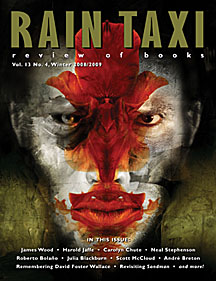
Rain Taxi Review of "Apologies Forthcoming"

In the mail today came a surprising holiday gift – the Winter 2008/2009 issue of Rain Taxi, sent by my publisher. When I took the magazine out of the envelop, it was opened to page 7, where a nice review of my book Apologies Forthcoming appears.

I don't know Lucas Klein – the reviewer – and I didn't find his introduction in the magazine. So I googled, which led me to an unusual literary e-zine called Cipher Journal. Given that the review opens with an adage of Confucius, I suspect the editor is the same Lucas Klein, who apparently knows Chinese. So, if you happen to subscribe to Rain Taxi, enjoy Klein's review, which is in print only. Otherwise,enjoy his Cipher Journal online.

By the way, an interview with my favorite literary critic, James Wood, also appears in this issue of Rain Taxi. In addition, the magazine is running a benefit auction right now, and you can find some very nice, even rare, books in their list.

Wednesday, October 15, 2008

Sushidog's Review

I'm very moved that someone who lives as far away as Tokyo has read Apologies Forthcoming. Thank you, Sushidog!

By the way - this is not a big deal - I've never been a tech writer, though several reviewers have assumed that. My previous career was in algorithm development. It seems the misunderstanding was stemmed from a line in my bio, "I gave up tech for writing," which could easily be read as "I gave up tech writing." For clarification I've just changed that line to "I gave up algorithms for writing."

Saturday, October 4, 2008

Another Interview

Donna George Storey, author of Amorous Woman and a writer friend, interviewed me for Eclectica, a cool literary magazine. Donna begins the interview with this question:
DGS     The first work of fiction I read about the Cultural Revolution was back in my grad school days—Wang Anyi's A Lapse of Time. This author wrote from the perspective of a privileged member of the generation who had already reached young adulthood in 1968. Thus, this ten-year period was like a long night of insanity sandwiched between two periods of "normal" life. Some of your older characters have similar experiences, like the father in "Men Don't Apologize." But many of the protagonists in Apologies Forthcoming were children and thus barely remembered any different life. Later they have to struggle with the death of the ideals they were taught. One narrator asks herself, "Which is better: to have a false belief and be content or to break the false belief and feel empty?" Do you have an answer to her question?
 Read the complete interview here.

Tuesday, September 30, 2008

Interview on Writing Neuroses

Kay Sexton, a talented British writer, interviewed me for her blog Writing Neuroses ... mine are rare, yours may be legion, and also wrote a thoughtful review of my book. Kay asked very good questions which I enjoyed answering. Her first question is:
Apologies Forthcoming has a central theme, or perhaps a central reef onto which all the stories are somehow driven - and that theme is the Cultural Revolution and its effects on Chinese society. Many Westerners, myself included, have had a one-sided view of this amazing social phenomenon. How much did it affect you, growing up in China?
Read the complete interview here.

Monday, August 25, 2008

Thank You, Matthew!

I'm (very pleasantly) surprised to see a nice review of Apologies Forthcoming on the Waiguoren Critic of South China blog. I wonder why Google alert did not bring it to me -- because the blog is in China?

I believe this review is the first one that has appeared in China. As Matthew pointed out, the topic of the Cultural Revolution is still sensitive there. When an entire generation -- a whole nation -- actively participated in something that later became their biggest shame, what could anyone say? This is why today you can only hear "the victim voice," not the participant's, even if the victim had been a participant himself.

Apologies Forthcoming will also be exhibited at the Beijing International Book Fair, September 1-4, 2008, ironically in Tianjing, not Beijing, because of the Olympics. If you happen to be there, you should be able to find the book on a shelf of the Combined Book Exhibit. I would be very curious to see if and how a Chinese publisher would react to the image of the once familiar hand-written enthusiastic slogan shown on the book cover: "Ardently acclaim the publication of the New Year Day Editorial!"

Monday, July 14, 2008

"Apologies" Trailer

A writer friend, Kim McDougall, designed a trailer for my book. Thought you might want to take a look. It's fun.

(For high resolution go to YouTube.)

Thursday, June 19, 2008

PIF Magazine Interview on "Apologies"

Steven Wingate, whose story collection Wifeshopping won the 2007 Bakeless Prize from Bread Loaf, interviews me for PIF magazine. This is one of the more fun interviews I've had since the publication of Apologies Forthcoming. Wingate asks some very interesting questions, and once again the topic of cultural differences is touched upon. You can read the complete interview here.

Friday, June 6, 2008

A Conversation on PekingDuck.org

You can probably call Peking Duck one of the China blog tycoons, together with Danwei, ESWN, and China Law Blog. If backlinks are of any measure for their popularities, here are the statistics:

Danwei - Age: 6 years 6 months; Backlinks: 5290
ESWN - Age: 8 years 4 months; Backlinks: 4,530
Peking Duck - Age: 4 years 10 months; Backlinks: 4,540
China Law Blog - Age: 2 years 4 months; Backlinks: 3,900

I'm having a conversation about Apologies Forthcoming with Lisa, an e-friend, on Peking Duck today . Because of the blog's large readership and outspoken, sometimes nasty, commenters, I expect interesting and contentious responses there.

Wednesday, June 4, 2008

Serious Frolic in LitPark

I'll be having fun in the "park" today – the LitPark, where I'll talk about the first Chinese novel I read as a child, the artwork in my book, and other things. Susan Henderson, a talented and generous writer and editor, is the host of this outstanding literary blog. My book's namesake story, "Men Don't Apologize," was first published in Night Train when Sue was the managing editor there.

LitPark is an exceptional blog in that it has a lively, entertaining, compassionate, yet thoughtful design, and is participated in by a wide audience from the literary and art world. It is always a learning experience when I visit LitPark. If you are even peripherally interested in literary stuff or writing in general, take a look and you'll see what I mean.

I asked Sue a few questions about her blog and here is our conversation:

Xujun Eberlein: Sue, what motivated you to start blogging?

Susan Henderson: I saw too many writers tearing each other down, hording industry secrets as if it gave them an edge, and that was a part of it. The other was that I would regularly talk with writers via email or private rooms at Zoetrope, and the discussions about writing were so interesting to me, at some point it just seemed like a good idea to start having those conversations where others could listen. Not just to share industry secrets, but so others could hear the joys and struggles of writing, editing and trying to get published.
XE: What is the most interesting thing that has happened to your blog?
SH: A lot of really wonderful things happened from blogging, not the least of which is the community of writers, readers and artists that's come together. It's also been a real pleasure watching writers finally find some success, seeing the hard work and luck come together, that's the best. Also, blogging has taught me to be more spontaneous. I think I over-edited my thoughts before. I've definitely shifted from an unrealistic desire to reach some kind of writing perfection to a desire to communicate with others and create a dialogue.
XE: The last bit especially resonates with me. What's the one unusual thing that's come from blogging?
SH: Well, the weirdest thing was that I was contacted a year ago by a talent scout at Warner Brothers, and to make a long story short, ended up doing a (hopefully never to be aired) reality TV show. My "role" in the show was a frustrated, workaholic artist.
XE: I'd love to see that show! How do you envision your blog evolving?
SH: The real joy I have with blogging is that it is all about my whim. Sometimes I'll do a serious interview. Sometimes I just want to gossip with a masseuse to the rock stars or talk about Neil Gaiman's hair. Having a structure but no real agenda within that structure keeps it exciting and spontaneous for me.
"Having a structure but no real agenda within that structure" is indeed the fun of blogging for me as well.