Showing posts with label translation. Show all posts

Sunday, August 13, 2017

Another Opinion on Ezra Pound's Translation

Just saw in a Reddit discussion an interesting comment related to my post "On Ezra Pound’s Translation of Ancient Chinese Poetry" (this is an example where the pronoun "he" is blatantly wrong in a comment, but the commentator still makes a good and on topic point 😊) .

Here is the gist of the comment (emphasis mine):

     This is an example where one of the poets is blatantly wrong in his translation, but he is still the best poet out of all of them. Even though the blogger tried to come up with his own style that is above the other two, he misses out on a lot of the subtle modernist poetic rhythms that Pound pulls in his. Pound, of course, misses out on the folk-song repetitive & rhymey quality of the original, but makes up for it in his skill.
      For example, in the first line of Pound’s poem, he builds up softer sound through “picking the first fern-shoots”, and uses more ‘o’s when the later part comes. The 3rd translation has the rhyme, but lacks this nuance. Pound’s version is lingering throughout because of his superb manipulation of sounds.

(Complete comment embedded below)

Friday, July 28, 2017

Chinese Translations of the Atlantic's Cover Stories


Translating the Atlantic's cover stories into Chinese is a project that my friends and I started in March, motivated by a feeling of responsibility to help serious journalism reach a broader audience.  In today's internet jungle that can readily swallow (and has swallowed many) uninformed readers, there are time-honored trustworthy publications that stand out by providing people with truth and perspective, and the Atlantic is one of those.

Fortunately, our attempt received support from the Atlantic's editorship led by John Gould, who had the courage and foresight to let us start this experiment.  Since then, our translations have been widely praised by readers; people are saying things like "翻译得真的很好,感觉不到翻译“ (meaning: "the translation is so good it does not feel like a translation"), "非常流畅的译笔" ("very fluent translation "), and "译文像是中文书写的一样" ("the translation is like ​original Chinese writing").

Some of our work, such as the translations of "How to Build Autocracy" and "My Family's Slave​,​" has generated a huge readership, and stayed on top of theatlantic.com's "Popular" list for weeks. We are very encouraged and truly appreciative of the editors, supporting staff, and readers. We have worked hard, and the project has been intellectually rewarding.

Here's the list of our translations so far, in reverse-chronological order:
  • July/August:  
How to Deal With North Korea
朝核困局:当今最棘手的问题
  • June:
My Family's Slave
洛拉:我家的奴隶
  • May
Alec Baldwin Gets Under Trump’s Skin
鲍德温怼特朗普
  • April

Tuesday, March 28, 2017

On the Intent of Translating

I'm fascinated by the assertion in Walter Benjamin's "The Task of the Translator" (in Theories of Translation) that "No poem is intended for the reader, no picture for the beholder, no symphony for the listener." Is this a philosophic contemplation, or the writer's belief of the highest state of art, or his belief of reality? He seems to be using this as a premise to derive a conclusion that, because the original art doesn't take the receiver into consideration, the translation can't either.

However, there exist several different approaches to translation, as pointed out in "On the Different Methods of Translating" by Schleiermacher. As far as I can tell, the need for more than one approach arises precisely due to the consideration of the receiver. Creation of art, in my view, is complete only after the receiver receives the art. In other words, art is co-created by the author and the receiver. Without the receiver, there is no art.

I would think that, in most cases, the aimed readership dictates the translation method. One example I'd like to cite is the Chinese translation of Finnegans Wake, which I've talked about before. I was visiting China when the translation was published, and I went to a bookstore to see what the book looked like. On each page there are more footnotes than text proper. This, clearly, is not meant for casual readers. The translator said in an interview that "I thought my readers would be scholars and writers." In this example, a scholarly, academic style was chosen. When I translate Chinese literature into English or vice versa, I would definitely consider my target readership's cultural exposure in regard to the source language. Is this not the right way to approach a translation?

Even were I to accept Benjamin's premises for art and literature in general, the above example convinces me his conclusion does not apply to translation. While translation is a creative and artful process, the very act of translation requires that the art has already been received. Moreover, the people who receive the translation want to do so often because they believe there is something special, based on the reactions of others who have already received it. A key motive of the translator is to have translation receivers share the experience, though necessarily in approximation, of the direct receivers, whether it be lyrical, sensual or intellectual (or all three).

So even if Benjamin is right about art, his claims do not seem to translate. 😃

Thursday, January 26, 2017

Old Adage, New Translation: Calling Deer Horse 指鹿为马

(Note: Zhao Gao (258-207BC) was the highest official under the Second Emperor of the Qin Dynasty.)

[in translation]

Aspiring to gain complete control of power, and anxious that others might not obey him, Zhao Gao set up a test. He led a deer to the emperor and said, "This is a horse." The emperor laughed. "Are you mistaken? Calling a deer a horse?" When the emperor asked the other officials in the court, some remained silent, some followed Zhao to say the deer was a horse, and some said it was a deer. Zhao then back-stabbed those who said the deer was a deer, causing them to be punished under the law. From that day forward everyone feared Zhao and repeated his alternative fact

[Original text] 赵高欲为乱,恐群臣不听,乃先设验. 持鹿献于二世,曰:“马也。”二世笑曰:“丞相误邪?谓鹿为马。”问左右,左右或默,或言马以阿顺赵高,或言鹿者。高因阴中诸言鹿者以法。后群臣皆畏高。(司马迁《史记·秦始皇本纪》)

Related:
This is what Trump voters said when asked to compare his inauguration crowd with Obama’s

Saturday, December 10, 2016

Gifts from a Great Man

Today Bob and I attended Jay Forrester's memorial service at the Trinity Episcopal Church in Concord. Jay was the founder of System Dynamics and Bob's mentor at MIT. Jay was also the inventor of magnetic core memory—the earliest widely used computer memory. (See the great man's obituary in New York Times, which was written before his death, with his approval.)

Beyond all that, Jay had a much more personal impact on my life. Twenty nine years ago, Bob was teaching System Dynamics in Shanghai, and I was studying it in Chengdu. Our first encounter in spring 1987 thus was an unintended gift from Jay.

When Jay was a young inventor of computer memory (1951)

Who'd have thought that Jay, even after his death, would give me another surprise? Today's otherwise completely traditional service took one digression from beautiful Christian hymns: we all stood and sang "Home on the Range" with the church's choir. Jay's children said this was a song Jay loved, and wanted to be sung in his service. Bob was amazed that I, who didn't know the other songs, was utterly at home with this one. I don't know who the Chinese translator of its lyrics was, but in the 1970s, for many of us "zhi-qings" (also called "sent-down youths"), the song had accompanied and consoled our homesick hearts through long days and nights in the countryside far away from home.

My eyes were wet when I softly sang the Chinese words I remembered from my youth—words I was surprised to still remember after all these years—they mingled harmoniously with others' English rendition. The words and music are so dear, intimate, nostalgic, that I've lost the ability to judge the translation.

[Chinese] 草原上的家园

在草原上 野牛自由流浪
我愿 把草原当家园
这儿难得听到 诅咒和吵闹
黑云消失在天外远方

我家 在草原上
有小鹿和羚羊在游荡
这儿难得听到 诅咒和吵闹
黑云消失在天外远方

[English] Home on the Range (listen to it on YouTube)

Oh, give me a home where the buffalo roam
Where the deer and the antelope play
Where seldom is heard a discouraging word
And the skies are not cloudy all day

Home, home on the range
Where the dear and the antelope play
Where seldom is heard a discouraging word
And the skies are not cloudy all day

Thursday, July 21, 2016

Chinese Poetry Translation: Room for Disagreement

      This might be a bit unusual: in the short span of two months, the LA Review of Books published two essays on Chinese poetry translation: mine titled "Is There a Good Way to Translate Chinese Poetry?" and Lucas Klein's "Tribunals of Erudition and Taste: or, Why Translations of Premodern Chinese Poetry Are Having a Moment Right Now." My piece focuses on contemporary poetry translation, while Klein's gives more attention to the ancient works, but our topics – at times even views – converge. Still, as Klein points out, "There is much room for disagreement inside the agreement that…" (feel free to finish the line with your own words).

Wednesday, December 17, 2014

On Ezra Pound’s Translation of Ancient Chinese Poetry

Can one translate poetry without knowing the source language?  Certainly that was what Ezra Pound did.  In his volume Cathay (1915), Pound translates a total of 19 pieces of ancient Chinese poetry spanning a period from the 11th Century B.C. to 4th Century A.D.  But of course he couldn’t have done it without help from someone who had knowledge of the Chinese language, in this case Ernest Fenollosa, an American orientalist. The unusual situation, however, was that Pound was approached by Fenollosa’s wife after the man’s death.  At the time, in the 1910s-20s, English information about Chinese poetry must have been scarce, thus Pound’s only basis for the translation was Fenollosa’s meticulous unpublished notes. In addition to providing a word-by-word mapping between Japanese and English, the notes also include line-by-line draft translation into English.
Given Pound’s lack of knowledge of Chinese at the time, it is probably not a big surprise that Cathay contains quite a few citation errors. For example, the first poem in the collection, “Son of the Bowman of Shu,” is cited by Pound as from Kustugen (the Japanese name for Qu Yuan) in the 4th Century B.C., however it in fact is an anonymous work collected in Shijing (also known as Book of Songs), the earliest known volume of Chinese poetry.   Another example is the third poem, the famous “River Song.” Though correctly cited as from Li Bai (whom the Japanese called “Rihaku”), one of the most acclaimed poets in the Tang Dynasty, Pound had mistaken two poems as one.  The first 22 lines of “The River Song” correspond to a poem titled “江上吟” (“Humming on the River”), while the rest, starting from “The east wind brings the green color…”, correspond to a different poem by Li Bai titled “侍从宜春苑奉诏赋龙池柳色初青听新莺百嗽歌”, meaning literally “Following orders to write about listening to new birds singing in early spring, while serving the Emperor in Yichun Park” -- two completely different occasions in distinct settings.  It is curious that Pound would regard their contents as fitting perfectly in a single poem. There are a few other minor errors that I will skip here.
If the above errors are merely technical, wherever Fenollosa had missed the original Chinese meaning (though such occasions were few), the same problem also transferred into Pound’s “translation.”  Take “The River Merchant’s Wife: A Letter” as an example. In Li Bai's original poem, "长干行," there is this famous line that has since become a timeless allusion known as "bamboo horse and green plums":  
郎骑竹马来,绕床弄青梅。
Which Pound translated as (underlines are mine):
You came by on bamboo stilts, playing horse,
You walked about my seat, playing with blue plums.

Here, the word “” usually means “bed,” but in ancient Chinese it also means the fence of a backyard well. The latter meaning happens to be what Li Bai is referring to in this poem. Such language nuance can present difficulties for even a native speaker, not to mention a foreigner. Curiously, In Fenollosa’s notes the word is translated as “seat” instead of the usual meaning “bed.” He might not have known the other, less-common meaning of the word, and felt that “bed” wouldn’t have made sense: the first part of the line obviously refers to an outdoor setting.  Either “you walked about my seat” or “you walked about my bed” wouldn’t read right, but apparently Fenollosa went for the less nonsensical.  Pound might or might not have noticed this inconsistency, but there was not much he could do about it, being unable to read the original text. In any case, a glitch like this could probably be explained away by “poetic license.” So the error is kept.  In the same line, “blue plums” should actually be “green plums,” indicating the fruits are unripe, a metaphor for the young girl and boy.  This metaphor is completely lost in the translation.  
Another interesting thing to note is that the original poem alludes to an allegory known as “Holding-pillar faith,” which originates from a book by ancient Chinese philosopher Zhuangzi. The allegory goes like this:  a man is waiting for his female date under a bridge. Before the woman arrives, however, the river water unexpectedly rises. To be faithful to his promise, the man doesn’t leave; he holds onto a pillar of the bridge until he drowns.  The moral of this allegory is one can place love above his own life. Li Bai's lines that allude to this

十五始展眉,愿同尘与灰。
常存抱柱信,岂上望夫台。

were translated by Pound as

At fifteen I stopped scowling, 
I desired my dust to be mingled with yours 
Forever and forever and forever. 
Why should I climb the look out? 

In Fenollosa's notes, he had written a draft translation “I always had in me the faith of holding to pillars / And why should I think of climbing the husband looking out terrace.”  This is quite accurate literally; however it is unclear whether he was aware of the allusion. In any case he did not explain it. At this point Pound, who had faithfully followed Fenollosa’s translation so far, took the liberty to exclude that line completely, probably because he couldn’t make sense of it.  In its place he put “Forever and forever and forever.” The meaning of “forever” was indeed implied by Li Bai in his poem, but the great Chinese poet would never have said it so tritely; that would not be his poetic style. 
This example is one of a few places where Pound's translation departs from Fenollosa’s notes.  Reading the two men’s translations side by side for this poem, one can see that Pound  copied Fenollosa’s complete lines more often than not. T.S. Eliot said in a 1928 essay that “There is as much as to say that Chinese poetry, as we know it today, is something invented by Ezra Pound.”  It seems to me in that statement Ernest Fenollosa’s name should have at least been in line with, if not replacing, Ezra Pound’s.
Interestingly, Pound’s translation of the Chinese poetry – or should I say Fenollosa’s translation instead? – especially of the longer poems, often reads more fluid than what I’ve seen from ethnic Chinese translators.  Let’s compare two different translations of the first poem included in Cathay
---------------------------------------
The Chinese original:
采薇

采薇采薇 薇亦作止
曰归曰归 岁亦莫止
靡室靡家 玁狁之故
不遑启居 玁狁之故

采薇采薇 薇亦柔止
曰归曰归 心亦忧止
忧心烈烈 载饥载渴
我戍未定 靡使归聘

采薇采薇 薇亦刚止
曰归曰归 岁亦阳止
王事靡盬 不遑启处
忧心孔疚 我行不来

彼尔维何 维常之华
彼路斯何 君子之车
戎车既驾 四牡业业
岂敢定居 一月三捷

驾彼四牡 四牡骙骙
君子所依 小人所腓
四牡翼翼 象弭鱼服
岂不日戒 玁狁孔棘

昔我往矣 杨柳依依
今我来思 雨雪霏霏
行道迟迟 载渴载饥
我心伤悲 莫知我哀
---------------------------------
Ezra Pound's translation:
SONG OF THE BOWMAN OF SHU

Here we are, picking the first fern-shoots 
And saying: When shall we get back to our country? 
Here we are because we have the Ken-nin for our foemen, 
We have no comfort because of these Mongols. 

We grub the soft fern-shoots, 
When anyone says "Return," the others are full of sorrow. 
Sorrowful minds, sorrow is strong, we are hungry and thirsty. 
Our defense is not yet made sure, no one can let his friend return. 

We grub the old fern-stalks. 
We say: Will we be let to go back in October? 
There is no ease in royal affairs, we have no comfort. 
Our sorrow is bitter, but we would not return to our country. 

What flower has come into blossom? 
Whose chariot? The General's. 
Horses, his horses even, are tired. They were strong. 
We have no rest, three battles a month.

By heaven, his horses are tired. 
The generals are on them, the soldiers are by them. 
The horses are well trained, the generals have ivory arrows and quivers ornamented with   fish-skin. 
The enemy is swift, we must be careful. 

When we set out, the willows were drooping with spring, 
We come back in the snow, 
We go slowly, we are hungry and thirsty,
Our mind is full of sorrow, who will know of our grief?
--------------------------------

A translation by Yang Yixian and Dai Naidie, from A Choice Selection of Ancient PoemsChinese—English, published by Foreign Language Press in China:

We Gather Vetch

We gather vetch, gather vetch,
While the young shoots are springing;
Oh, to go back, go back;
But the year is ending.
We have no house, no home,
Because of the Huns.
We cannot sit or take rest,
Because of the Huns.

We gather vetch, gather vetch,
While the shoots are tender;
Oh, to go back, go back;
Our hearts are sad.
Our sad hearts burn,
And we hunger and thirst;
But our garrison duty drags on,
And no messenger goes to take news home.

We gather vetch, gather vetch,
But the shoots are tough;
Oh, to go back, go back;
The tenth month is here again,
But the king’s business is unending;
We cannot sit or take rest;
Our sad hearts are racked with pain,
And no one comes to comfort us on our march.

What splendid blossom is that?
It is the blossom of the cherry tree.
What great chariot is that?
It is the chariot of a nobleman.
His war-chariot stands ready yoked
With four proud stallions;
How can we settle in one place?
We march to three different posts in a month.
           
The four stallions are yoked
To make a sturdy team;
The nobleman rides in the chariot,
We take cover behind;
Four stately stallions,
Ivory bow-ends and a fish-skin quiver;
Every day we must be on our guard,
We are hard-pressed by the Huns.

When we left home
The willows were softly swaying;
Now as we turn back
Snowflakes fly.
Our road is a long one
And we thirst and hunger,
Our hearts are filled with sorrow;
But who knows our misery?
--------------------
The translators were/are all literary experts in their own native language.  However, when it comes to translation, neither party appears to have sufficient knowledge of the nuance of the other language.  Though both translations are fairly accurate in meaning, they read quite differently as poetry.
This Chinese poem, "采薇," from the 11th Century B.C., laments soldiers’ homesickness as they guard their kingdom’s border against nomad invaders from spring to winter. Its meaning is straightforward and there are no allusions, but like other poems in Shijing, this one maintains a singing/chanting rhythm throughout, in which a refrain occurs often, not only between stanzas but also within a line.    
The Chinese translators certainly understood the form and meaning of this poem better than Pound, and their translation attempts to render the folk song quality with the refrain pattern.  However their English is not nuanced enough to match their Chinese level of artistic quality.  For example, admittedly nitpicking: using “to go back” without context is a common Chinglish way of expressing “returning home.” It is rather unclear here and could lead to basic misunderstanding of the literal meaning. In comparison, Pound’s translation has lost the original poem’s style and folk-song quality, but reads much more fluid and natural (and "get back to our country" quite clear).  This is to say, each translation has its own strengths and weaknesses. This also implies that, it is possible to keep the strength of each and avoiding many of the weaknesses by combining the two.
Consider a modified version that blends the above two translations and fixes their errors. For the sake of the sounds, I'm adopting the word "vetch" for , since there are so many interpretations for what this wild vegetable actually is/was – spinach, wild peas, fern shoots, vetch, etc., you name it – and I have no way to tell which is most accurate. For similar reasons, I'm keeping "Xianyun" from the original poem for the name of the "foemen" tribe.

Picking vetch, picking vetch, the first shoots are springing
Saying “Return,” saying “Return,” the year is already ending
No family, no home, because of Xianyun the foemen
No rest, no comfort, because of Xianyun the foemen

Picking vetch, picking vetch, the shoots are soft and fresh
Saying “Return,” saying “Return,” our hearts are full of sorrow
Sorrowful minds, sorrow is burning us, so is hunger, so is thirst
Our defense is not yet certain, no one can be sent home

Picking vetch, picking vetch, the shoots are getting tough
Saying “Return,” saying “Return,” it is October already the tenth moon
No ease in the king’s affairs, no break for us
Our hearts pain with sorrow, we still can’t go home 

What fabulous blossom is that?  It is the cherry tree’s
Whose great chariot is that? It is the general’s
The war-chariot is yoked, the four horses are tall
No one dares rest, three battles a month

Four horses are driving the chariot, four strong horses
The higher men are on them, the lower men are by them 
The horses are well trained, bows of ivory, quivers ornamented with fish-skin 
No one dares relax, the enemy is swift 

When we set out, the willows were drooping with spring 
When we come back, snowflakes fly everywhere
We go slowly, we are hungry and thirsty
Our mind is full of sorrow, who will know our misery?

If my modified version above is indeed an improvement in the translation, then a case can might be made that better literary translation would be a cooperative project between two translators, one a native speaker and expert of the source language, and the other the target language.  Only in this way, can the nuances in both languages be captured and presented in the translation.  This, of course, is mainly for the benefit of readers and the quality of the translated literature.  I do understand that not every translator would be willing to share his or her work or cooperate with another translator.
            

Sunday, September 15, 2013

Reviews of Unsavory Elements

I have gotten good feedback on compiling reviews for a book (example: "Reviews of Deng Xiaoping in Review").  So here is another one - today for Unsavory Elements: Stories of Foreigners on the Loose in China. Some of these reviews (as well as the comments they triggered) are surely interesting to read.

I also plan to write a review myself, and I can tell you beforehand that I honestly enjoyed reading most of the book. But since translation issues will be beyond the scope of my review, here I'd like to briefly discuss the translation of two Chinese phrases, which I happened to encounter in two of my favorite stories in the book. 

"思想汇报" -- in the book it's translated as "thinking reports,"  but "thought reports" might be more accurate, and read better.

"哪里哪里" -- as a modest response to praises, this is humorously translated as "Where? where?" in the book.  If you have read my posts on translation before, you would know I'm often in favor of literal translation, but here I agree with one of the book reviewers below that "Nah, nah" would be a better rendition. Note also that the question marks don't exist in the original Chinese phrase. As a bilingual reader I enjoyed and appreciate the writer's humor, but for English readers who don't know Chinese the confusion caused by  "Where? where?" might trump the humorous effect.

Now, here is my compilation of reviews as well as interviews with Tom Carter the editor, in reverse chronological order of their publication dates --

(Updated 11/5)

TheAtlantic.com, Nov. 5, 2013
http://www.theatlantic.com/china/archive/2013/11/unsavory-elements-on-foreign-lives-in-contemporary-china/281144/

LA Review of Books, Sept. 25, 2013
http://tumblr.lareviewofbooks.org/post/62262869667/foreign-elements-a-q-a-with-photographer

The Peking Duck, Sept. 13, 2013
http://www.pekingduck.org/2013/09/unsavory-elements-edited-by-tom-carter-2/

Caixin Online, Aug. 24, 2013
http://english.caixin.com/2013-08-24/100573568.html

Asian Review of Books, Aug. 17, 2013
http://www.asianreviewofbooks.com/new/?ID=1545

Business Insider, Aug. 2, 2013
http://www.businessinsider.com/unsavory-elements-by-tom-carter-2013-8

TheNanfang.com, July 22, 2013
http://www.thenanfang.com/blog/unsavory-elements-and-the-changing-nature-of-being-an-expat-in-china/

That's,  June 17, 2013
http://www.thatsmags.com/beijing/articles/15499

Chengdu Living, June 1, 2013
http://www.chengduliving.com/unsavory-elements-in-chengdu/

The Beijing Cream, May 21, 2013
http://beijingcream.com/2013/05/unsavory-elements-the-good-the-bad-and-the-boring-foreigners-of-china/

Beijing Bookworm: "A Q&A with Tom Carter," May 21, 2013
http://beijingbookworm.com/between-the-stacks/unsavory-elements-a-qa-with-tom-carter/

Time Out Shanghai, May 10, 2013
http://www.timeoutshanghai.com/features/Books__Film-Book_reviews/11883/Unsavory-Elements.html

The Beijinger, May 9, 2013
http://www.thebeijinger.com/blog/2013/05/09/book-review-unsavory-elements-stories-foreigners-loose-china

Shanghaiist, May 8, 2013
http://shanghaiist.com/2013/05/08/review_unsavory_elements_earnshaw_books_tom_carter.php


Sunday, February 24, 2013

Foreign Literature in China: Now and Then

In LARB:  In the Wake of Finnegan: A Q & A with Xujun Eberlein
 
image
 
This week’s Q & A is with the China-born and now Boston-based Xujun Eberlein, a short story writer, blogger, essayist, and contributor to LARB.

I contacted Xujun in part simply because I was curious to learn her reaction to two recent literary-minded and China-focused New York Times pieces. One focused on the surprisingly brisk sales in China of a book by James Joyce, while the other was a commentary by NPR Beijing bureau chief Louisa Lim on trends in censorship and the popularity of Chinese “officialdom novels.” Both brought Xujun to mind, since she has often reflected on the flow of books and ideas between China and the West and she has written an essay on the “officialdom novel” genre.

She was good enough to break up her Lunar New Year trip back to Chongqing to speak with me.

Jeff Wasserstrom: Do you have any thoughts on why Finnegans Wake might be selling so well in China?

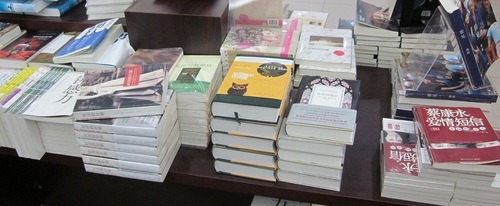
Xujun Eberlein: I was curious about this myself. I’m in Chongqing for Chinese New Year and I went to the Xinhua Bookstore downtown on Saturday (February 9) to have a look at the book. A young staff member led me to the desk where the Chinese translation of Finnegans Wake (the yellow cover at the center of the above photo) was on display with other new and noteworthy books. As you may see from the photo, next to Finnegans Wake is the translation of polish novelist Henryk Sienkiewicz’s Quo Vadis, which has a supplementary band to note the author is a Nobel Laureate. The red cover on the right is a Chinese popular novel titled Love SMSs. I asked the young man how Finnegans Wake was selling there and he said “Not bad.” He noted that its sales were similar to One Hundred Years of Solitude and Love in the Time of Cholera. When asked what kind of readers were buying it, he said “mostly young people.”

Read more.


Friday, February 22, 2013

"Skylark": a Translated Story

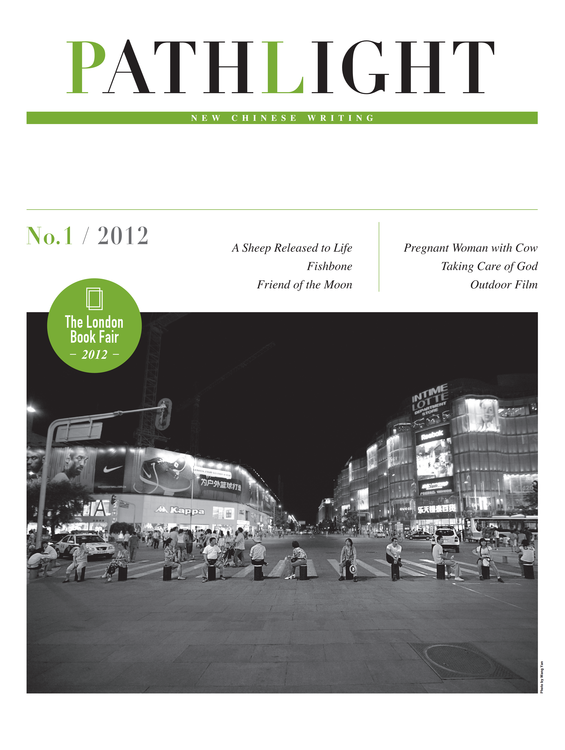
Cover Image(Note:  This is a short story I translated for Pathlight issue No. 1, 2012, posted here with permission. I had not heard about author Jin Renshun before I got the assignment. Her writing is both beautiful and subtle, and I truly enjoyed translating the piece. I tried to be faithful to her original style and hope I've succeeded somewhat. – Xujun)

Jin Renshun:   Born in 1970 of Korean extraction, and now living in Changchun, Jin Renshun has published the novel Spring Fragrance, the short story collections Cold Front of Love, Moonlight Oh Moonlight, One Another, and The Glass Café, and the essay collections Like a Dream in Broad Daylight and Poisonous Beauties. Her work has been translated into Japanese, English. German and Korean. In 2010 she attended the University of Iowa’s International Writing Program.

Skylark


Each day at dusk, from six to eight, the third table by the window was reserved for Kang Joon-Hyuk. Occasionally he brought friends – perhaps employees – with him, but mostly he came alone, magazine in hand, to read a few pages before the dishes were served. He and Chun Feng spoke every day, but nothing beyond her asking what he’d like and his ordering of dishes, followed by a few pleasantries of the “Thanks,” “You are welcome” sort.

One day Chun Feng forgot to put the “Reserved” sign on the table. By the time she realized her mistake, the table was occupied by two middle-aged women who chatted nonstop from the second they walked in. They ignored Chun Feng’s apologies and requests.

“This is where we’re sitting,” they said. “We’re not going anywhere.”

While another waitress handled their order, Chun Feng went outside to wait for Kang Joon-Hyuk.

“I’m really sorry,” she bowed to him, tears spilling forth. “It’s all my fault.”

“Did I cause you any trouble?” he said. “You stood in the wind for so long, for such a little thing! It’s me who should apologize.”

(Read the complete story here)

Saturday, December 31, 2011

A Few Anecdotes about My Hexagonal Pavilion

On its last day, let me end 2011 with a personal note.  After two laborious years, the hexagonal pavilion (六角亭) Bob and I started in September 2009 is finally finished (actually, I can only take credit for the inspiration, design and quality control; Bob is the one who built it):


To compare, here is a photo of it in the first winter:


From the beginning I racked my wits trying to come up with a good name for the pavilion. After many failed tries, the name arrived without effort. In December 2009, I emailed the above photo to a friend, Wang Yan, in China. He replied:
宋人当年每起一亭,必做文以记之,如喜雨亭记黄州快哉亭记等,皆吾所爱。但最爱者,为苏东坡超然台记
In translation:
In the Song Dynasty, whenever a pavilion was built, notes were written to record it.  I love such notes as those for "Happy Rain Pavilion," "Huangzhou Pleasure Pavilion," etc, but what I love the most is Su Dongpo's "Notes on the Terrace of Transcendence."
Terrace of Transcendence,  Shandong

I had forgotten all about it: The Terrace of Transcendence (超然台), in Shandong Province, was where the great Song Dynasty poet Su Dongpo wrote his eternal verse "Bright Moon, When Was Your Birth" (明月几时有). (Some translate the poem title as "When Will the Moon Be Bright," which is clearly incorrect to me as the poem itself indicates that it was written during a full moon.)

The word "超然," besides "transcendence," can also be translated as "detachment,", "aloof," and so on.  "Transcendence" seems to fit our mood the best and, on reflection, it must be more than coincidence that we live in the area where the 19th century "transcendental movement" originated.  It was sitting by Walden Pond one day in 2010, for example, that Bob wrote his letter of resignation to the company where he had worked for two decades. (Later, when discussing the pavilion name, I asked him, jokingly, what we are transcending, and he said, "The chaos of office politics." In that case, I “transcended” seven years earlier than him, when I quit my job as an algorithm developer with steady income and became a writer with two sleeves of clear wind (两袖清风). :-))

Looking back, my whole life seems to be a struggle between aspiration for some sort of transcendence and failure in achieving it. No matter.  Don't you know a classic Chinese saying, "Though unreachable, my heart longs" ("虽不能至,心向往之")?

Thus we settled on the name for our pavilion:  超然亭, or "The Pavilion of Transcendence."

The last touch to complete the construction requires an engraved plaque, or (bian), with the name inscribed.  I decided to use seal script (篆字) for the inscription, and easily found an on-line generator for the three characters. But the color combination for the background and the characters was a bit difficult to figure out, even with computer simulation.  I asked around for opinions among Chinese friends, but they were as varied as our own.  Alas, one friend convinced us that "only black characters on a wooden background would match the meaning of the words."

I sent the specification for the plaque to my sister and solicited her help to have it made in Shanghai. She took my request seriously.  A few days later, she wrote back (in translation):
At first I thought this would be simple, because on Puxi's Fuzhou Road there are all kinds of culture and art stores that make anything and everything. When I went to the store that made frames for my paintings, however, the wood-master who has worked on this 'culture street' for more than 30 years told me no store makes bian (). 

I didn't believe him, and walked through the entire Fuzhou Road to look. I found several engraving shops that make metal or plexiglass seals.  The workers, all young men in their 20s, had their mouths gasped in the shape of the question mark on hearing the word bian (), clueless as to what kind of thing it is. A nice young man called the storeowner for me. The owner asked, 'What is bian?'  I had no choice but say, 'It is a piece of wood engraved with words.' 'Aha,' he said, 'store sign!' I was speechless.  He then said if I provided a piece of wood he could engrave the words for me, 60 yuan a character.  Well, where do I go to find the wood?  Not to mention the wood for a bian requires certain machine processing.

I called directory information asking where to find a store that makes bian.  The operator was even more amazing. "Bian?" she said, 'you mean shoulder pole (bian dan 扁担)?'

I hadn't thought that Shanghai, the so-called international cosmopolitan center, would be so culturally ignorant.

I searched the internet with no results. An entire day was wasted.
The next day, my sister (who lives in Pudong) went to Puxi again and randomly looked around.  When she almost gave up, she ran into an auction store, above its door hanging an antique plaque with the inscription of "青莲阁," looking cultured.  She ran to the third floor asking if anyone knew where that plaque was made, and everyone thought her absurd. Fortunately she ran into a passerby, Mr. Dai, who said he knew which contractor made the plaque, and he helped to find their phone number. The very kind Mr. Dai also advised her that elm would be the best material for making a bian.

My sister then called the number Mr. Dai gave her, and found a Mr. Shen, who said he wasn't the right person and provided another number. Through that number my sister reached a Ms. Li, who told her to meet at a far place, nearly an hour's subway ride away. It turns out Ms. Li is a Fujian migrant worker in the business of antique imitation. My sister had finally found someone who is not a Shanghaies and knows what a bian is.

And certainly, the bian is made of elm, just as Mr. Dai advised:


I can't wait to hang it up on the pavilion next spring.

Btw, Bob is writing a series of posts on the process of building this beautiful monster.  His first post is already up here.

Wednesday, September 22, 2010

It Is the Moon Festival

Today is the 15th day of the 8th month in the lunar calendar – the Mid-Autumn Festival, what people here call "the moon festival."  If you look up at the moon tonight, chances are you'll find it the roundest, brightest of the year.  When I was a child, my grandmother used to tell us that if you place a basin of clear water under the moon on this day, you'll see the jade tree and the jade rabbit in it.  I tried, and I always saw a vague shape in shadow, which could be interpreted as almost anything. (Image from http://apod.nasa.gov/apod/ap070926.html)

Ancient Chinese poets seemed to have a special sentiment for the moon, as evidenced by numerous poems intoning it. One of the most well-known perhaps is Su Dongpo's "Shui Diao Ge Tou," in the form of Song ci, a rhymed verse composed of lines of three to seven characters which first appeared in the Tang Dynasty (AD 618-907), and reached its perfection in the Song Dynasty (AD 960-1279). It was 934 years ago today that Su Dongpo wrote this classic masterpiece.

Many English translations exist, however none could convey to me the sentiments wafting through the Chinese words.  As an example, the following are three different translations of Su Dongpo's lines "人有悲欢离合,月有阴晴圆缺,此事古难全":

Men know joy and sorow, parting and reunion;
The moon lacks lustre, brightly shines; is al, is less.
Perfection was never easily come by.

  • As translated by Xu Zhongjie (1986):
The moon has weather that change,
Fine or foul; it wax and shine.
Mankind is sad at parting;
Happy at reunion again.
From the utmost ancient time,
Down to our own very days,
The imperfection of all things –
Has for ever been the case.

  • As translated by Yang Yixian etc (2001).:
For men the grief of parting, joy of reunion,
Just as the moon wanes and waxes, is bright or dim;
Always some flaw – and so it has been since of old.

All are fine translations, but whereas the Chinese sounds extraordinary, the English makes it dull.  It is not the translator. It is the damn language. This is the reason I almost never attempt to translate ancient poems – I simply can't get the succinct beauty, the exquisiteness, and the sonorous sound across.  An ancient Chinese poem can make my heart tremble, but an English translation of it never does.  It is not the translator. It is the damn language.

Some say a pictographic language is more primitive than an alphabetic one – or in other words, an alphabetic language is progress in civilization.  Mao seemed to agree with this.  I still remember a Mao quotation from my childhood: "Chinese language should go the common alphabetic direction of other countries in the world."  I am glad this did not happen.  I'm sure an alphabetic Chinese would never give me the joy and intimacy the square characters do.

I recently read a very enjoyable book, Dreaming in Chinese by Deborah Fallows. Her experience in learning the Chinese culture through learning the language – the frustration and triumph, the pain and pleasure, the questioning and understanding –  are presented from a refreshing angle, often surprisingly so to a native Chinese speaker like me. I'd recommend this book to anyone who's new to things Chinese.  In one of the chapters the author asks a legitimate question, "Why do the Chinese hang onto this difficult character-based writing system?" She points out its disadvantages: cumbersome, hard to learn, awkward to look up in dictionaries, etc.  She also recognizes its merits, mainly its historical and cultural significance.  I want to add a personal perspective:  I think Chinese is the richest language in the world.  For me, as probably for most Chinese, its merits clearly overweigh the inconveniences.  (As a native speaker I actually never felt the inconveniences anyway.)

Why then, you might ask, am I writing in English now?  In fact several editors who interviewed me have asked that question. The answer is:  for communication.  I live among English speakers and I feel the need to communicate.  (If you want to know why I came to the US, the short answer is "for love."  Read the story here if you are interested.)  In other words, Chinese is a passion, English is a tool.  Today I still prefer to read Chinese books over English ones, and in fact I can read Chinese 30 times faster.

It is a pain to love one language and use another in daily life. It causes a schism in my consciousness.  But that's imperfection of life, and I accept it.  Su Dongpo has said it, 此事古难全.