Showing posts with label book review and interview. Show all posts

Monday, December 4, 2017

Aren’t We All Accomplices (Book Review)


In May 2012, a stranger contacted me through my website. A professor of cultural psychology at Hampshire College, Q.M. Zhang was interested in talking about Chongqing, the city I grew up in. What triggered her request for a meeting, apparently, was my article titled “Another Kind of American History in Chongqing,” which had appeared on the Atlantic website the previous year. She was writing a memoir about her relationship with her father, who had worked for the Kuomintang (aka the KMT or the Nationalists, the ruling party of China from 1928 to 1949) in Chongqing during WWII.

By contrast, my own parents were underground Communists in the 1940s. So her father and mine, though unknown to each other, had literally been enemies in the same city.  (Read the rest of my review on LARB China Channel)

Monday, February 10, 2014

What Foreigners Do in China

(Also published on LARB's China Blog)

In the remote mountains of Yunnan Province, China, a middle-aged European ecologist gave up his high-level international program manager job and made his home with a local woman. Together, they set forth to reestablish the rainforests destroyed by rubber tree plantations, cultivated a garden — a seed bank — that “was home to more species than all of Germany,” reintroduced indigenous plant species to China, and homeschooled two bright young children with knowledge, poise and manners belying their age. In 2010, the extraordinary life of the ecologist, along with the draft of an unconventional paper that could “be of enormous value to mankind,” was cut short by a heart attack.

This story about Josef Margraf, written by journalist Jonathan Watts, is not a news report or profile but rather an essay, moving for both Watts’ own introspection and his sketch of Margraf’s life. I read it in the anthology Unsavory Elements —Stories of Foreigners on the Loose in China, in which editor Tom Carter has assembled 28 short contributions by a variety of expat writers. I had opened the book with the intention of browsing through it quickly. Though I was curious about how expats live in China, and why there are so many of them now, as a Chinese writer with a certain cynicism, I did not expect to find anything truly surprising. But surprised I was, and my own stereotypical presumptions stand corrected.

In 1971, when I was a middle school student in the city of Chongqing, recruiters dressed in military uniforms from the faraway Yunnan Production and Construction Corps — a more attractive name, I suppose, than “rubber plantations” to teenagers at the time — arrived at my campus and called on students to join them “guarding the frontier and cultivating the borderland.” Many of us, me included, applied with youthful enthusiasm, and almost everyone I knew who applied got their wish. I was spared because I was under-aged and also because some insightful adults, who viewed higher education as more important than planting rubber trees, stood in my way. In all, about 100,000 middle school students were collected from the cities of Beijing, Shanghai, Chongqing, Chengdu, and Kunming and sent to labor in Yunnan’s rubber plantations. The collective name for those young people was “Zhiqing,” or “Educated Youth.” Seven years of hardship and many tragic stories later, in the winter of 1978-79, those Zhiqing launched a spontaneous mass rally that has since been termed the “big return-to-city storm,” which eventually did bring them home. By then I, as one of the lucky few, had entered my second year in university, but my middle school friends who went to Yunnan missed their chance not only for university, but even for a high school education.

I had thought that the wasted youth of my 100,000 contemporaries qualified as the biggest damage caused by the rubber plantations, and that an end had been put to the practice in early 1979. Not until reading Watts’ chapter did I realize with a shock that the rubber plantations have been expanding during China’s recent economic boom and have gone on to become one of “China’s greatest ecological disasters.” The invasive species eats away at the region’s fertility and diversity, changes weather conditions and rainfall, and threatens to wipe out China’s only tropical rainforest. Many friends from my youth, through their goodwill and hard work, had unknowingly contributed to the disaster while also bringing short-term benefits to China’s industries.

In his essay titled “Invasive Species,” Watts also points out that, ironically, it was Europeans who brought rubber trees and monocultural practices to China more than a century ago. As a European himself, Josef Margraf’s effort thus could be viewed as “looking to the future by making up for the past wrongs.” “I think Josef has achieved more than any foreigner I had met,” says Watts, who also wonders loudly, “weren’t we too part of a kind of invasive species?”

Nowadays, there are over one million foreigners living in China, “many of whom are in effect economic refugees,” says Tom Carter in his introduction. The exponential growth of foreign residents compared to the late 1980s, when I first met my American husband in Chengdu, alone illustrates the now tried and true cliché “look how much China has changed!” Chinese readers of my generation, however, might also find in the book more than a few things that are unchanged, sometimes in unexpected corners. Dominic Stevenson, who fits more into the category of adventurer than economic refugee, left a comfortable life in Bangkok for China, but ended up spending two years in a Shanghai prison for being a hash smuggler along the ancient Silk Road. Stevenson’s essay, titled “Thinking Reports,” provides a rare glance at life as a foreign prisoner. A bizarrely familiar scene described in the chapter is probably unfamiliar to today’s young generation of Chinese: Stevenson and his cellmates are required to write “thought reports,” a maddening practice prevalent in the Cultural Revolution years that had “reformed” more than a few otherwise noble men into despicable informants betraying their friends. The suspense of Stevenson’s story is thus how he, a liberal-minded foreigner, will react to such a request. I can only hope the practice of “thought reporting” preserved in a prison is not going to reappear in Chinese society at large, a dreadful outlook no longer unthinkable under Xi Jinping’s rule.

But I might be too pessimistic. Simon Winchester takes my emotional ride with the expat experiences to a high point in his epilogue, where he is stuck in the void of western China’s desert alone with his dead car, toying with the prospect of perishing. “Except.” Following this emphatic pause is a cellphone signal, and his rescue because of it. “The Chinese build their infrastructure well these days, and one of the first things they have created in making their new nationwide transportation system — long before finishing the roads — is a cell phone network.” I might not agree with the author’s conclusion that China has become so successful today “precisely because it [is] not a casually planned society any more,” but that does not stop me from being in a celebratory mood when reading about a man’s life saved by China’s modern telecommunication infrastructure. This despite my own support for a neighborhood protest against the building of another cellular tower in our Boston suburb.

While my contradictory attitude might be explained away by the Chinese adage This is one time, that was another, Graham Earnshaw’s chapter “Playing in the Gray” tells a story eerily reminiscent of an earlier time. In 1872, a British businessman named Ernest Major launched one of the first and most prominent Chinese newspapers, Shen Pao, in Shanghai, which went on to lay the foundation for modern Chinese newspapers and continued publication for 77 years, until the Communists took over Shanghai in May 1949. Half a century later, in 1998, Earnshaw, again a Briton, again in Shanghai, founded “the first independent weekly English-language newspaper to be produced in Shanghai since the communist takeover in 1949.” “Sure, it was illegal. It had no publication license, its content was not reviewed by the Propaganda Bureau ahead of publication, and we had no right to print or distribute. But we did it anyway.” This fascinating experience led Earnshaw to believe China is a place where “nothing is allowed but everything is possible.”

Perhaps that is one of the major attractions of the Middle Kingdom. In an interview with Business Insider, Tom Carter was asked, “Do you think that the influence of foreigners on China is a good thing?” and he answered, “All things considered, I think China is more of an influence on the expats who live here than we are on it…” Circling back to the story about Josef Margraf, the influences work both ways, and every person has a different story to tell. I ended up reading through Unsavory Elements page by page, story by story, on the train to work in the morning and, when I was lucky enough to find a seat, on the way home in the evening as well. It is an uneven book, as might be expected of any anthology. There are a few stories that come across as condescending, sentimental, or dull. But the majority of them are captivating and, as a whole, the book is unexpectedly wide-ranging, thought-provoking, and entertaining.

Monday, November 4, 2013

"Better to Let Half of the People Die," said Mao?

http://www.amazon.com/Tombstone-Great-Chinese-Famine-1958-1962/dp/0374277931
Nearly two years ago, when I translated Yang Jisheng's response to Dikötter's strange comments on Tombstone, I said I was intensely interested to find out whether Mao really said "It is better to let half of the people die so that the other half can eat their fill," and if he did, in what context.  I received a couple of clues, but none provided the complete context, and I have been left wondering since. I even sent an email to Yang Jisheng asking if he knew about this Mao quote, but did not hear back – perhaps the email address I got from a journalist friend was no longer valid.

Amazingly, last week the answer came to me by accident, as I was reading a scholarly article written by Anthony Garnaut, a historian at Oxford, published in the journal China Information. 

In his article, "Hard facts and half-truths: The new archival history of China's Great Famine," Garnaut finds out that the Mao quote in question is not from a speech Mao delivered on March 25, 1959 as Dikötter claims, but it represents an impromptu response Mao made to Bo Yibo's report on the implementation of the industrial plan in the days that followed. "The comment is preceded by several remarks by Mao about Party oversight of the industrial sector, none of which touch upon agriculture or rural welfare." Mao was weighing in on how many projects should be undertaken to accomplish the plan set forth in Bo's report. Mao says:

If we want to fulfill the plan, then we need to greatly reduce the number of projects. We need to be resolute in further cutting the 1,078 major projects down to 500. (要完成计划,就要大減项目。1078个项目中还应該堅決地再多削減,削到500个。)

To distribute resources evenly is a way to sabotage the Great Leap Forward. (平均使用力量是破坏大跃进的办法。)

If all are unable to eat their fill, then all will die. It is better for half to die, so that half of the people can eat their fill. (大家吃不飽,大家死,不如死一半,給一半人吃飽。)

"The ‘people’ whom Mao was willing to let die of starvation turn out to be not people at all," Garnaut concludes, "but large-scale industrial projects."

I'm glad this fact is clarified, not because it mitigates Mao's guilt (it doesn't), but it supports the conclusion I reached in my LARB review of the two books by Yang and Dikötter respectively, that "the catastrophe was not a deliberate act of mass murder like the Holocaust, as Dikötter suggests. Rather, it was the result of policy failures from a governance system based on the control of ideology and information." This distinction is important if there are any lessons to be learned for today's leaders.

Another China scholar once wrote me – after reading my LARB review – that Mao's
monstrous moral failing was not in the motivation of starting the Great Leap Forward which turned out to be disastrous, but in his attitude toward criticism of his policies in the aftermath. I couldn't agree more with this assessment.

A question remains:  did Dikötter know what Mao meant but intentionally misinterpret it for wanting a smoking gun, or was his Chinese not good enough for him to know what he was doing?

By the way, Garnaut's article also analyzes Dikötter's repeated assaults on Yang Jisheng and his unacknowledged use of Yang's research results. I must say that, to date I still don't quite understand Dikötter's motivation in turning around on someone who had helped him generously with his research.


Sunday, September 15, 2013

Reviews of Unsavory Elements

I have gotten good feedback on compiling reviews for a book (example: "Reviews of Deng Xiaoping in Review").  So here is another one - today for Unsavory Elements: Stories of Foreigners on the Loose in China. Some of these reviews (as well as the comments they triggered) are surely interesting to read.

I also plan to write a review myself, and I can tell you beforehand that I honestly enjoyed reading most of the book. But since translation issues will be beyond the scope of my review, here I'd like to briefly discuss the translation of two Chinese phrases, which I happened to encounter in two of my favorite stories in the book. 

"思想汇报" -- in the book it's translated as "thinking reports,"  but "thought reports" might be more accurate, and read better.

"哪里哪里" -- as a modest response to praises, this is humorously translated as "Where? where?" in the book.  If you have read my posts on translation before, you would know I'm often in favor of literal translation, but here I agree with one of the book reviewers below that "Nah, nah" would be a better rendition. Note also that the question marks don't exist in the original Chinese phrase. As a bilingual reader I enjoyed and appreciate the writer's humor, but for English readers who don't know Chinese the confusion caused by  "Where? where?" might trump the humorous effect.

Now, here is my compilation of reviews as well as interviews with Tom Carter the editor, in reverse chronological order of their publication dates --

(Updated 11/5)

TheAtlantic.com, Nov. 5, 2013
http://www.theatlantic.com/china/archive/2013/11/unsavory-elements-on-foreign-lives-in-contemporary-china/281144/

LA Review of Books, Sept. 25, 2013
http://tumblr.lareviewofbooks.org/post/62262869667/foreign-elements-a-q-a-with-photographer

The Peking Duck, Sept. 13, 2013
http://www.pekingduck.org/2013/09/unsavory-elements-edited-by-tom-carter-2/

Caixin Online, Aug. 24, 2013
http://english.caixin.com/2013-08-24/100573568.html

Asian Review of Books, Aug. 17, 2013
http://www.asianreviewofbooks.com/new/?ID=1545

Business Insider, Aug. 2, 2013
http://www.businessinsider.com/unsavory-elements-by-tom-carter-2013-8

TheNanfang.com, July 22, 2013
http://www.thenanfang.com/blog/unsavory-elements-and-the-changing-nature-of-being-an-expat-in-china/

That's,  June 17, 2013
http://www.thatsmags.com/beijing/articles/15499

Chengdu Living, June 1, 2013
http://www.chengduliving.com/unsavory-elements-in-chengdu/

The Beijing Cream, May 21, 2013
http://beijingcream.com/2013/05/unsavory-elements-the-good-the-bad-and-the-boring-foreigners-of-china/

Beijing Bookworm: "A Q&A with Tom Carter," May 21, 2013
http://beijingbookworm.com/between-the-stacks/unsavory-elements-a-qa-with-tom-carter/

Time Out Shanghai, May 10, 2013
http://www.timeoutshanghai.com/features/Books__Film-Book_reviews/11883/Unsavory-Elements.html

The Beijinger, May 9, 2013
http://www.thebeijinger.com/blog/2013/05/09/book-review-unsavory-elements-stories-foreigners-loose-china

Shanghaiist, May 8, 2013
http://shanghaiist.com/2013/05/08/review_unsavory_elements_earnshaw_books_tom_carter.php


Sunday, February 24, 2013

Foreign Literature in China: Now and Then

In LARB:  In the Wake of Finnegan: A Q & A with Xujun Eberlein
 
image
 
This week’s Q & A is with the China-born and now Boston-based Xujun Eberlein, a short story writer, blogger, essayist, and contributor to LARB.

I contacted Xujun in part simply because I was curious to learn her reaction to two recent literary-minded and China-focused New York Times pieces. One focused on the surprisingly brisk sales in China of a book by James Joyce, while the other was a commentary by NPR Beijing bureau chief Louisa Lim on trends in censorship and the popularity of Chinese “officialdom novels.” Both brought Xujun to mind, since she has often reflected on the flow of books and ideas between China and the West and she has written an essay on the “officialdom novel” genre.

She was good enough to break up her Lunar New Year trip back to Chongqing to speak with me.

Jeff Wasserstrom: Do you have any thoughts on why Finnegans Wake might be selling so well in China?

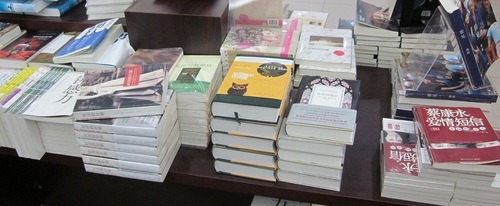
Xujun Eberlein: I was curious about this myself. I’m in Chongqing for Chinese New Year and I went to the Xinhua Bookstore downtown on Saturday (February 9) to have a look at the book. A young staff member led me to the desk where the Chinese translation of Finnegans Wake (the yellow cover at the center of the above photo) was on display with other new and noteworthy books. As you may see from the photo, next to Finnegans Wake is the translation of polish novelist Henryk Sienkiewicz’s Quo Vadis, which has a supplementary band to note the author is a Nobel Laureate. The red cover on the right is a Chinese popular novel titled Love SMSs. I asked the young man how Finnegans Wake was selling there and he said “Not bad.” He noted that its sales were similar to One Hundred Years of Solitude and Love in the Time of Cholera. When asked what kind of readers were buying it, he said “mostly young people.”

Read more.


Thursday, February 2, 2012

A Dual Review of Tombstone and Mao's Great Famine

(Note:  I'm traveling in China right now, where I don't have access to my own blog.  I have to ask someone else outside to put this post up for me.  It was a surprise to me, though, that LA Review of Books is also blocked.  I don't know why and doubt that there was a particular reason, but now with my following review published, the Chinese government might indeed feel the need. Sigh. )


THETEACHER OF THE FUTURE
XUJUN EBERLEIN
on two accounts of the great Chinese famine.

In July 2011, Frank Dikötter’s Mao’s Great Famine won the BBC’s Samuel Johnson Prize, one of Europe’s best known and most lucrative awards for a work of nonfiction. One of the judges, Brenda Maddox, explained to the Guardian why the book impressed her so much: “Why didn’t I know about this? We feel we know who the villains of the 20th century are — Stalin and Hitler. But here, fully 50 years after the event, is something we did not know about.”

That reaction highlights both the main contribution and main limitation of Dikötter’s book. Though there have been many books and articles published on the same subject — in English, Chinese, and I’m sure other languages — apparently Dikötter’s is the one that brought awareness to at least one more Westerner ignorant of the catastrophe. On the other hand, Dikötter’s attempt to draw parallels between the Mao-era famine that swept over the entirety of mainland China from 1959 to 1961 and killed tens of millions, the Holocaust, and the Soviet Gulag is, at best, an over-simplification that hinders understanding. To borrow what the discerning Asia scholar Ian Buruma once said on a different subject: “To distinguish between atrocities does not diminish the horror, but without clarity on these matters history recedes into myth and becomes a form of propaganda.”

The most authoritative study on the famine is Yang Jisheng’s Tombstone, which has a broader and deeper perspective. The Chinese language edition of the book was published in Hong Kong two years before Dikötter’s, and an English version is due out from Farrar, Straus and Giroux in fall 2012.

(Read the complete review at LOSANGELES REVIEW OF BOOKS)

Wednesday, December 7, 2011

Yang Rebuts Dikötter on Famine Research

[Note:  I don't know either Frank Dikötter or Yang Jisheng, but I have read both China's Great Famine (in English) and Tombstone (in Chinese), two books I'll be reviewing.

For research purposes, I'm intensely interested in finding out whether Mao really said "It is better to let half of the people die so that the other half can eat their fill," and if he did, in what context.  According to Dikötter, Mao made the speech on March 25, 1959, in a secret meeting in Shanghai, but the source Dikötter cites in his book is "Gansu" – Gansu's provincial archive. If Dikötter can show us the complete speech of Mao that contains those words, or the complete context if they are words attributed to Mao by someone else, that would be a great help to all researchers of the subject. – Xujun]

Update:  my review for both books has been published in LA Review of Books in January 2012:  "The Teacher of the Future"


In Response to Mr. Dikötter's Comments on Tombstone

by Yang Jisheng 
Independent Chinese Pen Center, November 16, 2011

[In translation]

Not long ago, when I heard that Mr. Dikötter's book on China's great famine had been published, I was very happy: with one more comrade researching China's great famine, I felt in my heart the consolation of not being alone. Later, when I heard his book had received an award, I was again very happy, for our research field had attracted serious attention from international academic circles.

I got to know Dikötter in 2007.  I was visiting the Chinese University of Hong Kong, mainly to make use of its various chorographic resources for my final proofreading and correction of the Tombstone manuscript. Beijing’s Library on Wenjin Street also has chorographies, but does not allow open-shelf reading; one has to check out a single book a time to read, which is very inconvenient. 

One day perhaps in May 2007, through the introduction of Prof. Cao Shuji of Shanghai Jiaotong University, Dikötter found me at CUHK. I told him about my research.  He said, "You study about death; I study about survival."  I thought his angle was original.  We also discussed the number of [starvation] deaths. I said 36 million is only an approximate number; it is impossible to find an accurate count. Later I gave a talk at a lunch meeting on China's great famine; I remember Mr. Dikötter was also there.

Tombstone was published in May 2008 in Hong Kong by Cosmos Books, and it triggered unexpectedly strong reaction.  Sometime later, probably in 2009, Dikötter's assistant Ms. Zhou Xun visited me in Beijing. I gave her some information and methods for gathering famine data.  I half joked, "With your Chinese face and pure Sichuan dialect, maybe you could sneak into Sichuan's Provincial archives!" 

I have not read Mr. Dikötter's book (note: Mao's Great Famine has not been translated into Chinese – Xujun), and can't make comments except to congratulate. But I'll have to say a few words in response to his comments on Tombstone. I read his comments from the October 30, 2011 issue of Asia Weekly.  This is an influential journal; if I don't provide a bit of the necessary response, it will be difficult to clear up its many readers' misunderstanding of Tombstone.  A few things are discussed in what follows.

1.  Mr. Dikötter speaks of the causes of the Great Famine: "This is a system or structure issue, not that of a certain person.  That's the biggest difference between my book and Yang Jisheng's."  Anyone who read Tombstone knows that, from the introduction through every chapter, the book talks about the system issue; it never says the cause for the great famine was the problem of "a certain person." In addition, Chapter 26 focuses on analyzing systematic causes of the famine, and Chapter 27 explores the theoretic roots of the system. I always think that, to inculpate Mao Zedong alone for all China's problems in the 30 years before Reform, such as anti-rightists, the great famine, and the Cultural Revolution, is contrary to historical facts, and is superficial.

2. Mr. Dikötter says, "He [Yang Jisheng] writes Mao Zedong as very bad, the Communist Party as very good."  Tombstone neither says "Mao Zedong is very bad" nor "the Communist Party is very good," of course it does not say Mao is good either.  Not only are there no such words, but also no such meaning, in my book.  Readers who have read Tombstone must think Mr. Dikötter remembered wrong.  Tombstone just objectively writes the historical course as it occurred. When writing about several leaders of the Party central, the book does not give any evaluation of "good" or "bad," because that kind of simplified evaluation is not scholarly thinking, and is not scientific.  Especially for such a large-scale catastrophe as the great famine, the roots are in the system, it can't be the consequence of whether a certain person is "good" or "bad."

Speaking of Mao Zedong, I will have to point out, one piece of information Dikötter introduced to prove "Mao Zedong is bad" is not reliable. Dikötter quotes Mao as saying "It is better to let half of the people die so that the other half can eat their fill." Based on my many years of research on the great famine and Mao Zedong, I am positive that Mao did not say such words.

3. "He [Yang Jisheng] says Zhou Enlai is wonderful, Liu Shaoqi is wonderful, Deng Xiaoping is wonderful; as such this cuts apart the history of the relationship between Mao Zedong and the Party."  Readers of Tombstone can testify, my book absolutely does not have any such words as Dikötter says it has. Not even a hint of such. Tombstone only states historical facts and the systematic systemic causes that made them happen; it does not evaluate credits and faults of any particular leader. In addition to describing Mao's words and behavior, Tombstone especially spends many pages describing Liu Shaoqi's speeches during the Great Leap Forward, and then states: "When I list here a series of speeches by Liu Shaoqi that led to the 'Five Winds,' it is not to say that the source of the 'Five Winds' was Liu. It is also not to reduce Mao's responsibility; rather it is to illustrate that, after the criticism of 'countering rash advance,' the majority of the then Party leadership was in keeping with Mao’s attitudes and was supportive of Mao. Among them, Liu Shaoqi and Zhou Enlai were in tune with Mao; sometimes they even spoke more radically than Mao."

4. Dikötter says, "On the so-called three-year natural disasters, in fact there weren't big natural disasters." In fact, it is not that there weren't big natural disasters.  There were natural disasters. To research the impact of the natural disasters on farm crops, I went to the National Meteorological Administration five times to gather information and seek advice from meteorological experts.  My conclusion: "Natural disasters occur every year; those three years were normal years. The cause of the Great Famine was a man-made disaster."

5. Dikötter says, "His [Yang's] book rather emphasizes on how many deaths occurred in which province, which place. To use a not very appropriate word,  I feel that's a bit stupid (无聊)." 
Dikötter calls my research on each province's death numbers "stupid"; to this criticism I would rather not respond. Readers please make your own conclusion. But I do want to make clear that, for this "stupid" thing, I indeed expended great efforts. For example, I sought advice from many demographers, and had in-depth discussions with them. I collected nearly all foreign and Chinese demographers' research data on China's famine death figures, studied their methods, and analyzed their calculation results. Further, I hand-copied each province's relevant data, book by book, from the 30 books of  Population of China, drew up tables to organize the data,  and then calculated the data province by province.  Each day, I calculated the data after work; one evening was enough for only one province. Why did I devote such big efforts in such a "stupid" thing? I treasure life. Behind every figure is an array of lives from birth to death.

6. Dikötter said many times that, his biggest discover is that besides starvation deaths, many people were beaten to death.  Is this his new finding?  Readers of Tombstone know this well, readers of Ms. Qiao Peihua's Xinyang Incident know this well, too. Both books described many cases of peasants being beaten to death.  Tombstone was published three years earlier than Mr. Dikötter's book.  Xinyang Incident was published over a year earlier than Mr. Dikötter's book.

7. Mr. Dikötter said many times that China's archives are now opened, he visited China's inland archives and read over a thousand documents relating to the great famine, and said his book is based on the archive materials.  I went to 10+ Provincial Archive Establishments as well as the Central Archive, hand-copied and Xeroxed several thousand original documents; the hardship I experienced is unspeakable. I had the status of Xinhua Agency's senior reporter, and the help from many high-ranking friends, and still I ran into lots of trouble and setbacks; some provinces did not let me in. … As far as I know, China's famine archive is not opened. Some Archive Establishments opened other files, but those related to the famine have a small rectangular stamp on them with the word "restricted", and reading is not allowed. Mr. Dikötter is a foreigner with distinctive exterior and language, who'd have thought he could access over a thousand files of the famine archives!  There must be some tricks.  If he could tell of his experience, it would be a great help to all scholars of China.

Yang Jisheng, October 28, 2011

-------------------------------
(Update: Thanks to  Joshua Rosenzweig for pointing out that Mao's Great Famine has been translated into Chinese j.mp/rfrHtU.  – Xujun)

(Update 2: My review for both books has been published in LA Review of Books in January 2012:  "The Teacher of the Future"   – Xujun)

Monday, October 17, 2011

China's Officialdom Novels: Translators Pay Attention!


There is a rumor on the Chinese internet that, at various government levels, Party bosses are requiring their secretaries and subordinates to make a new novel their "must-read." This novel, which I'm reading right now, is titled "No. 2 Boss." (By the way, the Chinese word "首长" is a bit difficult to translate precisely in this context.  I'm using "boss" for the moment.  If anyone has a better suggestion, I'm all ears.)

In China's "officialdom" jargon, "No. 2 boss" refers to the boss's secretary (administrative assistant), and this novel's protagonist is the secretary of a provincial Party chief (roughly the equivalent of a governor). Such a character's wide perspective on the Chinese officialdom sphere, from the central government and Party apparatus to the local bureaucrats, supports a plot that is never dull.

The author, Huang Xiaoyang, apparently has intimate knowledge of government business and its daily particulars. In this tremendously entertaining and stunningly detailed novel, Tang Xiaozhou, a journalist-turned-secretary, navigates the open strife and veiled struggles of provincial politics with great skill and craftiness.  While more or less maintaining the tenets of basic decency in a world full of corruption, the protagonist does not sacrifice his own opportunities for advancement.

I have finished reading the first two volumes of the long novel, which can be bought online and in bookstores everywhere in China. The author is still working on the third volume, and is publishing one page a day online as he writes it. Such serial installments as a form of novel publishing in China can be dated back to 1892, according to this study. The difference today is the internet has overtaken newspapers. I confess that reading one new page a day of a Chinese novel has added a certain addictive pleasure to my daily morning tea.

The political worldview expressed in "No.2 Boss," not surprisingly, has a heavy imprint from a Chinese politician's cynically pragmatic angle, and some of it might be unacceptable to American readers. At times, I also feel the book's excessive number of sex scenes undermine its literary quality. (I hope to address these issues more explicitly in a longer review later.) On the other hand, the novel's realistic and meticulous portrayal of Chinese political culture has irreplaceable value to anyone who is interested in understanding China.  Nowadays, an unprecedentedly large number of Western writers and journalists are working and living in Beijing, Shanghai and other Chinese cities,  publishing more and more books written in English.  These books make significant contribution for the world's understanding of China, and the viewpoint of  outside observers is often refreshing to Chinese readers as well.  However, no foreigner could have written a book like "No.2 Boss"; the nuance could only come from the hand of a cultural insider.  

By the way, officialdom novels are not a new genre in China as some foreign observers think. The genre flourished in the Qing Dynasty. In my youth I read with great interest several of those novels mentioned in this article. The genre disappeared in the Mao era, but has made a comeback in recent decades. It seems to be reaching a new peak now. The fact that the genre has become hot again might be a bellwether for the level of government corruption.

Update: here's my longer review in Foreign PolicyThe Rules of the Game

Related links:


Tuesday, May 17, 2011

Kissinger Encloses Many Sides of Mao – A Review of On China

On China by Henry Kissinger, Penguin Press, hardcover, 586 pages, $36

Reviewed by Bob Eberlein

“God has sent me an invitation, yet he [Kissinger] says, don’t go.”

So Mao Zedong reflects on the passing of his soul in a conversation with Gerald Ford and Henry Kissinger in 1975. There is a chance that I have seen this quote before. If so, it passed me by. With limited knowledge of China and Mao at the time, I would not have understood the overwhelming irony embodied in the conversation.

Reading it afresh in Henry Kissinger’s new book On China - released today - I laughed and laughed. The conversation follows the riveting story of the opening of diplomatic relations between the US and China that was spearheaded by Kissinger. Though I knew how the story would end, I still found myself reading with great anticipation, for in this part of the book Kissinger has really managed to bring us into the moment, to show us things as he saw them then. And he certainly did not know what was going to happen next.

Monday, May 2, 2011

The Ambivalent Role of China's Middle Class -- A Book Review

The Chinese Dream: The Rise of the World’s Largest Middle Class and What It Means to You by Helen H. Wang, Bestseller Press, $16.97 paperback, $9.99 Kindle edition

"What do you think 'middle class' means in China?"  I raised this question to Chinese friends during my trip to Chongqing in April.  I was after a spontaneous answer.  From what I heard, the consensus seems that if you own a house and a car, you are in middle class.  An art professor, who owns neither, said that by classical definition a professional is middle class, but in today's China he is no longer sure if he is middle class despite the fact he is a professional.

Saturday, March 5, 2011

Bicycle-Free China: A Review of The Lost Cyclist

The Lost Cyclist by David Herlihy, Houghton Mifflin Harcourt, $26, hardcover

Reviewed by Bob Eberlein

In a recent post on the Atlantic’s web site, Xujun made the claim that I was the first American to ride a bicycle across China in 1987. She was thinking, of course, about her China, the one she had grown up in under Mao that had pretty much shut Americans out and certainly had no appetite for foreign adventurers. I would be very surprised if I was the first post-Mao, though I have no idea who beat me. I just know that there are lots of people who do things just to do them, and don’t try to call attention to themselves. Perhaps, in this day of YouTube and Tweeter, such actions have fallen by the wayside, though I still like to think of the multitudes out doing odd and wonderful things all under the cover of anonymity.

Forget about modern China. Before Mao, before the Nationalists, before the Warlords, while China still had an Emperor (or at least a Dowager) in charge, the Americans Thomas Allen and William Sachtleben rode their bicycles together across the Gobi desert, reaching Peking in the fall of 1892. A kind reader sent a comment to Xujun telling her about a book, The Lost Cyclist, which gives an account both of their trip, and another by Frank Lenz heading east to west shortly thereafter. Xujun clarified her meaning, and acknowledged the book in a follow-up post. The publisher, noticing mention of The Lost Cyclist on the Atlantic site, sent along a copy – a wonderful surprise!

No one ever did identify any of the cyclists I assume preceded me in crossing the People’s Republic of China, perhaps this review will prompt such a revelation.

The Lost Cyclist: The Epic Tale of an American Adventurer and his Mysterious Disappearance by David Herlihy is both an adventure story and a murder mystery, unique for nonfiction, with a fair bit of historical information thrown in. It chronicles the emergence of the vehicle we now think of as a bicycle, then called a safety bicycle to distinguish it from the high wheelers that preceded it, and the, mostly, men who rode them. Then it takes off across America, Europe and Asia from west to east with Allen and Sachtleben, and east to west with Lenz.

Drawing on the material that Lenz himself had written, the book paints a very interesting picture of 1890s China as Lenz perceived it. Remarkable to me was that he thought of it as the most wild and uncivilized place on the planet. In an interview while in China Lenz says “Afghanistan, Persia and Asia Minor, each have formidable difficulties. But they are not of so dangerous a nature as those who entertain the superstitious belief that a man on a bicycle is a flying devil from the clouds.” 

This was a China that had never seen a bicycle. To me that is almost as unfathomable as Lenz must have been to the Chinese peasants. Almost a century later I also astonished people in the countryside, but they knew exactly what a bicycle was. They would ride side by side with me and marvel at my beard and the foreign vehicle on which I traveled.

As I read of Lenz’s travels through China a feeling of dread fell upon me. I feared, as did those he met along the path (for there were few roads in China), that his life would end there. It was with a sigh of relief that I turned the pages onto his passage into Burma.

Lenz never finished his trip and never returned home. I will not say where his travels ended so as to allow some feeling of mystery to remain for those who have not yet read the book. A third of the book is devoted to the attempt to unravel what happened to him, and bring those responsible to justice. Sachtleben took on this responsibility and found himself in the midst of amazing and heart rending political unrest. On his quest Sachtleben demonstrated bravery, tenacity, competence and even guile. More than anything though, the events depicted saddened me, for he was caught in a dangerous and dark moment in human history, and Sachtleben was lucky to escape with his life.

Though he did solve the mystery, justice was never done. Rather the injustice that Sachtleben witnessed carried him back to the United States with a heavy heart. The book opens with a brilliant scene some sixty years later, where Sachtleben returns to his boyhood home to look again upon that innocence. That scene is nice on first reading, but ever so much more powerful when reread after finishing the book.

So all in all The Lost Cyclist is a great read. And yes, for those purists among us, Thomas Stevens road across China in 1886. But his bike was one of those high wheelers and, for goodness sakes, the guy was British.


Saturday, December 4, 2010

American Conspiracy in China – A Review for Rock Paper Tiger

Rock Paper Tiger by Lisa Brackmann, Soho Press, $25, hardcover

Reviewed by Bob Eberlein

Lisa Brackmann has put out a terrific thriller that runs us around China on an adventure including sightseeing, espionage, terrorism, torture and, of course, art. Rock Paper Tiger is the never-boring, fast moving story of a woman wounded in Iraq finding unexpected refuge in China, only to have the nightmares of the Iraq war revisit her.

It starts with the innocuous meeting of Ellie, the protagonist, with her occasional boyfriend Lao Zhang, and a Uygur man from Xinjiang who some believe is a terrorist. The meeting itself would never have happened but that Ellie’s cell phone ran out of money. That small failure in life management is pretty typical for Ellie. An encounter with an IED in Iraq has also left her with a leg that causes constant pain and a disposition that is often downright skittish. Those bits of her characters, along with the general impulsiveness that seems to be her trademark, lead Ellie into lots of trouble very quickly.

Thursday, August 26, 2010

What Everyone Needs to Know about China

China in the 21st Century: What Everyone Needs to Know, by Jeffrey N. Wasserstrom, Oxford University Press, USA, $16.95 (paperback)

Reviewed by Xujun Eberlein

Being surprised is something I expect from a good work of fiction, but not necessarily from nonfiction, especially when I am familiar with the subject – or so I thought.

Thus it was a treat when I found plenty of surprises in Jeffrey Wasserstrom’s new book, China in the 21st Century: What Everyone Needs to Know, such as the following passage from the section titled “What is the alternative to viewing Mao as a monster?”:

There are many alternatives to thinking of Mao as a fiend who was China’s Hitler. One useful one is to see Mao’s place in China today as comparable to that of Andrew Jackson’s in the United States. Though admittedly far from perfect, the comparison is based on the fact that Jackson is remembered both as someone who played a significant role in the development of a political organization (the Democratic Party) that still has many partisans, and as someone responsible for brutal policies toward Native Americans that are now often referred to as genocidal.

Both men are thought of as having done terrible things, yet this does not necessarily prevent them from being used as positive symbols. And Jackson still appears on $20 bills, even though Americans tend now to view as heinous the institution of slavery (of which he was a passionate defender) and the early 19th-century military campaigns against Native Americans (in which he took part).

This comparison is refreshing, and it could only come from someone who knows both American and Chinese history intimately. Admittedly, I have limited knowledge about President Andrew Jackson. Growing up in China before “reform and opening,” the most familiar images of US presidents to my generation then were Johnson and Nixon – the former a caricatured warmonger and the latter a chameleon suddenly changing from China’s number one enemy to the hero who normalized Sino-America relations to the world’s biggest scandal maker. (If you find those one-sided images laughable, perhaps it sheds some light on why many images of China commonplace in the West make no sense to Chinese.) 

On the Chinese internet today, however, when searching for “President Jackson,” glorious descriptions fill my eyes: “people’s friend,”  “the bank killer,” a war hero who defeated the British army, a wise politician who prevented the US from splitting apart. No mention of his not-so-glorious role in killing Native Americans.  You wonder how an average internet surfer in mainland China can get a complete picture of this controversial American president.

But, before you feel fortunate to have the benefit of a free press and internet, hold on a second. Can the average American reader get the whole picture of Mao? This really depends on what you happen to read or hear. If you have only read Jung Chang and Jon Halliday’s best-selling biography, Mao: The Unknown Story (2005, and see my review here), for example, then Mao was born a monster. If you have only read Edgar Snow’s Red Star Over China (1937), on the other hand, then Mao was a legendary hero of the Chinese peasants. The actual Mao, of course, was a more complex historical figure than either of those works portray.  

Chinese in the Tang Dynasty already understood “Listen to both sides and you will be enlightened; heed only one side and you will be benighted” (兼听则明,偏听则暗), but it is never easy to consistently follow this practice. The few American writers I know of who write about China with this maxim in mind include James Fallows, Peter Hessler, and Jeffrey Wasserstrom. If you are interested in China and don’t want to be benighted or brainwashed, read books with different views before forming your opinion. Or, as a short cut, start with a book like China in the 21st Century: What Everyone Needs to Know. The parallel between Mao and Andrew Jackson might be imperfect, as Wasserstrom has noted, but it is a big step up from good-evil dichotomy that seems so pervasive.

In fact, one of the most appealing characteristics of Wasserstrom’s new book is that it does not sidestep controversial issues and opinions.  On the contrary, it deliberately provides the reader with views from opposite sides, in a rather straightforward and balanced manner.  Here’s another example. In addressing the question “How does the reputation of the [Boxer] crisis differ in China?” Wasserstrom writes:

In the West and in Japan, the Boxer Rebellion is presented as a tale of the rise and fall of a violent Chinese group. Emphasis is placed on the Boxers’ superstitious beliefs, including their notion that they could make themselves impervious to bullets and that railway tracks should be torn up to appease local gods. In China, by contrast, while the violence and superstitions of the Boxers are sometimes criticized, there is more emphasis on other aspects of the crisis, such as the grievances that led to the insurrection. These injustices included decades of foreign powers’ extending their reach into Chinese territory, and the atrocities committed during the “Invasion of the Eight Allied Armies,” including the looting of Chinese national treasures and the revenge killing of thousands of northern Chinese. In Chinese accounts now, the Boxer Protocol is described as one of many humiliating and unjustly one-sided treaties.

Perhaps no viewpoints are as starkly in contrast as those on the so-called “Boxer Rebellion” crisis. I still remember the shock, just after moving to the US, of hearing how Westerners view the Boxers as nothing more than a frenzied mob engaged in slaughtering and burning. In China, now as then, a common view is that the Boxers were patriots, though perhaps too superstitious and prone to violence.  In other words, they were regarded as flawed and tragic heroes. Tales of a bare-handed Boxer, with his outstanding kungfu, beating an armed foreign bully are still greatly entertaining among common Chinese.  There has been a change over the past three decades though: today when people talk about the historical event itself, more emphasis seems to be placed on how stupid the Boxers were to use bare-hands to fight firearms, and how backward China was then in terms of national defense.

The official view has changed more dramatically. As a deeply cultured Chinese writer, Feng Jicai, whose novel about the Boxers was very popular in the 1970s and who is now unhappy with the portrayal in that book, says in an interview earlier this year, Chinese understanding of the Boxer movement has never been free of political utilitarianism. During the Cultural Revolution, to meet the political needs of the time, the Boxers were portrayed as revolutionaries consciously anti-imperialistic. Today, on the other hand, to comply with the reform and opening policy “we treat the Boxer movement as a typical case of blind xenophobia.” As such, Feng believes no historian has really touched the truth of that history, which he is trying to find. A native of Tianjin, a city with rich stories of the Boxers, Feng says the subject is always a knot in his heart. He has been writing new stories about it.

I like what Feng said, that the truth has yet to be found, because it whets my appetite to learn something new about an old topic. In a sense, Wasserstrom’s book has a similar effect on me. In recognizing differences between Western and Chinese views, Wasserstrom helps break stereotypical perceptions and opens the reader’s inquiring minds. He does so throughout the book.

The breadth of this relatively short, 150-page book is amazing. Starting with “Who was Confucius,” it continues without pause to  “What was the Dynastic Cycle,” “What was the Opium War,” “Why did the Qing Dynasty Fail,” and much more. Given the brevity and the format, there is a necessary lack of nuance, but there is a great overview of the backbone of Chinese history presented in the blink of an eye.

Building off of the past, the book devotes a chapter to the post-Mao development of China into the modern state it now is. Then it outlines “U.S. –China Misunderstandings,” and finally presents a chapter on what the future holds, providing useful insights into the different ways that Americans and Chinese view one another and how differently they interpret the same events.

Understanding what is happening in China, or America, is difficult for even the best informed people on both sides of the globe. If you are trying to get real insight into the Boxer Rebellion, Mao Zedong, Tibet or a host of other issues relating to China, one short book is surely not enough. But whether you are new to things Chinese or are an old China-hand, something said in China in the 21st Century: What Everyone Needs to Know will make you think twice, and the references included should carry you quite a way. If you feel a bit lost for not getting a definitive answer to some questions, then you might be one step closer to learning the truth.

Tuesday, August 17, 2010

On Writings about the Cultural Revolution


Random Thoughts on Writings about the Cultural Revolution
(excerpt in translation; read the Chinese text here.)

Chinese often say, “Misfortune of the country is the fortune of poets.”  Actually, this depends on time and place. WWII brought disaster to many countries, but also provided endless source material for writers and artists. The Cultural Revolution brought China a catastrophe, but only increased the never ending troubles of [Chinese] artists and writers:  A painter’s oil painting “Shouting Long Live” can only be hidden in a corner of 798 art zone.  A sculptor who made a statue of Lin Zhao was summoned by the government many times. Writers wrote novels about the Red Guards and no publishers dared to publish. A director who made a movie called The Blue Kite,

Monday, August 9, 2010

Chinese Social Sci-Fi Follow-Up

Since my essay, “The Return of Politically Charged Science Fiction in China,” appeared in Foreign Policy, I’ve heard from a number of readers seeking further information on Chinese Sci Fi.  Interested readers should check out Joel Martinsen’s blog post "Social commentary in Chinese SF: 2013, Han Song, and others" for a more complete picture of the present Chinese SF scene.  I find the post, in which Joel (dubbed by a reader as "truly a Chinese SF fan") noted a number of recent SF works that are “socially conscious,” is very interesting and informative.  Joel concluded that, Chen Guanzhong’s China 2013 “may be the first political fantasy to take such direct aim at the modern social order and to discuss politics in such depth, but these and other science fiction stories also engage with contemporary Chinese society in

Saturday, July 31, 2010

The Return of Politically Charged Science Fiction in China

My essay about social sci-fi in China and Chen Guanzhong's recent novel, China 2013, is now up on the website of Foreign Policy magazine. It seems to be getting quite a few reads. I've already gotten questions about an English translation of the book. It is not yet available; if you need further information about a translation, someone in this podcast, "Science Fiction in China," might know more than I do.
 
There was also a reader question as to whether Lao She's suicide was real or only an "official version" of the story. As far as I know, that is the fact. Lao She's son, Shu Yi (舒乙), has written many articles about his father's suicide; you can read one of them here (in Chinese).

If you are interested, here are some other English reviews of China 2013:
(Indeed there are different translations of the book title and even the author's name, the latter depending on whether Cantonese or Mandarin is in use for pronunciation.)

Friday, March 5, 2010

China 2013: A Quick Review

The Prosperous Time: China 2013, by Chen Guanzhong, Oxford University Press (China), HK$70.00.

In a country where social science fiction is currently rare, this neo-Orwellian novel by a Hong Kong author who has lived in Beijing for a decade is quite phenomenal. Set in 2013's Beijing, the story follows Mr. Chen, a writer whose life experience and surname resemble that of the author, as he attempts to track down and pursue the frequently disappearing love of his life, a marginalized woman named Xiaoxi who distrusts the government and whose son is a Party informant. Meanwhile, Chen's old acquaintance, Fang Chaodi, a man in his mid-60s with a complex background, involves Xiaoxi in a different kind of search – for a lost month from the spring of 2011. Both efforts are unpopular and run into political and social obstacles. Suspicious of the government's foul play, Fang, Xiaoxi and another friend eventually kidnap a Party politburo member for questioning. In the novel's final revelations, we learn that there have been 28 bloody days preceding China's prosperous time. However, though the Chinese government has in fact done tricks to successfully create prosperity at a time of world doom, the populace's selective memory loss is not due to one such trick.

What sets the novel apart is its attempt at maintaining an Orwellian perspective against the one-party autocracy while bringing the setting up-to-date: the dark gruesome milieu in Orwell's 1984 is replaced with a jubilant celebratory mood. This proves to be both an accomplishment and a challenge for the plot. The storyline hangs together well for most of the book, but falls short in the end. It seems as if the author had set out to tackle the paradox of why an authoritarian government should be advocated by the majority of people, but ends up being persuaded by his own antagonist of the regime's legitimacy. Part of this weakness might have been caused by missed opportunities in the plot, for which I will attempt a more detailed analysis in a formal review. Despite this neo-Orwellian novel's unintended counter-Orwellian ending, it nonetheless leaves the reader troubled by the possibility of widespread public support for a non-democratic regime and thus the failure of democracy's universal value.

Update: related link - "The Return of Politically Charged Science Fiction in China" (Foreign Policy)

Wednesday, December 16, 2009

Book Review: Paper Butterfly by Diane Wei Liang

Paper Butterfly by Diane Wei Liang
Simon & Schuster (May 5, 2009), 240 pages, $24

The 1989 student movement that ended in blood underlies the cause and effects in this detective novel set in Beijing, China. That year, a 19-year-old student named Lin is condemned to a labor reform camp. Eight years later, he is released and becomes a migrant worker. Meanwhile, private detective Mei Wang, the heroine of the novel, takes on an investigation into the disappearance of a famous pop star, Kaili. When Mei finds a paper butterfly and a stash of old love letters in Kaili's apartment, she feels a historical link between Kaili, the letter writer, and herself. Soon Kaili is found dead, and her boss, who hired Mei for the investigation in the first place, now deploys, without success, all means at his disposal to stop Mei. More paper butterflies appear in a poor neighborhood, where a child also vanishes. With the help of her connections, Mei eventually ties all the ends together and discovers the truth.

This novel is the second of Diane Wei Liang's Mei Wang series that features China's first female private detective. The plot of Paper Butterfly is more gripping than the author's first novel, The Eye of Jade, and there are a number of rural scenes that are rendered quite vividly. Unfortunately, the characterization is weaker. Mei Wang's personality traits, which may have fascinated the reader in the previous novel – her aloofness and distaste for "back doors," her rare courage as a female detective, her conflicting emotions toward her mother – are no longer given enough stage to perform, or develop, in this 224-page thin sequel. As a consequence, Mei Wang's role in Paper Butterfly is not as memorable. Using a political event familiar to Western readers as the plot driver might be a clever idea, but it does not necessarily work well for an uninteresting protagonist.

Contemporary Chinese detective stories are not a new comer in the stage of English literature. Qiu Xiaolong, for example, has successfully portrayed inspector Chen Cao in a series of novels set in Shanghai. Diane Wei Liang's unique angle is the introduction of a female detective, but that uniqueness has yet to be well exploited.

The novel's writing, executed in the author's second language, poses an issue as to how much rendering of foreign-language terminology is too much. The author seems very eager to teach her readers Chinese nouns, as she uses pinyin (the most commonly used romanization system for standard Mandarin) way too frequently. Many of those nouns, such as "hulu," "tufei," etc, are insignificant words in the book which have readily available English equivalents, thus presenting them in Chinese pinyin doesn't seem to serve much of a purpose. A less arbitrary display of Chinese terms might be more effective.

Monday, October 12, 2009

Double Nature of Student Movements in China

It was like déjà vu. About one-third into Leslie Chang's Factory Girls, a book I was reviewing for WRB, I found a story about the tragic death of the author's American-educated grandfather, Zhang Shenfu, who had become a leading engineer in China's mining industry in the 1940s.

I knew the story. I knew the name. But from where? I didn't know anything about the author before reading her book. I went to check my notes from another project. Sure enough, in an interview with my mother four years ago, she had cited the "Zhang Shenfu Incident" as the earliest trigger of her political career. I’d just started to work on a memoir provisionally titled Letters Lost in Chongqing, researching my parents' youth as Communists also in the 1940s.

On August 9, 1945, the same day the U.S. dropped its second atomic bomb on Japan, the Soviet Union attacked the Japanese army in Northeast China. The entire war of Chinese resistance against Japan ended within a week. Both America and the Soviet Union took the credit.

When Japanese soldiers laid down their arms, the Soviets replaced them as occupiers of Northeast China. The then-government of China was anxious to regain control of the industry infrastructure there. In January 1946, the Nationalist government in Chongqing (my home city) sent eight engineers, led by Zhang Shenfu, to take over operations at the Fushun Coal Mine. The Soviet occupiers refused to cooperate.

On their way back to the nearby city of Shenyang, all eight men were pulled off their train and brutally killed. A nation was in shock. The Nationalist government accused the Soviets of the murder; the Soviets blamed it on "anti-Soviet forces"; the Chinese Communists blamed it on local thugs. The case was never solved. Today the Chinese Wikipedia has an item for "Zhang Shenfu" plainly stating that he was murdered by the Soviet Red Army. According to Chang’s version of the story in Factory Girls, her family believed this as well.

My mother was a sixteen-year-old student in Chongqing when news broke of Zhang Shenfu's murder. Thousands of angry people took to the streets to protest, my mother among them. She and her fellow students shouted slogans such as “Soviet Union Show Your Conscience!” and “Avenge Martyr Zhang Shenfu!” The demonstration, the first of many against the Soviet occupation, lasted all day.

Six decades later, however, my mother belittled the action and attributed it to her political naïveté. As she recalled, that demonstration also started her distrust of the Nationalist government supporting it.

Because of their political unity with the Soviets, the Chinese Communists took a restrained approach at the time, neither openly opposing nor contributing to the student movement. Meanwhile, the Nationalists used the murder to damage the Communists. The Nationalist officials running my mother’s school required everyone to participate, she told me, threatening to expel those who hung back.

Before the parade, the students were warned to be careful when passing the office of Xinhua Daily, the Communist newspaper, of a possible attack from the Communists. Male students took this warning so seriously that when the parade approached the Xinhua Daily office, they walked on the outer lines to protect their female schoolmates. What my mother saw, however, was the newspaper’s door tightly shut; no one seemed to be inside.

When the students returned to school, they heard that a mob had wrecked the Xinhua Daily office. The Nationalist media blamed angry students; the Communist media blamed the Nationalist secret police. My mother didn’t know which side to believe, but she trusted the student leaders, who firmly denied any role in the destruction . She found a copy of Xinhua Daily and eventually became convinced by its version that Zhang Shenfu had been killed by local thugs.

The nationwide protests apparently did help to speed up the Soviet Army's withdrawal; this began a month and a half later. Meanwhile, the American troops that came to China's aid during the war stayed on. On Christmas Eve of the same year, a female student in Beijing named Shen Chung was raped by two U.S. marines. This incident triggered another, larger wave of student demonstrations across China.

This time, my mother was no longer a mere participant. She became a leader and an organizer at her school, fighting on campus against the officials who tried to block the news of Shen Chung's rape, and protesting American troops on Chongqing's streets. She did this because of her "righteous hatred toward injustice and violence," as she proudly put it during my interview. Curiously, she didn’t note her political naïveté here. She was unaware of the heavy involvement of Communists in facilitating this later demonstration, but they were watching her, and she was soon recruited.

In fact, all her close friends who actively participated in the "Shen Chung Incident" demonstration were recruited and later joined the Communist Party. Organizing student movements was a most effective way for the underground Communists to discover new blood. To many young patriots at the time, the Communist Party’s anti-American position was exactly what attracted them to join, as it had become clear that the Nationalist government wanted to keep American forces in the country for support in fighting China’s civil war. In a sense, the American military activities in post-war China helped cultivate massive future cadres for the Chinese Communists.

So my mother became an underground Communist at age 17, and met my father, another comrade, two years later. My family's tortuous fate was thus sealed, long before my birth, by the "Zhang Shenfu Incident.” Our path was the opposite of the one followed by Leslie Chang's family. And although many decades have passed, the double nature of student movements in China has never ceased.

(A slightly shorter version of this piece was originally posted on WOMEN = BOOKS, the Blog for the Women's Review of Books, with the title "Déjà Vu: A Surprising Link from Author to Reviewer.")

Monday, September 21, 2009

Book Review: The Beijing of Possibilities

The Beijing of Possibilities by Jonathan Tel
Other Press (June 30, 2009), 208 pages, $14.95

Reviewed by Xujun Eberlein


Chinese stories can be exotic to foreigners, while a foreigner telling stories about China can be exotic to the natives of the land as well. In recent years, there has been no shortage of nonfiction books set in Beijing written by expats, but fiction in the same category remains sparse. Jonathan Tel's new story collection, The Beijing of Possibilities, stands out as a notable exception, its twelve stories displaying a gripping juxtaposition of realism and allegory.

Tel's prose treats serious themes in a romantic, humorous, at times mystical way. He is evidently very familiar with Beijing's settings, geographically and culturally, having lived in the capital city as early as 1988. The stories, set in places and with characters the author has clearly experienced or observed, present Beijing's distinctness in an enjoyable combination of realistic detail and imaginative musing. Often a story starts by building up a picture of a very real situation, only to surprise the reader by the sudden twist to parable. Or vice versa.

One familiar with Chinese literature might see traces of influence from the classical novel Journey to the West, a hybrid between a fictionalized historical event (a Tang Dynasty Buddhist's journey to India to fetch the holy scriptures) and the myth of Monkey King (who helped the monk completing the perilous journey). Tel's opening story, "Year of the Gorilla," features an unnamed migrant worker in a Monkey King suit. But that is hardly the only connection.

Among the so-called "four greatest Chinese classics" – A Dream of Red Mansions, Three Kingdoms, and Out Laws of the Marsh being the other three – only Journey to the West is a fantasy with a happy ending. In Chinese literature typically filled with great tragic stories, that is a rare presence. In world literature, though written some 350 years earlier, Journey to the West belongs to The Lord of the Rings category. It seems that its fantastic nature makes Journey to the West more easily resonate with Westerners than the other Chinese classics.

It may not be a mere coincidence that The Beijing of Possibilities opens with the line "It's been a while since the Monkey King set out on his Journey to the West." In more than one way, many of Tel's stories apparently continue the literary tradition of Journey to the West, bringing the reader into a fictional dream where reality, parable and fantasy can hardly be told apart.

One of my favorites is "The Three Lives of Little Yu," which tells the story about a childless country couple's life-long attempts at adopting a daughter. Each time they name the girl "Little Yu," and each Little Yu is "as delightful and talented as the previous versions," but each dies unexpectedly young, until time turns to the mid 1980s. At last, to the reader's relief and fascination, the third Little Yu grows up, her "health couldn't have been better," and she has memory of her previous lives:

She remembers her first childhood: the precious spoonfuls of sorghum gruel and how in her hunger she chewed bark off the trees. She remembers the coughing, the ache in her chest, the fever and the fading away of her body. She remembers her second childhood too: the entire school dancing the Loyalty Dance – left hand up, right hand out, "Loyal loyal loyal / to Chairman Mao! / Boundless boundless boundless / Forever forever forever!" – while the commune secretary kept time, taping a spoon on the desk."

Thus, in a clever, parable-like structure, the story reflects a three-decade history realistically.

Another amusing story is "The Unofficial History of the Embroidered Couch." It starts as a time-travel sort of tale, about a relationship across four centuries, between a Ming Dynasty princess and a modern-day young man who works at an advertising agency in Beijing. The cross-century communication between the two is certainly entertaining, but it is the turn at the end that is the drollest yet totally realistic: their dialogue that has been exuding tenderness and love unexpectedly turns into a text message war. Both characters' personalities change, a common phenomenon we can't be more familiar on today's internet.

Tel's stories are full of contrasts. The past and the present are comingled in the romance across time. The city and countryside are blended when the two farmers arrive in Beijing to collect baby Yu on the words of a soothsayer. Right and wrong are confused when the man dressed as a monkey is punished for his good deeds. Adventure and duty are probed when a boy tries to collect a cotton-candy machine for his grandfather. The underlying theme in all of this, not surprisingly, is that Beijing offers opportunities both real and imagined for those who come. That the opportunities are fraught with peril, and that the people taking them are both good and bad is as it should be.

Americans are said to be an optimistic people. The Chinese are accustomed to millennia of calamities. Perhaps the biggest contrast between Chinese and American authored stories is pessimism vs. optimism. From China's classical literature to its contemporary counterpart, it is rare that a novel or story has a happy ending. In contrast, none of the stories in The Beijing of Possibilities ends tragically. For those readers who have had their fill of Chinese "scar fiction," this book should be a pleasant change. On the other hand, while the descriptive details about the Chinese lives usually ring true, the musings and imaginative reality that occupy in the stories seem more akin to Western perceptions of China than to the way Chinese people think. A reader should not expect to gain significant insights into Chinese thinking, but he or she will certainly get a good glance at the Beijing life through an observant expat's eye.