Showing posts with label Larry Mongoss column. Show all posts

Monday, August 17, 2009

The Health Care Rebate

by Larry Mongoss, guest blogger

This is not a particularly China related topic, though it does reflect on the public versus private view that is one of the big disconnects between China’s government and its Western critics. Now that China has started to try some sort of insurance system for its public health care, Chinese people may find themselves on the other side of that divide. Perhaps there are some lessons from the US experience they can apply.

To the point is the ongoing bickering, arguing and fighting about health care reform that is going on in Washington and around the country. To call it a debate would be elevating it above its current station. Since most the arguments seem to be recycled I have decided to call it a “rebate,” though anyone hoping to get something back is likely to be disappointed.

As I see it, there are three basic things at issue in health care: who has access to it; how much do we spend on it; and how well does it work. The crisis in health care that many people are pointing to is a result of the reality that many people do not have access, we spend a lot, and by objective public health measures the system does not work very well. So what do we do to fix it?

Clearly we give more people access, we spend less, and we get better results. Public policy is so straightforward.

Politicians, unfortunately, seem to have pretty short attention spans and it appears they have gotten themselves completely stuck on the issue of coverage and simply want to argue about how much that will or will not fail to decrease costs and ignore the final question altogether. Worse, hampered by narrow vision, reelection worries, special interest groups and lobbyists, the only viable solution for expanding coverage seems to be a new “insurance company.” Thus the debate on what it will do to costs.

What exactly is required to lower the cost of healthcare?

I have heard people say increase competition in the insurance industry. Bush 43 used to like to talk about getting rid of malpractice law suits. More thoughtful conversations do look at lifestyle, nutrition and the ratio of general practitioners to specialists. But I have never heard anyone say that we need to have fewer doctors.

This is what confuses me. If we are going to decrease the cost of health care, does not that mean exactly that – we need to lower the number of doctors, nurses, hospitals, researchers and (of course) insurance workers. If we really like to have lots and lots of these people around I guess we could just pay them less, but somehow I don’t think that will work. More people means more money, fewer people means less money.

For those of you who want to simply take it all out of corporate profits, there is a legitimate argument to be made there. The United States does, to some extent, subsidize the rest of the world in pharmaceuticals by paying much higher prices for prescription drugs than most of the rest of the world. But that, like malpractice costs and insurance inefficiencies, is not enough to turn the tide.

As a society we need to make some serious choices going forward. It would be great if everyone in America was a doctor. But where would we shop, and who would grow our food? We won’t be able to import that because, frankly, as good as the doctors are in America they are also expensive. People in other countries are very price conscious, and only the very richest of them will come to America for treatment.

Market forces will eventually take care of this, by making it very unattractive to be in the health care industry in America. When this happens it will be seen as a terrible thing and the politicians will try to reverse the trend. If the current thinking on Capitol Hill persists I expect we will see this day sooner rather than later.

We need to add price consciousness to health care to our list of imports from China and other developing nations. The current employer-based insurance schemes and the extensions of that scheme under discussion will not do this. Health care, like any service, can’t be provided in unlimited quantities. It has to be rationed, either by price or by another mechanism. Until everyone recognizes that, and we are willing to actually talk about the hard choices, there will be little fruitful discussion.

Tuesday, February 24, 2009

The Cultural Revolution on Wall Street

by Larry Mongoss, guest blogger

I figured I had either heard of, or conceived in my own imagination, every possible way one might think about the current financial crisis. Thus my surprise and delight, while watching Charlie Rose, to hear David Faber of CNBC compare it to China’s Cultural Revolution.

Well, in all fairness to Mr. Faber he didn’t actually mention the Cultural Revolution, and probably would be baffled by the comparison, but he said something that really resonated. For a CNBC special on the financial meltdown called House of Cards he had been talking to many people. Lots were mad, he said, but also said that both the victims on Main Street and the culprits on Wall Street must carry some of the blame for what happened. Without borrowers willing to take on houses beyond their means the bubble would not have been there to pop in the first place. Or more thematically, given the name of the special, the cards would not have been stacked so high.

And that brings me back to the Cultural Revolution. The borrowers and the Wall Street bankers believed in the miracle, that prosperity will yield prosperity. Somewhere in the excitement, common sense went out the door. It is human nature to get caught up in the moment, and this time the factions, instead of fighting amongst themselves, were all pulling together till the cards began to topple.

So if the bankers and the borrowers where different Red Guard factions, then who was Mao? That one is pretty easy, and he is one of the featured speakers in the special. Even today, Alan Greenspan basically says he could not have taken any action to make this adjustment less painful. It is kind of funny to hear him say that. If you ever chewed bubble gum as a kid, and can remember back to that time, you can probably see the bubble forming in front of you. Some of those bubbles were amazing: huge, round, perfect. Others did not look so good: lopsided, weak and just plain ugly. When I saw that things were not working out I would suck the air out, and chew some more. Some of my friends, however, would simply blow hard and force the bubble to pop. Apparently Mr. Greenspan was like them.

Getting past Mao to the Gang of Four is a little bit more of a stretch, but Mr. Bernanke certainly seems like he ought to be included. Then, given Mr. Geitner’s much awaited, and astonishingly underwhelming, announcement of his plans, or lack thereof, I have to add him to the roster. Rounding that out with Mr. Paulson and Mr. Summers seems to make sense, though I wouldn’t care to hazard a guess as to which of them is Jiang Qing. They are, it seems, unhappy allies in this boondoggle we find ourselves in.

Ridiculous and absurd you say? Though that is true, there may actually be something in the comparison beyond what is, hopefully, a bit of comic relief in the face of so much dour news. And that is what happens next.

The end of the Cultural Revolution marked the beginning of China’s emergence as world economic power. A very important ingredient in that spectacular rise has been the development of businesses, activities and really just ways of doing things that simply did not exist before. This has been done in the face of a large and well established bureaucracy that, at first glance, should have doused any attempt of the country to lift itself.

A similar situation exists in America today. Too big to fail is something that people might have said about the Chinese Communist Party, but in America it is banks, car companies and insurers that get the tagline. The number of entrenched interests in America is substantial, and they are guided by very powerful people. So the challenge is similar to that faced by China in the 80s, to keep all that from standing in the way of progress. This is always difficult, but has become much more so as the very existence of many of yesterday’s most powerful institutions is threatened.

Can Barack Obama, through reason and persuasion, accomplish what Deng Xiaoping did through concentrated power? It seems unlikely, but I am ever hopeful. So I will watch the drama on Wall Street and Main Street as well as in Washington unfold with that picture in my mind.

Friday, January 30, 2009

The Silk Road to Recovery

by Larry Mongoss, guest blogger

It was interesting to see Xujun’s post on consumer activity in China. Her observations suggest some interesting developments may be coming in the years ahead. Curious about this, I contacted a couple of my friends in Shanghai to get their take on consumer activity. Their personal observations were consistent with hers, but they were prudently reluctant to draw any conclusions from that, especially given the Spring Festival splurging going on. When it comes to officially reported numbers, all were viewed with skepticism.

With all those disclaimers, it is still seems that the Chinese consumer is far more confident than his or her American counterpart. Could this mean that China will help rescue the US?

China and America have had an odd relationship over the past 20 years. Things get produced in China and sent to America. Then, instead of sending back other things of equal value, America sends an IOU. Lots of people, including me, have worried endlessly about what will happen when those IOUs come due. But we have been missing the point.

Now that America doesn’t want so much of the stuff it was not paying for, the Chinese will have to turn elsewhere, most notably to themselves. It sounds like the government, by simple admonishment, can cause a jump in consumer spending. The effect of that may dwarf their 500 billion dollar stimulus package announced last year. A pretty cool technique if it works, especially if it is possible to turn consumer spending back down as well.

Telling Americans to spend more, on the other hand, is not at all likely to work. Many would need to borrow money to make that happen, and right now those that can borrow don’t want to and those that want to can’t – or so it seems. Most Chinese, in contrast, only spend money that they have saved, and many have built up modest accounts over the past decade. Thus, narrowly from the perspective of consumer sentiment and ability to spend, China is much better positioned to grow consumption, and there are signs they are doing just that.

Put simply, the Chinese are taking care of themselves. Domestic consumption appears to be compensating for the fall off in exports, not magnifying it as is happening in Japan. And that consumption, though with a different focus than the export production, is related. All of this is good for China, at least in the short run, but what about America?

Since the 1980s, China has seen amazing economic advancement, in large part from catching up to western manufacturing techniques. Some people have belittled this as just being the activity of copycats, but that was exactly smartest thing to do. It is much faster to copy what is being done than to reinvent it. Giving stuff away, and manufacturing to the needs of the developed world, has allowed China unprecedented growth in both activity, and sophistication.

That sophistication is good news for America, because it also carries over to consumers. Chinese consumers love things that are made in America, and growing consumerism in China is a golden opportunity. In the past, the Chinese government has discouraged consumption to keep the export driven economy from overheating. Now, it will need to discourage exports, to keep the consumer driven economy from overheating.

An exaggeration most likely, but we have a very real possibility to see more exports from America to China. We may, in fact, see the huge American trade deficit turn into a trade surplus. America will be producing things, and giving them to the Chinese along with the money to pay for them. Only this time through, it will be because the money is being paid back by America instead of lent by China.

Unlike the past situation, which was clearly not sustainable, the present situation is. If America can become proficient at producing more than it consumes, it will pay back its foreign debts. Once those debts are paid back, America can turn back to itself, and use that excess production to take care of its retired people. China becomes the training ground for dealing with the social security crises people keep talking about.

For China the path is somewhat more convoluted. They are facing an even stronger demographic adjustment than America. In addition to doing something for the rural population, the Chinese need to temper their domestic consumption with the knowledge that people will be retiring without replacement in the near future. Developing the equivalent of a social security system is critical to keeping China functioning smoothly. Luckily for them, there is no shortage of poor people to practice on.

Monday, October 20, 2008

How Can China Support America

by Larry Mongoss, guest blogger

When China lowered its interest rate on October 8th, people outside of China attributed the action to an attempt to fall in line with what the central banks in Europe and the United States had done. There was actually no reason given for the change, and it was done in conjunction with a reduction in reserve requirements, suggesting that the effort was part of an attempt to buffer the Chinese banking system rather than really fall in step.
(photograph by Maple Xu, ©2008, all rights reserved)

Regardless of the motivation, however, there was some negative reaction inside China on the grounds that China should forge its own path, and not follow the lead of the West. When later there was a rumor that the Chinese were considering injecting $200 Billion into the US financial system by buying Treasury notes, that reaction heightened immensely. Unfortunately, I have to bug other people to look at Chinese web sites so I never really got to the bottom of where that rumor started, though I do find it ironic that adding $200 billion to the current Chinese holdings would give the central bank $700 billion, just matching the size of the bailout plan.

More to the point, though, people started asking the question what China should do to help in this crisis. The very fact that people are asking that question is breathtaking to me. Some ten years ago, during the Asian Financial crisis, China did its best (pretty successfully for the most part) to simply avoid the pain. The current attitudes are a testament to the progress China has made economically, its own housing boom, and the much higher reach of the internet. People not only hear about, but talk about, almost everything and almost all of them are thinking about home ownership.

The most prevalent answer, if you are curious, is no, the Chinese should not be worrying about the rest of the world. Not a big surprise, most concerns are closer to home, quite literally. There is more interest in figuring out whether the experience in the US housing market has some lesson in it for the people in China. If past experience worldwide is any indicator, the answer is almost certainly yes, but almost none will learn it.

What is really interesting about all this though is that the real lesson may be exactly the other way around. The US, and European governments responded loudly, and hopefully effectively, panic stricken that the financial markets would collapse and leave everyone jobless. To look at the Shanghai Stock Exchange Index, which dropped from 6000 last October to 2000 this October, you would definitely conclude that China is headed into a depression. Not so. Nobody is talking about anything except for abnormally low, which is to say less than 10%, growth in the next year. While things may yet turn out less rosy than people expect, the connection between stock prices, and housing prices, is much weaker in China than it is in the US. Part of this is relative size – a much bigger portion of the US economy is represented by these two things – but part of this disconnection is the command nature of the Chinese Economy.

Though many people are calling for the Chinese government to do something about the stock market, it has not been quick to take drastic action. I have no doubt though, that should producers find demand dropping away for their product, the government would step in. Certainly such steps would be clumsy, the norm for a command economy, but they would be strong. The knowledge that this would be done might very well be enough to mean the action never needs to be taken. McCain and Obama talk about hatchets and scalpels. What the Chinese government holds in reserve is more like a bulldozer. That level of control is often problematic, but at times like this it comes in handy.

Monday, September 29, 2008

Bailing Out the Leaky Boat

by Larry Mongoss, guest blogger

(Photo by nikok)

Everyone keeps talking about the bailout, but it is interesting to me that nobody continues with the analogy to talk about the leaks in the boat. On the water, when you bail out a boat because something has gone wrong, it only makes sense to do so if you can get the water out faster than it is coming in. If that is the case, you get to keep bailing until the boat gets to shore, or it can be repaired. So, if we are going to have to keep bailing in order to forestall catastrophe, the real question people should be asking is how long that 700 billion will last.

On and off over my lifetime I, like many other people with a background in economics, have spent a great deal of time thinking about the great depression, its causes and ways it might have been avoided, even the desirability of avoiding it. On the financial side, some of these are obvious and fairly well understood. Large scale insider trading, which was business as usual at the time, loose credit, and a general adolescent feeling of invulnerability caused a remarkable run up in stock prices that eventually collapsed. On the real side – what politicians are calling Main Street these days – things are a lot more muddy, a funny thing in a time we associate with the dust bowl. While there is some consensus that there was not enough demand to keep up economic activity, why is not so obvious. Some say there was simply not enough money. Others point to a disconnect between what America was tooled to produce, and what people wanted.

The bailout is, to my mind, an absolutely fascinating, and incredibly expensive, test of the theory that there was not enough money. A long time ago, back when Paul Volker was heading the Fed, there was a great headline in the wall street journal that read something like “What happens if you throw a credit crunch and nobody comes?” The reigning assumption then, as now, was that easing credit will allow people and businesses to borrow money and get things moving. But really, beyond a few anecdotal assertions, there has not been much evidence presented that those who want to borrow money can’t. Just listening to the radio, and the ads from banks that want to lend me money, seems to suggest otherwise to my simple mind. If credit is eased, and still nobody borrows, what then?

While people in America are painfully aware that the price of gasoline is high, all of the talk is about how to make it lower. Almost nobody wants to acknowledge even the possibility that there is a new game afoot. But what if it is just that, a new game, rather than the turmoil in the financial markets, that is really driving down Main Street. What if, what we are feeling now, is the fundamental mismatch between and unlimited ability to consumer and a finite ability to produce. Mark Twain is often attributed with the saying “buy land they aren’t making any more of it,” and in his time others were buying people. Well guess what, they are still making people and in the world of supply and demand that means they should be getting cheaper.

Stepping out of slavery, all this boils down to less going into the hands of those that do the work. While this effect can be lessened, potentially even avoided, by rapid changes in technology, there is no guarantee, or evidence, that this will be sustained. In fact, if you look at the last 20 years in America, the amount earned by most people has not allowed them to lead increasingly better lives. More ironically, if you look at China over the same period, land is probably the single biggest factor in concentrating the wealth into a tiny fraction of the population. It is ironic, because the land was socialized when the communists took over precisely in order to prevent that.

So perhaps the bailout can be paid for by the Chinese who are now rich because land, in fixed supply, is getting progressively more expensive while labor, with unlimited supply, is relatively cheaper and thus Wall Street can keep itself intact while the residents on Main Street and Renmin Road work their butts off just to survive.

A postscript on this. After reading through the proposed bailout bill, the whole activity is being put under the acronym TARP for Troubled Asset Recovery Program. I am not sure if the new metaphor is intentional. But if it is, apparently those in the know think all of this is simply the result of too much rain, and has nothing to do with a leaking boat. Funny though, I did not see anyone named Noah involved in writing the bill.

Monday, September 8, 2008

Funny Business in China

Book review by Larry Mongoss, guest blogger

Business Republic of China
Tales from the front line of China’s new revolution
by Jack Leblanc
Blacksmith Books, 248 pages, HK$118 / US$14.95

What do an academically oriented young man from Belgium with an interest in physics and a dour middle aged party secretary at a pipe factory in China have in common? Well, neither has ever had a mortgage, any entrepreneurial experience, or anything in the way of material well being. Still both were positioned to prosper greatly in the miracle that has seen China go from a business backwater to one of the biggest players on the block.

Jack Leblanc’s book Business Republic of China: Tales from the front line of China’s new Revolution provides a superb coverage of the challenges, mysteries and sources of success or failure for foreigners doing business in China. Covering a period of almost two decades, it also gives some insight into ways in which business in China has grown up, or failed to, in that time. This is a light and entertaining book that I would recommend to anyone thinking about doing, or just observing, business in China.

There are two threads that run through Leblanc’s book. One is very intentional and in the forefront, and that is the vast cultural and practical differences that exist between business in China and business in more developed countries. The other thread, that is much more in the background, underlines what happens when you turn a substantively socialist country upside down and desperately try to hold some of the pieces in place. In short, there are two ways to do well in business in China. Be smart, or use connections.

Of course it never hurts to have both of these, but there is enough variety in the stories Leblanc tells that in most cases the dominance of one over the other does come out. Mr. Li, the motorcycle magnate, presumably the same person that Ted Koppel interviewed in The People's Republic of Capitalism, stands out as superbly capable. So does Mr. Zhang, the widget maker, who manages to buy the brand of the German make previously dominant in his market. On the other side, Ms. Luan, the party secretary turned public relations head mentioned above, and Smile, who got Leblanc into all of this in the first place demonstrate that connections can be enough.

The book itself is written up almost as a series of informal case studies. While the writing is not quite what could be called literary, several of the cases could belong to the mystery genre and I enjoyed greatly watching the cases unfold. Leblanc is called in to troubleshoot a number of joint ventures that have not worked out as expected. He typically starts by trying to get to know the management team on the Chinese half of the joint venture. He seems to be surprisingly successful in doing this, so I suspect he understates his own personal charm in the telling of his stories. Whether from frank conversation, or just checking to see how the numbers add up, he uncovers some interesting activities. The great delight is just how varied these activities are. I won’t spoil the endings by reveling them here, but the pipe factory, and a bottled water factory are especially interesting.

Still, my favorite chapter was actually the first, in which Leblanc goes to China to teach physics, and finds himself in the literature department. The description of his arrival in Beijing in 1989, is so reminiscent of my own arrival in China around the same period, that I couldn’t help but be touched. His ignorance of Chongqing, and the train ride from Beijing that took him there are also great introductions to China. Most important though, his lack of understanding of what was happening and the handling by his Chinese hosts is a compelling insight into what it felt like to be adrift in that land and time. Fortunately for me, I actually ended up teaching what I thought I would, but not so for Leblanc. The request that he teach English literature, his response to it, and his hosts reaction to that are both comical and telling.

His drift into business is unplanned, and does not seem particularly well executed. But that is the beauty of the story. Leblanc, like most Chinese at the time, did not really know what made sense, and just hoped for a good outcome. In this case he got one, making a big sale of European glass for a new hotel. From all appearances the result was largely luck, but may have been related to Leblanc’s own likability. Either because he did not have a real preconceptions of business, or because of a natural empathy, Leblanc learned early on to simply go along with the way people around him did things. That is an important lesson.

Not all of the mysteries facing a person doing business in China come from a deep cultural divide. Many of them rest on the simple ability to put yourselves in the shoes of the people you are talking with. Many people fail to do this. Leblanc, and almost all the honorable outsiders he worked with, were European. As an American it is nice to hear how people from those more civilized places would also make stupid self-centered assumptions about the way the world should work. In the end it is the person, not the place they come from. Perhaps western business rewards insensitive people, so that a disproportionate number of those trying to do business in China really don’t belong there.

My biggest complaint about the book is the continual reference to those from outside China as barbarians. The more idiomatic translation of the two most common terms used to refer to non-Chinese are “honorable outsider” and “foreign person.” It is true that both of these can, and often are, used derisively, but they are also used both affectionately and, most commonly, as simple monikers. Keep in mind that people from Shanghai make fun of people from Beijing, there is no shortage of outsiders.

All in all, I would have to say this book is both entertaining, and informative. It is not a complete guide to doing business in China and plainly says that. Still, it probably tells more about this subject in its few pages than many lengthier tomes. If, after reading it, you come away frustrated at how fickle, chaotic and unfathomable things can be in China you have learned a great lesson.

Monday, July 7, 2008

Gas Prices and China’s Feast from Famine

by Larry Mongoss, guest blogger

Last year when I was in Chengdu, a bicycle brushed by me as I was walking along the sidewalk. I was surprised to see the rider was not pedaling. A second look brought my attention to the two wheeled things that I remember so fondly and I noticed that most had batteries and a little electric motor down where the business gets done. I was also surprised at how quiet the scooters were until I realized that they too were battery operated. I had fun counting old fashioned bicycles – still lots around but it seems like there were more of the new kind. So I went window shopping and saw that they were available everywhere and, while not downright cheap, priced quite reasonably. A nice convenience for those that can't afford cars.

So what does this have to do with the price of gas in China?

When the Chinese government recently announced that gas prices were going up, I, like many people, was surprised. Mostly, cynics that we are, we didn’t expect something that might anger people to happen before the Olympics. But I guess, when the alternative is long lines at the pumps, and taxis that won’t go, the early price increase seemed reasonable.

Taking a longer term perspective, which is what I am more interested in talking about anyway, gasoline and diesel prices are on the rise. This recent 20% increase is pretty muted relative to what we have seen in the US, but things will catch up. There is enough market influence in China now that having a state set price on anything that effects more than a few select cadres is no longer practical. Make the oil companies sell cheap and they simply stop refining. The days of rice coupons and rationing, though not forgotten, are looked back upon and not part of the future. Expensive oil, on the other hand, is.

High energy costs are not new to China. In fact for anyone over 30, both energy and the things that use it have been generally costly. I can remember taking a taxi in China some 20 years ago and being surprised at how quickly the driver would shift into third. I was thinking dirty valves and poor acceleration; he was thinking two more kilometers on my tank of gas. Though prices have gone up, the steadily increasing income of the rising middle class has made energy, cars and air conditioners seem affordable.

Most likely, though, that flirtation with cheap energy is coming to an end. In China cheap oil has just started its seduction of a generation. This is in contrast to the US where, since the Second World War, we have been shaping our lives to the idea that traveling farther-faster-cheaper is what we do. Our highways, suburbs and shopping malls all have the reliance on cheap oil built into them. While China’s growth over the last two decades has been frenetic, and much of it imbued with this same bigger-faster-further mindset, there are few in China who do not know what a shoulder pole is used for.

So – and this is a question I have been pondering for the last five years – what happens when gasoline finally reaches $10/gallon in the US and China? For me the obvious answer has always been bicycles and trains – and that brings the US right back to China as I first met it. I may be wrong about the exact technology. It is electric cars and not bicycles that people talk about in the US. While, as I pointed out in the opening, in many of China’s cities electric scooters and bicycles significantly outnumber the pedaled kind. But this latter observation kind of makes my point. China is, ironically, much closer to a reasonable end state for dealing with high energy costs than the United States.

The real question, then, is whether the leaders of China, both political and business, will recognize this and change course. It is actually a tricky thing to do, because the technology is not all there. China, like Japan in the 1960s, is quickly gaining on the richer countries copying the way things are done in those countries, but that path is becoming obsolete. The current increase in the price of oil makes it a dead end. Copying what works in the US to deal with this would mean a very long wait. Grappling with the issue head-on, however, is something that China is well positioned to do. The solutions, from a social perspective, resemble more closely China of two decades ago then America of today. The technology required to make it work is still unknown, but it is knowable, and China is a great place to try it out. Perhaps then, the US can start copying what happens there.

Sunday, June 15, 2008

Confusion Democracy for China

by Larry Mongoss, guest blogger

Xujun’s recent article on The China Beat and the comments it engendered made me think a little bit more about the whole concept of democracy. I can’t help but admire Jiang Qing, he really is a man who believes in his cause, and his cause does seem worthy. His epic search for good governance is reminiscent of both the spiritual search that Siddhartha undertook in search of enlightenment and the adventures of Odysseus.

Of course most people who go off in search of something don’t end up being noticed, let alone becoming Buddha. Much of the trick in making an impact is finding the right stopping place. Had Jiang Qing decided he liked Christianity, or gone on to become a libertarian it is unlikely any would have heard his name again. But, as it happens, he stopped on Confucianism and that does seem to strike a chord with many in China.

While the article itself seems to be more about the man and his journey, the comments all seem focused on his landing point. Few of those who commented embrace the idea of a Confucian state, deriding it as a quaint but impractical, if not simply bad, idea. I share in that skepticism, though not the derision, but it is worth pointing out that what is proposed is quite similar to the evolution of democracy in England and so is not without precedent. Perhaps, if there hadn’t been that pesky communist revolution, Confucianism would have been a nice path to democracy for China, but the cards have changed.

What did strike me strongly in the things Jian Qing said was that popular will alone is not sufficient for good governance. To put this in a more western turn of phrase, how do we protect democracy from the voters?

While that may seem like a tongue in cheek questions, it really is worthy of pretty serious consideration. Iran, Iraq, Russia, Venezuela and Gaza all have governments that have been voted into power by what appear to be a legitimate democratic process. Yet none of those governments behave in a way that most people in the US and Western Europe would think of as democratic.

It is not simply that the people voting don’t understand what is being asked of them. The voting processes in the United States, Japan and other stable democracies are also driven by lots of irrational impulses. Good governance demands more than, and does not really depend upon, good elections. Most, in the US, would point to the constitution as the basis for both governance and law that keeps things right. By that argument, China should also be a thriving democracy. So maybe the constitution has to be strictly adhered to, so that Canada, until 1982 was not really a democracy.

To get good governance, even political stability, you need a clear set of rules that people, by and large, will adhere to. For a democracy with individual freedom, those rules are pretty complicated since they have to let people do mostly what they want but not anything they want. The wealthy democracies have all found their own mix of freedom and restraint managed by both the force of law and social custom. I guess, when you reflect on it, all of this is painfully obvious, and was well understood by people from Cromwell to Jefferson. It was also well understood by Lenin, Mao, Tito, Hussein and Amin who put emphasis on force, though certainly channeling it through social conditioning.

So what does that imply for China? I think the implication is actually that the social conditions for democracy (or perhaps something even better) need to be in place before the new system will work. Those conditions, based on Confucianism or not, need to be engendered by a government that is definitively not democratic. That may seem like an unlikely prospect, but then the current degree of economic and information freedom would have been unthinkable just two decades ago. Let’s just hope that the release of the old state apparatus is timed right – for Mikhail Gorbachev it was too soon, for Saddam Hussein much too late.

Monday, March 3, 2008

Also on Literal and Literary Truth

by Larry Mongoss, guest blogger

Did you read the story in the New York Times – “National Enquirer Article a Fabrication?” I can’t remember what the article being referred to was about, something to do with the founding of Rome I think. Still, I was astonished that a nationally distributed periodical would knowingly publish something containing falsehoods.

After that, when I read the story about Misha Defonseca admitting that her book, Misha: A Memoire of the Holocaust Years, was made up I was not nearly as surprised as everyone else seems to have been. I have not had a chance to read the book but in it four year old Misha’s parents are taken to a concentration camp by the Nazis and she wanders for several years in the woods until she is adopted by a pack of wolves.

OK, I guess I can understand that the temptation to believe a story like that. A few internet searches do turn up modern day Moglis. From the girl found in Cambodia after, some claim, 10 years in the jungle to a boy raised by dogs in Russia, these stories appear often (there is actually a website devoted to such children). Unlike Mogli or Tarzan though, these people do not present as well adjusted mentally healthy individuals. They are, in fact, stunted and traumatized to the point where most can never function as a member of society.

Anyone with even a little bit of common sense reading Defonseca’s book must have known it was not literal truth; the question then is whether it is literary truth. In this case the real source of distrust probably arises from the fact that her parents were not taken to a concentration camp, but underground movement members caught and executed. Does that discredit every, or most, insights into the human condition that one can get reading the book?

When James Frey’s book went through a similar turn I read it with just that question in mind. The book fascinated me, not so much because of the rich, and fabricated, storyline, but more because of the disdain it showed for the AA five step program. I have always been struck by what I perceived as a lack of dissent on that program. Frey’s book provides that dissent, but is it legitimate?

The whole question of literal and literary truth has been, and continues to be, heavily debated among writers. An article in the November issue of Harper's,A Lie that Tells the Truth” by Joel Agee, looks at this, concluding that some license is reasonable. When you approach this question from the perspective of the reader, however, different issues are at play. First, and foremost, everybody lies. Be it a memoir, a textbook or a newspaper article expecting the truth, the whole truth, and nothing but the truth seems pretty naive.

Thus the question of legitimacy is not one for Frey, or Defonseca, or really any writer to answer, it is for the reader to decide. Literary, and most human, truths have to depend on a preponderance of evidence. In short that means you have to read more than one thing. If anyone ever tells you there is only one book you need to read on a topic, run the other way and read none, or plenty. A great writer should be loved, but never trusted. #

Related posts:

Disagreeing with Smart People
Decreasing Readership among the Corn-Fed

Friday, February 29, 2008

Disagreeing with Smart People

by Larry Mongoss, guest blogger

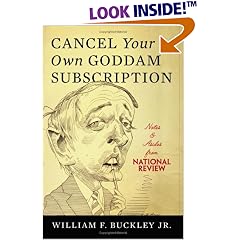
Charlie Rose, as he is wont to, did a retrospective on William F. Buckley Wednesday night, running together conversations from the many interviews he had done with him over the years. The show, and the passing of Buckley, made me reflect on my own dilemma: How do I think about people who are both brilliant and insightful while at the same time embracing ideals that seem to be an affront on common sense.

Listening to Buckley talk is an absolute delight, but thinking of him as the intellectual father of modern American Conservatism is frightening, made ever so much more so because he, apparently, was proud to be seen that way.

The more urgent dilemma, however, may be why there is a dilemma at all. When stupid people say stupid things it does not bother me. I shrug it off as a curiosity or, if I am feeling particularly empathetic, try to understand how they might have arrived at those views. But when smart people say stupid things it bothers me. Instead of trying to understand how they arrived at their views, I try to understand what mistake they made in arriving at their views.

That intolerance is more than a product of getting grumpy and set in my ways. Public discourse, especially political public discourse, more and more looks for a one dimensional rating system. When Hillary Clinton claimed that Barack Obama was to the right of George Bush because he did not support freezing interest rates on subprime ARMs, I was astonished. I just can’t fathom in what sense picking a position on the best way to deal with foreclosures is a left-right choice, I would have hoped there would have been some talk of effective versus ineffective.

In the face of this one dimensional worldview, I think it is more important than ever to listen to the people you disagree with, especially when they are talking about the things you disagree about. It is true that some disagreements are big enough that all the understanding in the world won’t change anything. But there are lots of disagreements that are not like that and by listening more thoughtfully, we might get closer to the truth. If in doing this we end up needing seven dimensions by which to identify ourselves so be it.

So thank you Mr. Buckley for everything you have said that I disagree with. Perhaps it is time for me to read more of your 55 books.