Friday, January 30, 2009

The Silk Road to Recovery

by Larry Mongoss, guest blogger

It was interesting to see Xujun’s post on consumer activity in China. Her observations suggest some interesting developments may be coming in the years ahead. Curious about this, I contacted a couple of my friends in Shanghai to get their take on consumer activity. Their personal observations were consistent with hers, but they were prudently reluctant to draw any conclusions from that, especially given the Spring Festival splurging going on. When it comes to officially reported numbers, all were viewed with skepticism.

With all those disclaimers, it is still seems that the Chinese consumer is far more confident than his or her American counterpart. Could this mean that China will help rescue the US?

China and America have had an odd relationship over the past 20 years. Things get produced in China and sent to America. Then, instead of sending back other things of equal value, America sends an IOU. Lots of people, including me, have worried endlessly about what will happen when those IOUs come due. But we have been missing the point.

Now that America doesn’t want so much of the stuff it was not paying for, the Chinese will have to turn elsewhere, most notably to themselves. It sounds like the government, by simple admonishment, can cause a jump in consumer spending. The effect of that may dwarf their 500 billion dollar stimulus package announced last year. A pretty cool technique if it works, especially if it is possible to turn consumer spending back down as well.

Telling Americans to spend more, on the other hand, is not at all likely to work. Many would need to borrow money to make that happen, and right now those that can borrow don’t want to and those that want to can’t – or so it seems. Most Chinese, in contrast, only spend money that they have saved, and many have built up modest accounts over the past decade. Thus, narrowly from the perspective of consumer sentiment and ability to spend, China is much better positioned to grow consumption, and there are signs they are doing just that.

Put simply, the Chinese are taking care of themselves. Domestic consumption appears to be compensating for the fall off in exports, not magnifying it as is happening in Japan. And that consumption, though with a different focus than the export production, is related. All of this is good for China, at least in the short run, but what about America?

Since the 1980s, China has seen amazing economic advancement, in large part from catching up to western manufacturing techniques. Some people have belittled this as just being the activity of copycats, but that was exactly smartest thing to do. It is much faster to copy what is being done than to reinvent it. Giving stuff away, and manufacturing to the needs of the developed world, has allowed China unprecedented growth in both activity, and sophistication.

That sophistication is good news for America, because it also carries over to consumers. Chinese consumers love things that are made in America, and growing consumerism in China is a golden opportunity. In the past, the Chinese government has discouraged consumption to keep the export driven economy from overheating. Now, it will need to discourage exports, to keep the consumer driven economy from overheating.

An exaggeration most likely, but we have a very real possibility to see more exports from America to China. We may, in fact, see the huge American trade deficit turn into a trade surplus. America will be producing things, and giving them to the Chinese along with the money to pay for them. Only this time through, it will be because the money is being paid back by America instead of lent by China.

Unlike the past situation, which was clearly not sustainable, the present situation is. If America can become proficient at producing more than it consumes, it will pay back its foreign debts. Once those debts are paid back, America can turn back to itself, and use that excess production to take care of its retired people. China becomes the training ground for dealing with the social security crises people keep talking about.

For China the path is somewhat more convoluted. They are facing an even stronger demographic adjustment than America. In addition to doing something for the rural population, the Chinese need to temper their domestic consumption with the knowledge that people will be retiring without replacement in the near future. Developing the equivalent of a social security system is critical to keeping China functioning smoothly. Luckily for them, there is no shortage of poor people to practice on.

Saturday, January 24, 2009

Hainan, China: Market Crunch

Surprise! Blogger.com is not blocked here in Hainan, though my blog is. This is illogical to me. I'm not sure what I have done to deserve such an honor. This also means that I can log in and post, but can't view my blog normally – quite ironic really.

Let me come to the main point quickly. I returned to China with the lingering question of how people fare in the financial crisis. (Apparently I'm not the only one who is concerned. An American writer friend wrote me to say she "would be fascinating to hear how China is weathering this amazing economic descent into wherever we're going. How is it affecting the people there? I'd love to hear." PekingDuck also had a post on this subject titled "China is the place to be," which attracted quite a few comments.

I've been throwing questions around since my arrival Friday (AA delayed my trip by one day, hardly a surprise). And this is the impression I got:

For urban people, the financial crisis is largely a Western issue. Life and business in Chinese cities are humming along as usual. If anything, the purchasing activity has only increased in the run up to the Spring Festival. A relative who works in the financial sector for a private company tells me that, since last fall, the government has changed its position from discouraging general consumption (in order to slow down the overheated economy) to encouraging domestic consumption (as the world braces for recession). Now, "to consume is to be patriotic," and people seem to be more than happy to follow this calling.

I was in Shanghai Thursday night and saw on CCTV that some cities were subsidizing grocery prices to help stimulate holiday shopping. My experience in Hainan, hardly a rich place, seems to question the necessity of such a policy.

Here are a few photos I took Saturday in a huge supermarket named Da Ruenfa owned by a Hong Kong company, where I went grocery shopping with my sisters and their husbands. I haven't been in such an overwhelmingly crowded store for decades.

Supermarket: an entrance ("New Year Goods Avenue")

The supermarket is one of the biggest I've ever seen, yet there wasn't even enough space for a single shopping cart to turn around. I was told it had been like this crowded for over a month. At the pork counter, people fought like looters ("as if the meat were free," my sister Maple complained). However the fact is that nearly all prices have increased because of the high demand. It was near the meat counter that a staff member came to stop me from taking photos. "We are a business, not a journalism unit. No photos," he insisted. Afterward my brothers-in-law said he probably thought we were from a competitor.

Supermarket: meat counter

After my sisters finally snatched their pork (to make dumplings for New Year eve), they went to the next counter to have it ground, a free service provided by the supermarket. However the staff working there simply ignored all such requests. Instead they were busy selling pre-packaged ground pork for 13 Yuan a pound, a 75% increase from the 8 yuan/pound of our pork. My sisters had a brief conference between themselves on whether to go for the expensive price and abandon their hard-earned unground pork, but they had little option.

There were about 40 check-out lines, each looked like it would take an hour or longer to reach the cashier. We diverted to look for the shortest line, another bit of hard work. Eventually Maple's husband found one at the farthest corner of the supermarket and called by cell phone for us to converge. "Line 15!" he ordered. It took a sweaty battle to push the packed shopping cart through layers and layers of human walls.

Supermarket: an exit

Presumably, it is premature to make a general conclusion from this thrilling shopping scene. For one thing, the biggest holiday season of the year may have colored things. At the dinner table with my family members, who came from different cold-weathered cities to gather in this warm island, Maple's home, for the Chinese New Year, I asked about housing markets and the situation of migrant workers. The consensus was that the export business (in which one of the men works) has been hit hardest (surprise!), especially the light manufacturers such as textile factories in Canton and other coastal cities. Those producers had been the biggest employers of migrant workers. The estimated contribution from the export business to China's GDP is about 20%. There had been about 200 million migrant workers across the country, and among those about 20-30% lost their jobs due to the financial crisis. That 40-60 million people was a big number to cause a stir, and the government worried intensely about the holiday season's "harmony and stability."

That was when I asked if they had heard Charter 08. The answer was uniformly "No," though they knew the name of one of the signatories Liu Xiaobo. My brief description of Charter 08 did not generate much interest. "Useless," one of the men said, in an immediate reaction. Then he thought about it a bit more and said tolerantly that such things were not that bad to have. "The democracy activists and foreign media complaints about our government help to improve policies sometimes. Just one of those natural noises that should be allowed to exist. But if they attack too much they will get attacked back by Chinese people." His assessment was that right now the government enjoys the highest trust ever in history, and others agreed with him.

Their guess on why the government has blocked the spread of information on Charter 08 was it 's timing, with the clouds of financial crisis hanging above the migrant workers and the Spring Festival approaching. At a time like this the government is most nervous about potential chaos and tends to overreact.

My relatives mentioned that local governments such as those in Sichuan, one of the provinces that supplies a large number of migrant workers from its countryside, were ordered to arrange local jobs for the newly unemployed who returned home from coastal cities. There is no concept of unemployment insurance for those people, but apparently actively putting them to work is part of the mandate. Many did get new jobs, I heard, though no one could say to what extent the problem had been resolved. I may find out more about this when I go back to Sichuan after the Spring Festival.

About the housing markets: I heard Canton was again hit the hardest, with an estimated 40% plunge in real estate prices. People say this was mainly the result of bankrupt factories selling no-longer-wanted properties cheaply. Chengdu's real-estate market, where my younger sister bought a yet-to-build house last year, went down 10-20% in the last several months, but it has stabilized since the government began to encourage domestic consumption. Chongqing's housing market has actually been going up, because its prices were low to start with. These two cities are among my planned next visits.

The Chinese stock market has crashed badly, but none of my family members were affected because they are not players. Lucky for them.

Wednesday, January 21, 2009

Terracotta Typewriter

One more thing before I go --

Matthew Lubin, a writer and editor living in China, is starting a new literary magazine, Terracotta Typewriter. The magazine welcomes submissions from Western expats in China and Chinese expats in other parts of the world, or anyone who has something to say about China. You can write about any subject, as long as there is a connection to China. I think this is a great idea. Please take a look and send your creative work to Terracotta Typewriter!

See you in February.

Friday, January 16, 2009

The Sky Is Not All Grey

Postcards from Tomorrow Square: Reports from China
by James Fallows

A review by Xujun Eberlein

1.
A proprietary approach I use to help assess English journalism books about China is to measure how much they tell me, a Chinese, what I don't already know. This, needless to say, lacks objectivity, and it can easily undervalue an otherwise excellent book. As an example, Out of Mao's Shadow by Philip Pan consists essentially of stories I had already read from the Chinese media or the internet. Not new to me, but that doesn’t mean the book is not worth reading for Western readers (in fact, it is).

On the other hand, this approach raises a high bar for journalists writing about China. To find stories not broadly known even to the Chinese requires not only extraordinarily acute ears, but also the admirably open mind of a deep thinker. Thus, I can narrow down my reading list to a few outstanding books. James Fallows' new book, Postcards from Tomorrow Square: Reports from China, is one of them. Many things he writes about are new to me, but that's the least of the delightful surprises. Continue reading on The China Beat >>

Monday, January 12, 2009

The Mosuo Walking Marriage on Lugu Lake (2)

by Maple Xu

(Maple's travel log continues from The Mosuo Walking Marriage on Lugu Lake (1)...)

On the long distance bus to Lugu Lake, two men sitting behind me had been chatting about "walking marriage." One man asked, "Mosuo men can 'walking-marry' freely, but they don't get to live with their children, wouldn't they be too lonely in old age? Who take care of them when they get old?" The other replied: "The abundant romance of youth, is worth the loneliness of old age. Everything has a price after all."

The two men did not know all the facts. Though Mosuo men live with their mother, and are not responsible for rearing their own children, they have the duty to help bring up the children of their sisters. In a Mosuo family, uncles are the decision makers on external affairs. They have an adage, "The biggest flying thing in the sky is eagle, the biggest walking thing on the earth is uncle." When they get old, their nieces and nephews attend upon them until their death.

Lugu Lake

A friend once told me, his Mosuo friends couldn't understand why the Han people have terms like "lonely old widows" and "five-guaranteed households" (五保户"). They don't understand why Han families are full of domestic fights, even violence and family wars. Those are things they just can't imagine. The Mosuo people living along the Lugu Lake are proud of the auspicious and peaceful ambience in their family life; in this respect they think they are superior to any other race.

*
One morning I was photographing a sunrise at the lakeside, and ran into a bunch of tourists waiting for a bus to return to Lijiang. A fifty-ish northern woman was talking volubly. She said, "Yesterday I asked the young man rowing the boat, 'You sing and laugh all day, do you ever have an unhappy moment?' But he asked me back, 'What is "unhappy"?' I wasn't convinced and again asked a girl who was washing her hands in the lake, 'Are there times that you feel unhappy?' She replied, 'Unhappy? Why unhappy?'"

At this point the northern woman got very excited and raised her voice, "Look! They don't even know what unhappy means! They are always happy!" Her companion replied that nobody can always be happy. The woman argued, "They don't suffer extramarital affairs or property disputes like in our Han families, why shouldn't they be always happy?"

Her friend teased, "Sounds like heaven, then why don't you stay here?" The woman said seriously, "I really wish I were a Mosuo woman!"

That was the moment I understood why my friend has lived here contentedly for ten years.

*
Last night at my friend's teahouse, we warmed ourselves by a fire and chatted. The landlord came by, and I tagged him. "I have many questions for you," I said. He sat down by me and said good-naturedly, "I'm happy to answer any question."

My friend's tea house on Lugu Lake

- First question: How come you and your wife live together?

- That's because we have three brothers but no sister, and our mother died early. A family must have a woman as the household head; I'm the oldest brother, so my wife has to live here and take the responsibility of managing the family. Actually, "walking marriage" isn't the only form of marriage. There is another form: man and woman live together with either one's family. The principle is that the relationship is based on love, to marry by will, to leave freely. If the relationship is terminated, then each side returns to his or her mother's family. Unlike me, my two brothers are in walking marriages, and my youngest brother is the village head.

- How did you decide on your wife?

- Our love is no different from you Han people. When I was young I dated three or four girls. Only after I had children with my wife did the relationship become stable.

- How do you end a relationship?

- When the woman stops opening her door, or the man no longer comes in the night, the old relationship is ended and both sides are free to start a new one. It's all natural.

- How does a woman's family view her man in a walking marriage?

- The man comes to the woman after dusk, and leaves before dawn. At first he would avoid running into her family members. In the morning if you see sheepish men passing by, chances are they are returning home after a night of the walking marriage. The lovers will stay shy, even pretending not know each other on the street, before they have children and their relationship goes public. If you observe closely you will see that, in the night, no matter who knocks on a door, no one inside will open it for you, unless you shout out that you are an outside visitor, then an elder or a child will come.

- Since a man does not have the legal obligation to raise his children, wouldn't that give men too much freedom and women too much work?

- Mosuo women are the happiest members in their family. The female house head has all the power, including control of property and money. Her siblings take care of the children together with her. Even in sexual relationships women take initiative. On the surface, men have all the freedom, but once he is rejected by his girlfriend, there's nothing left for him except a "spring dream." There is a Musuo adage, "Men's heaven, women's world."

- Could a man be walking-marrying to three women simultaneously?

- (Laugh) Where does his time or energy come from? When I was dating my wife, we had a 20-kilometer distance between us. It was only because we were young and energetic that we lasted. Although there is no rule on how many walking marriages one can have, you must terminate one relationship before starting another. Custom and tradition do not allow two relationships simultaneously; an unfaithful man is going to be despised. This is no different from you Han people.

- Would you enter another walking marriage?

- Certainly not. What age does what things. Most Mosuo people settle down after they have children. Furthermore, I'm very satisfied with my present life. My wife is good in every respect!

What he said made my thoughts fly to the Mosuo life style. All relationships are based on love. A big matriarchal family with tens of members is filled with joy and peace. Children are loved by multiple mothers. Elders calmly enjoy their final years with a loving family. In another thousand years, will we Han evolve to such an ideal state? But the vanguard Mosuo people already began the heavenly life 1500 years ago. #

(All photos by Maple Xu, ©Copyright 2008, Maple Xu)

Wednesday, January 7, 2009

China: Revolution or Reform? - A Summary of the "Charter 08" Dispute

New America Media, News Analysis, Xujun Eberlein, Published: Jan 07, 2009

(Note: the following text is my original draft, slightly longer than the NAM published version, with more complete links. Posted with NAM's permission. - Xujun)

During the final month of 2008, there was a heated debate among Chinese bloggers and commentators outside of China. The cause of it was "Charter 08," a democracy manifesto originally signed by over 300 Chinese citizens and published on the internet on December 10.

Times Online said Sunday that since then it "has been signed by more than 7,000 prominent citizens," but the number is difficult to verify. Two versions of the English translation for this manifesto can be found online, one at nybooks.com (by professor Perry Link), and one at Human Rights in China. While the former is widely linked and reprinted, the latter is a more accurate translation of the Chinese original. A detailed recounting of the birth of the Charter can be found on Fool’s Mountain.

By now the hubbub around "Charter 08" has largely died down, however the issues raised in the dispute continue to beckon for attention. There are unanswered questions as to why the Chinese government and the US media reacted the way they did, and whether the Charter has achieved its intended effect. As such it might be a good time to look back at the reactions the event has provoked, and make a few observations.

The official reaction from the Chinese government was both harsh and overdone. Liu Xiaobo, a primary drafter and signatory of "Charter 08," was arrested in Beijing two days before its publication. No explanation was given by the government. Twenty three days later, Liu was allowed to see his wife for New Year’s Day, but police still did not say why he was detained. Many other signatories were summoned and threatened, according to a post on Fool’s Mountain.

Any discussion of "Charter 08" likely has been banned in China; a Google search using the Chinese keywords turned up no mainland links on the subject.

A well-known dissident writer and journalist in Beijing, Dai Qing, also one of the signatories, said in an interview with Voice of Germany that "the [Chinese] government's reaction is too irrational, a total surprise to us."

On December 11, The US State Department's spokesman Sean McCormack said in a statement that "We are particularly concerned about the well being of Liu Xiaobo, a prominent dissident writer, who remains in the custody of authorities."

According to Time Magazine, Chinese Foreign Ministry spokesman Liu Jianchao told journalists on Dec. 16 that the U.S. position was another example of the unwelcome "interference of other nations in China's internal affairs."

Curiously, major US media outlets, CNN including, have been unusually quiet, despite the fact that the Charter is hailed as a major breakthrough by its supporters. Time Magazine and the Christian Science Monitor were pretty much alone in reporting on the Charter, with the latter commenting in a somewhat upbeat tone that "the Communist Party's hesitancy to crack down harshly on the scholars, lawyers, engineers, and others who issued the so-called 'Charter 08' document sends a subtle signal of hope."

More curious, and changing, reactions, came from Falun Gong, or FLG, a religious and political group that has been banned in mainland China. A search on FLG's Chinese language website Sunday came up with 100 links cheering "Charter 08," with titles such as "Reform Is Dead, Long Live Revolution!" However a click on any of those links gave only a blank page. Remnants of posts here and there indicate that FLG originally found "Charter 08" an exciting sign of the coming revolution and supported it whole-heartedly. Later, though, they made a 180 degree turn after the FLG leader deemed the manifesto not revolutionary enough, but rather a "ghost shadow" of the communist party.

Understandably however, revolution is favored by few Chinese, whether supporters or contenders of Charter 08. In contrast, many pointed out the legitimacy of Charter 08 in accordance with China's constitution.

Among the well-known signatories, Dai Qing calls the Charter a mild appeal. "If the government can't even accept such a mild appeal, I think the government is too frail," she says in the aforementioned interview. A scholar of Western philosophy, Xu Youyu says the Charter is totally constitutional, and his signing was a citizen's "rational and responsible decision." Bao Tong, a high-ranking official imprisoned after the June 4th movement in 1989 and still under house-arrest, angrily inquired of the government "What crime has Charter 08 committed?"

On nearly every website I visited that discusses Charter 08, in English or Chinese, there are not only voices advocating and opposing, but also supporters raising constructive criticism and contenders issuing moral support (plus the usual white noises and meaningless vituperates). The issues that are at the center of argument include – by no means an exhaustive list – whether the ideas are too "Western," or the proposed democracy model suits China; whether the proposal for a "Federal Republic of China" makes sense, or it has gone too far; whether the wording in the Foreword is needlessly inflammatory; whether Taiwan's democracy is a good model for the mainland; whether the aim of the Charter is to agitate the government or have a practical impact.

There are also a few one-of-a-kind remarks worth noting:

-- A blogger on dwnews.com is unhappy that the signatories include a well-known advocate for Tibet independence. He says he is against the Charter because it supports the Dalai Lama's "republic of greater Tibet". (On a related note, On December 12, the Daila Lama issued a statement saying “I am greatly encouraged by the launching of Charter 08.")

- Taiwan News published an editorial on Dec. 25 to praise Charter 08 but also criticize it as "unable to transcend 'great Chinese nationalism' as its implied commitment to eventual unification seems to share the CCP`s rejection of the free right of choice of Taiwan`s 23 million people, not to mention the people of Tibet or even Hong Kong and Macau."

- A religious blogger claims that she does not support the Charter because it doesn't address how to reform the Chinese people's faith.

As a Chinese adage goes, "What bewilders the players, spectators see clearly." A European expat blog in China, Chinayouren blog, which was the first to note the inconsistency between the Chinese original of Charter 08 and Prof. Link's translation of it, published a post on December 26 titled "Charter 08 and political change in China." It assesses positively the Charter's significance and provides several constructive criticisms. The author points that, "A document of this kind should try to seek the maximum consensus in mainland China. This is, in my understanding, the main weakness of the Charter 08."

The post ends with:"… Most importantly, from a theoretical point of view, figures like Mao or KMT should have no place in a Charter that wants to unite the Chinese. The recent History of China is an amazing tale of cruel failures and unequaled successes. Events that need to be openly discussed at some point, certainly, and compensation given to the victims. But direct accusations are altogether at a different level and unworthy of sharing the same document with the generous ideals stated in the Charter. These things do not only weaken the Charter 08 from a practical point of view, but also reduce its soundness as a Universal Statement."

If nothing else, "Charter 08" has stimulated a great discussion on China's future direction. #

Monday, January 5, 2009

Chinese Humor Posters

A friend sent me the following photos. If you can read Chinese, you're guaranteed to get a few chuckles out of them. The English translation on some of the posters is incorrect, so I provided my own. I'm afraid though, the humor may have been lost in translation.

"Everyone pretends to be proper; I'll have to pretend to be improper"


"Dare to love, dare to elope"


"Carrying talent is like being pregnant, only time can tell"


"Oh love is like a ghost - more people believe in it than encounter it."


Thursday, January 1, 2009

Today!: China's Premiere Underground Magazine Turns 30

(image from http://book.ifeng.com)

The January 2009 issue of Hong Kong's Mingpao Monthly published an article titled "For Today's Yesterday and Tomorrow" by poet Liao Weitang. It reports on the celebration activities for the 30th anniversary of Today magazine in Hong Kong during December 11-13. The celebration was initiated by Bei Dao (北岛), and many Chinese poets participated, including my old friends Zhai Yongming (翟永明), Ouyang Jianghe (欧阳江河), Meng Lang (孟浪), and a new friend Xi Chuan (西川, whom I met in Beijing in summer 2007).

American readers probably know nothing about Today, the once extremely influential "underground" literary magazine in China. Nobel nominee Bei Dao was one of the founding editors of the magazine, and his poetry first became known to us through Today. When I was a university student in China, in the early 1980s Bei Dao's sorrowful lines such as "Privilege is the passport of the privileged / low is the epitaph of the lowly" were recited on every campus I visited. Whoever got hold an issue of the mimeographed Today magazine, it was quickly grabbed by another student. The magazine passed from hand to hand until it literally melted to pieces. Oh, what an unforgettable time it was! I can't think of it without being sentimental. We gathered in undersized dormitory rooms in this and that university, in small groups, arguing about China's future and read aloud poems from Today. As the first batch of students admitted to universities after the Cultural Revolution (the so called "year 77," though our first class began in spring 1978), we felt responsible for changing China. Each issue of Today induced more passion in us, even after the magazine was banned (around the time the "Democracy Wall" in Beijing was demolished in late 1980, I think).

I know of no other literary magazines, official or otherwise, that had the influence on young people Today did in the early 1980s. (Around that time there were many others, underground magazines thrived like bamboo shoots after a spring rain.) Later Today resumed its publication overseas, however it has lost its clout. On the other hand, it is the only unofficial magazine from the post-CR time that still exists today.

Bei Dao says in commemorating Today magazine's 30th anniversary that (in translation):

I want to emphasize that, a nation needs a spiritual sky, especially at a time of materialism. Without imagination and passion, no matter how wealthy a nation is, it is still poor; no matter how powerful a nation is, it is still weak. In this sense, Today returns to its starting point: it revolts not only against autocracy, but also against abuse of language, mediocrity in aesthetics, and wretchedness in life.

Sadly, the impact of poetry seems to be getting weaker and weaker as society grows its material wealth. Perhaps poetry's revitalization requires mankind's purposeful effort to restrain both material wealth and the development of luxury technologies.

Tuesday, December 30, 2008

Who, or What, Is Doing the Fake Links?

Last night when I logged in The China Beat to read their interview with James Fallows (a great interview by the way), I was quite surprised to see several of my blog posts appeared linked to that one. The problem is, I wasn't the one who created the links, and even if I wanted to, I would have to time travel, as those posts of mine occurred earlier than the one they were linked to. In short, those links apparently were done by some automatic program on the internet – quite annoyingly.

The China Beat is a great blog and I have no problem promoting it. However those links made it look like I was promoting my own blog. I've always detested excessive self-promotion, and I'm very bothered by those automatic links.

Similar things also happened on my blog. Recently I often see the so-called "links to" appearing under a post of mine, but a check on those links showes they are not actually linked to my post. That is, they are fake. In most cases I tolerate the fake links, but I have also deleted a few that are obviously irrelevant to my blog content.

So the question is, who, or what, is creating the fake links? One suspect is Sphere, which I first noticed a while ago on CNN. Often one can see under a CNN report the "From the blogs" feature, marked "powered by Sphere."

Sphere offers a so-called "contextual widget" free to bloggers; at first I was intrigued and even considered installing it. However after I saw the irrelevant fake links appearing on my blog and fake links using my blog's name appearing excessively on other sites, I became sick of it.

So, my message to Sphere or any similar program: it is obnoxious and violation of my right of authorship when you insert fake links that are not actually linked from my blog posts. Please stop doing this!

Monday, December 29, 2008

China's Gas Tax: Progress in Spite of the Press

I'm excited to see that ten professors from Tsinghua and Beijing University wrote to Premier Wen Jiabao proposing a further increase in the gas tax. This is on top of the recent announcement that, starting in 2009, China's gas tax will be raised from 0.2 yuan (3 cents) to one yuan (15 cents) per liter, a 5-fold increase already.

The new proposal from the professors argues that (in translation):

One yuan fuel tax can't at all send the resource shortage signal to society. This figure not only is lower than the EU countries (about 6 yuan per liter) but also our surrounding countries and areas. It is only close to the United States. We can't imitate the American life style. We don't have sufficient resources. As such we can't follow the US fuel tax example either.

We think the fuel tax of 3-4 yuan per liter conforms to China's situation. Right now is the best time to introduce this tax quota. Currently the international oil price has fallen hard. If we keep our retail gas price intact, while adjusting the price of processed oil close to international standards, we will be able to provide room for the 3-4 yuan per liter tax. A one-Yuan tax wastes such a room; only 3-4 Yuan can fully take advantage of this rare opportunity. The opportune time, once passed, will not return.

This is a bold proposal, which would increase China's gas tax 15-20 fold instead of 5 fold. However, it sounds to me like the right move. We have seen in the US that, with gas at $4 a gallon, people really started to change their behavior. There were fewer miles driven, and a noticeable movement away from gas guzzlers. SUVs became hard to sell. A substantial tax increase in China would certainly change people's behavior there as well. The current tendency to drive more and bigger cars more miles will certainly lead to an American-style consumption disaster.

Strangely, since Xinhua's report on China's gas tax increase on December 20, I've not seen any major US paper mention it. This is certainly not because the gas tax issue is not a major concern. NY Times, for example, had an excellent editorial a few days ago, on December 26, which argues eloquently the need to increase "The Gas Tax." However the editorial completely shies away from the fact that the Chinese are one step ahead of Americans in this. It is an uncomfortable truth after all.

Another possible reason that major US media outlets avoided reporting China's gas tax increase might be due to their politically oriented attitude in journalism.

A great op-ed columnist of the NY Times and a two-times Pulitzer winner, Thomas Friedman, has also been strongly advocating a gas tax hike. However, I was quite surprised, and all the more disappointed given my admiration of his writing, when I read one of his op-eds in August titled "Postcard from South China." That op-ed begins with a great point that Macau's gambling business largely cancels the power of Zhuhai's wind turbines, a poignant observation on human conduct. (IMO, both Las Vegas and Macau are contributing to mankind's self-destruction.) However Friedman ends his piece vacuously with a mocking postcard and, because of ideological differences, dismisses all attempts in China to develop a cleaner economy. A demonstration that even a great journalist can sometimes be fooled by his own strong attitude.

"The problem for the ruling Communist Party is this: China can’t have a greener society without empowering citizens to become watchdogs and allowing them to sue local businesses and governments that pollute," Friedman writes. While this sounds profound and indisputable, what is his point, really? Does it mean that the Chinese should stop their efforts to develop a greener society and instead engage in a revolution to overturn the government first? Does it mean that the right political solution is the absolute premise of any economic solution? If so, since America has the absolutely best political system in the world, shouldn't its economic and environmental problems be solved already? Unfortunately, that is not the case.

I can see why Friedman hates China's political system. I don't particularly like it either. However, the attitude that always ties non-political issues with politics does not help. America is the world’s largest energy consumer, China is second. China is the world’s largest greenhouse gas producer, America is second. Any effort in either country toward a greener economy should be encouraged rather than ridiculed. The two countries should learn from each other, and be willing to follow suit when a good idea emerges in either one.

I should mention that, a non-political American publication, Morningstar, did report on China's increased gas tax. "We believe the reform is a major step toward reducing the distortions in fuel pricing and making sure consumption taxes are proportional to actual usage," stock strategist Dan Su comments. Nice to see someone is paying attention, though his name does sound Chinese.

Sunday, December 28, 2008

The Most Accomplished American President

By Weigeng Shi, guest blogger


It is Bush 43. His biggest accomplishments include (this is by no means a complete list):

  • Liberating American privacy;
  • Making possible the election of the first black president in US history (even if that hadn't happened it would have been the first woman president);
  • Bringing Florida, where the 2000 election was decided, five of its biggest hurricanes;
  • Reinvigorating the word "depression," which had fallen out of use since WWII;
  • Starting a war from scratch (he is the first modern American president to do so);
  • Getting bipartisan support to nationalize banks (he is also single-handedly doing the same for the auto industry);
  • Growing executive power enough to prevent serious legislative checks;
  • Eradicating crime in New Orleans, even though temporarily;
  • Successfully dismantling the Republican Party;
  • Bestowing the control of both the House and the Senate to the Democrats.

Wednesday, December 24, 2008

"Thirteen Books that Changed America"


Monday morning, my friend Jessica alerted me that Jay Parini was going to be on WBUR's "On Point with Tom Ashbrook." She told me this because she knew how much I admire Jay and his writing.

I first met Jay when I attended Bread Loaf Writers Conference under a fiction scholarship in the summer of 2005. Jay was the instructor for my group of twelve writers. We each brought a short story manuscript to workshop. The morning before we workshopped my story, Jay told me he dreamed about Sail, the 10-year-old protagonist in my story. "Sail is such an unforgettable character," Jay said to me. These were the warmest words I had ever heard about my writing, especially surprising as they came from such a prominent author, at a low point of my writing career. I had submitted that story to many magazines, only to receive form rejections. Toward the end of the conference, Jay surprised me even more by recommending the story for the Best New American Voices anthology. Though in the end it did not get in, Jay had saved my writing career. That story, now titled "Feathers," is included in Apologies Forthcoming.

After the conference, I occasionally emailed Jay. I did so a bit gingerly, worrying about disturbing him. But he always replied. He has no airs. This is a rare quality in a great writer, in a time when it's common for established authors to be dismissive of newcomers. Jay stands out not only for his masterful writing, deep insights and great humor, but also his generosity and big heart. He has won forever my respect and fondness.

Listening to Jay's talk on WBUR Monday, I was very pleased to find that his new book, Promised Land: Thirteen Books That Changed America, is just what I need. I've always wanted to learn about American history more systematically and thoroughly; what a fun way to do it via discussion of influential books! Jay's book comes just in time for me to get myself a very nice Christmas gift.

Here are the thirteen books Jay is talking about (h/t www.onpointradio.org):

- Of Plymouth Plantation (1620-47), by William Bradford
- The Federalist Papers (1787-88)
- The Autobiography of Benjamin Franklin (1793)
- The Journals of Lewis and Clark (1803-06)
- Walden (1854), by Henry David Thoreau
- Uncle Tom’s Cabin (1852), by Harriet Beecher Stowe
- Adventures of Huckleberry Finn (1885), by Mark Twain
- The Souls of Black Folk (1903), by W.E.B. DuBois
- The Promised Land (1912), by Mary Antin
- How to Win Friends and Influence People (1936), by Dale Carnegie
- The Common Sense Book of Baby and Child Care (1946), by Benjamin Spock
- On the Road (1957), by Jack Kerouac
- The Feminine Mystique (1963), by Betty Friedan

Interestingly, and I'm quite proud to say, during my childhood and youth I've read at least three of the thirteen in Chinese translation (in comparison, my American husband had only read two: "Walden and Huck Finn," he said), which are:

- The Autobiography of Benjamin Franklin
- Uncle Tom’s Cabin
- Huckleberry Finn

As I recall, those were popular books in China at the time. Ironically though, Uncle Tom’s Cabin had served as evidence to support China's anti-America propaganda in the 1960s and 70s. And all of us school kids had bought into the notion that the capitalist America had nothing good but was full of racial discrimination and labor exploitation. This is not much different from the way average Americans view China today: that the communist country has nothing good but is full of human rights suppression and government corruption. I'm sure Americans got that simplified notion from reading some well-written books, just like we Chinese did. Once again, reading diversely is crucial for real understanding.

On the radio, in answering an audience question, Jay said another book, Whitman's Grass, would have been the 14th in his list but was reluctantly left out because not many people read it upon its original publication. Interestingly though, the Chinese translation of Grass was a most popular poetry book among Chinese writers and poets when I lived in China.

Now I wonder, if I come up with a list of 13 most influential contemporary Chinese books, how many would have been introduced to America? I wouldn't even ask how many have been read by Americans.

Another thought: it would be an interesting research to find out which American books have been most influential in China. I can think of a few already. I would love to conduct this research if someone is willing to sponsor it.

"Reading is thinking, and writing is thinking," Jay said on the radio. That is exactly what I feel. Thank you, Jay, for saying this!

The holiday is upon us and let me stop here for now. Merry Christmas, everyone!

Wednesday, December 17, 2008

On "Translationese"

Lucas Klein correctly asserts in his Rain Taxi review of Apologies Forthcoming that the value of my writing "is to convey to an American audience the emotional complexities of individuals amidst the historical change of recent Chinese history." I find consolation that a discerning reader and reviewer has recognized my intention in realistically portraying individuality of Chinese people even in a time of collectivism.

In terms of writing style, on the other hand, Klein raises an interesting – and recurrent – issue. He writes:

Written in English, the stories often narrate with an awareness of the distance between the circumstances told and the circumstances of their being read. While the narrative voice tends toward a native fluency, quotations of speech or writing often come across in a kind of translationese. At its most productive, the styles of English and Chinese are blended, as when a character in "Second Encounter" is described as having "to spend too many lips and tongues in explanation." Too often, however, the stylistic switch locks the Chinese language into an essentialized otherness, and Chinese speakers come across as linguistically clumsy.

Not coincidentally, the same issue of "translationese," or "Chineseness" in English writing, has concerned other readers and reviewers as well, for example in Cliff Garstang's review, see discussion in an earlier post titled "On Chineseness". In that post the same example is mentioned ("to spend too many lips and tongues in explanation") – what a coincidence! – though with an opposite view.

I appreciate very much Klein's recognition that such stylistic switch is by design. He has noticed, again correctly, my purposeful use of the "translationese" style in dialogue, as opposed to the more standard English expressions in the narrative voice. And he isn't the only one. Matthew of Waiguoren Critic of South China, for example, writes in his review:

One quirk of Xujun's writing is the dialogue. It's not typical dialogue by American standards, but it is a close translation of Chinese speech, which helps to portray more of the culture to readers.

Obviously, my dialogue-writing approach has met with different reactions. My rationale is exactly what Matthew points out, that the "Chineseness" in dialogue can help portraying realistic characters in the context of their culture. As Chinese, in our real-life daily dialogues, folk adages (俗语), two-part allegorical sayings (歇后语)and even 4-character idioms (成语) are a common occurrence. To me, nothing reflects the thousands of years of Chinese culture more than the language. So why not use it with as many of the native idiosyncrasies in place as possible when writing in English? There is also, of course, the intentional effect of "otherness" – in Klein's word – to be considered.

Interestingly, there is often an English saying corresponding to a Chinese adage with nearly identical meaning and connotation. For example, in English "shoot yourself in the foot" and in Chinese "drop a rock on your own foot" (搬起石头砸自己的脚) . Apparently, when the English invented guns Chinese were still using rocks as weapon :-). If I invoke such a saying in a Chinese story dialogue, which form should I use? Naturally and without hesitation, my choice would be the latter. The reason, again, is the cultural context.

Do I sound convincing? Still, things are not that simple. I have heard several readers and reviewers expressing their feeling of occasional "awkwardness" while reading my book, for example see the latest Amazon review by Linda Austin. And they do have a valid point.

The problem as I see it is not the "translationese" but how to blend English and Chinese expressions in a seamless way, and that is the hard part, as the two languages are, well, not designed for blending. But this is not to say improvement is impossible. One way to do it might be to break long lines into short parts, to make the "translationese" appear more like accent and with less frequency.

Right now I'm proof-reading Apologies Forthcoming for its Asian edition (again in English), which is scheduled for publication by Blacksmith Books around the coming holiday season. I see this as an opportunity for improvement. If anyone who has read my book found a particularly awkward expression, I'd appreciate it very much if you could tell me.

Okay, I've just found one myself, in "Disciple of the Masses":

Then he told her, “They’ll be here. Don’t worry. Who’d have eaten a leopard’s gallbladder to disobey Chairman Mao’s instructions, huh?” He laughed.

Perhaps I should change " Who’d have eaten a leopard’s gallbladder to disobey Chairman Mao’s instructions, huh?" to " Who’d dare to disobey Chairman Mao’s instructions, huh? Unless he has eaten a leopard’s gallbladder." What do you think?

Tuesday, December 16, 2008

Rain Taxi Review of "Apologies Forthcoming"

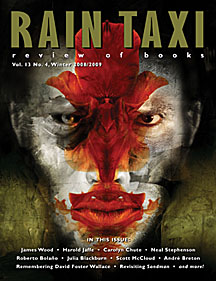
In the mail today came a surprising holiday gift – the Winter 2008/2009 issue of Rain Taxi, sent by my publisher. When I took the magazine out of the envelop, it was opened to page 7, where a nice review of my book Apologies Forthcoming appears.

I don't know Lucas Klein – the reviewer – and I didn't find his introduction in the magazine. So I googled, which led me to an unusual literary e-zine called Cipher Journal. Given that the review opens with an adage of Confucius, I suspect the editor is the same Lucas Klein, who apparently knows Chinese. So, if you happen to subscribe to Rain Taxi, enjoy Klein's review, which is in print only. Otherwise,enjoy his Cipher Journal online.

By the way, an interview with my favorite literary critic, James Wood, also appears in this issue of Rain Taxi. In addition, the magazine is running a benefit auction right now, and you can find some very nice, even rare, books in their list.

Monday, December 15, 2008

The Mosuo Walking Marriage on Lugu Lake (1)

by Maple, guest blogger

(Note: Some of you already know that Maple is an avid traveler and photographer. This is one of her latest travelogues, posted in two parts. See also her Dream Left on Covered Bridges 廊桥遗梦, and Yuyuan Taiji Celestial Village. - Xujun)

[in translation]

Ten years ago, what first brought me to Lugu Lake was a travel magazine photo. In that photo Lugu Lake was like a sparkling gem, inlayed on the northwest Yunnan highlands, the water's radiating reflections and the mountains' rich colors comprising an unsurpassed beauty.

I did not know much then about the rare continuation of the Mosuo people's matriarchal tradition. At the time Lugu Lake was a newly developed tourist attraction. The entire village had only one or two guest houses, two-floor wooden lodges made by the locals. Upstairs were bedrooms. On the ground level was the spacious central room, in the middle of which a huge fire pit burning wood day and night. On the fire buttered tea was boiling; in the fire fresh potatoes and corn were roasting.

Lugu Lake

In the house I stayed at there was an old grandmother, who sat in a big wooden bed cushioned with a thick sheep wool blanket, and smiled at me kindly. She did not speak Mandarin, and I didn't know the Mosuo language, so the only thing I could do was to smile back at her. We smiled at each other for probably a couple of minutes or longer, but neither of us felt awkward. Then she went to the fire pit and dug out two cobs of roasted corn, deliciously aromatic. She patted the residual ashes off the cobs with her furrowed hands before giving them to me. I obediently sat by her and ate. She looked at me; the warmth of a tender affection in her eyes made me remember my late grandma.

During the next few days I noticed that men and women in the house all revered the grandmother. When eating they held the best food to her first. When sleeping they kept the warmest place for her. For everything they asked her opinion first.

I asked her son, This place is called a "girls kingdom," does it mean women have the highest status? And he told me about the Mosou tradition of "A'xia," or "walking marriage." The man and woman in such a relationship each lives with his and her own mother. The man comes to the woman at night and leaves at dawn. All their children are raised by the woman. The two sides have no ties in terms of production, living, or properties. Their relationship emphases love, and they marry freely and part at will.

I was not impressed. Such a marriage is not protected by law. Wouldn't things fall into chaos? A woman can have many men and a man can have many women. Children don't even know who their real father is.

Mosuo woman

But the son said to me in all seriousness: Don't you Han people also have unfaithful men? The situation does exist among Mosou, some men to have "walking marriages" with several women. However usually a man has a relationship with only one woman at a time. When a couple fall out of love, the man simply stops "walking" to the woman, there is no property dispute or custody fight. It's not like you Han people who turn into enemies because of a divorce.

In every Mosuo family, the household head is the oldest woman. The grandmother in the house I stayed had two sons and three daughters. The oldest daughter had been in a "walking marriage" for three years already and they had a boy. Her other two sisters were still young. Both brothers were in their twenties and every night they went out for their "walking marriage." The older brother had a daughter, raised by the baby's mother.

Mosuo cats

I was both confused and curious. That night I begged the oldest daughter to take me to their "guozhuang" dance party. Mosuo women are natural sopranos. The woman's singing of "Qinhai and Tibet Highlands" stunned all the Han tourists.

At that time the Lugu Lake area did not have street lights. The oldest daughter and I walked home in the dark, behind us were a bunch of men holding touches, chatting and laughing. I asked, Is your boyfriend among them? Is he coming to you tonight? I want to see how handsome he is. She laughed bashfully, pointing a finger at me but couldn't talk. Not until we reached the door when she whispered to me that it was still early, time for men to drink and chat. He would come late in the night, after everybody at home had gone to bed.

I became more curious. You two already have a son, how come you are still so shy about it? Her face turning red and she laughed again. She pulled my long hair and complained, Why are you asking about everything? I'm not talking any more. Her expression made me yearn for the Mosuo love.

I imagined myself as a strong Mosuo man, on a night with a bright moon and thin stars, rowing a boat carved of a whole tree trunk, from the island in the lake, knocking my lover's door. Not for money, not for status, not even for progeny, just for love, pure love.

Mosuo man

That night by the fire pit, I asked my host's youngest daughter, Your sister's son is only a few months old, and she needs to work in the day, tending her walking marriage in the night, who takes care of the baby? The girl looked surprised by the question. We all take care of him, she said, whoever has the time. He's OUR son.

Children call all women at home "Ama." The grandmother, aunts and uncles are all their guardians.

~
Now, ten years later, I arrive at Lugu Lake again. It has become a hot tourist attraction. The lakeside is full of bars, shops, and hotels. Tourists do not come in groups of two or three carrying backpacks; they pour out of buses and cars. Using the words of a friend, who has been running a teahouse here for a decade, "It is horrible!"

Fortunately there are still misty waves on the lake of the horse hoof shape. Fat clouds in the blue sky are still exaggeratedly gorgeous. Water reflecting mountain, mountain shimmering with dew, Lugu Lake is still like a fairyland. Perhaps even more fortunate, the transportation is still backward. From the nearest travel center Lijiang is 200 kilometer and takes nearly10 hours winding up the mountains. I don't want to imagine, if there were a highway, or an airport, what would happen to Lugu Lake.

Mosuo dog

What would happen? My teahouse owner friend replies, Of course my business would be even better. Apples and walnuts from the mountains would be easier to sell to outside.

Don't you know that the ancient town Dayan in Lijiang has been destroyed by the endless development of tourist business? Do you want Lugu Lake to become the next Dayan? I say to my friend.

You don't understand, my friend pats my shoulder tolerantly; Mosuo people have the instinct of self-preservation. What you worry about won't happen here. (To be continued)

(All photos by Maple Xu, ©Copyright 2008, Maple Xu)

Friday, December 12, 2008

Harvard Student Observing Beijing's Gay Club

(Introduction: Samantha Deng, who speaks fluent Chinese, is a Harvard student studying abroad at a renowned university in Beijing for a year. The following is an excerpt from her report for a Medical Sociology observation project, posted with permission. – Xujun)

Destination is a Double-Edged Sword

by Samantha Deng


Building designed to escape rather than attract attention

Destination ("目的地") is the most well known gay bar and nightclub in Beijing. Located on Gongti West Road, it is directly across the street from a strip of popular nightclubs, bars, and restaurants frequented by expatriates and locals alike. I visited the club on a Friday night in November with two other girls and arrived around 10:30 at night.

Unlike its flashy neighbors with their ground-to-roof neon lights and large flat-screen televisions, the exterior of Destination is very modest and discreet, seemingly designed to escape (rather than attract) attention. The building that houses the club is about six stories high and looks modestly residential.

At the time of our arrival, all the windows were dark, and the blinds were drawn. A dark brown stone wall about two meters tall surrounds the building and blocks the first floor windows from view. On the building is a small lighted sign with the club’s name in English and Chinese. There are two doors facing the main streets but are sealed off with a red string on which hang small gray signs that point the visitor left with the words “酒吧入口” in Chinese and “Enter” in English.

A male staff member dressed all in black stood near the blocked doors and helpfully directed confused visitors to a gate on the side. Through this rusty iron gate, one stepped into a small courtyard, and on the other side – effectively in the back of the building – one finally sees the entrance to the club, guarded on either side by traditional Chinese stone lions.

Seven people staffed the well-lit room one first enters. Two were men dressed all in black who visually scanned every visitor walking in. The entrance fee was 60 RMB, and the ticket stub is redeemable for a drink up to that price inside. Based on my experiences, this price is comparable to middle-ranged clubs in the city, but it may nevertheless be expensive for the average Beijing resident and prevent frequent visits.

The club does not have separate restrooms for women and men; instead, each floor has one restroom that has both urinals and stalls. This arrangement is most likely a reflection of both the dearth of women visiting the club and the lack of sexual threat between people of different sexes here.

Women far fewer and noticeably less vivacious than the men

At its fullest, Destination held close to two hundred people, the overwhelming majority of which was male. The handful of women that were present was scattered in male-dominated groups and were noticeably less vivacious than the men.

The majority of men at Destination are the Hip Youths type, look to be in their late teens or early twenties, and exude an air of familiarity, even ownership, in the club.

One young man who typifies this came in a small group of about four. He wore a fitted white t-shirt with a colorful design in front and tight black jeans. Upon arriving in an upstairs room, he saw that a large vacant sofa, plopped himself down, and loudly beckoned his friends to join him. A moment later, he recognized another group of young men standing near the bar and rushed over, loudly exchanging greetings and hugs.

Another core type is the Older Men, though far fewer than the Hip Youths, they nevertheless occupy central positions within the club. In their early- to mid-thirties, the Older Men dress more conservatively than the Hip Youths in looser fitting clothes and are generally less active. They seem to frequent the bar and know other people there. One group that consisted of perhaps four foreigners and a slightly larger number of Chinese sat at a bar for a long time chatting animatedly with each other. More than once, one member would stop someone walking past that he recognized and the newcomer would stop to talk with the group. Both the behaviors of the Hip Youths and the Older Men described above suggest the existence of a “community” at Destination.

There are also Peripheral Observers and Outsiders. For example, during the course of the night I saw two old men who were at least sixty years old. They were in the club separately talking with a few young men, and neither stayed very long. The Outsiders, numbering very few, are people in the club who are not gay. One white heterosexual couple, for example, danced affectionately on the dance floor for about ten minutes before exiting. Another example was a twenty-year-old Korean man who did not realize that Destination is a gay club before entering. He expressed shock and slight disgust upon discovering the sexual orientation of the men around him.

"Five minutes into our acquaintances, he bluntly asked me to marry him"

We spoke with three men, who were of the Older Men type, for over an hour. They have been to Destination many times and befriended each other at the club. They did not know that we were at the club for an observation study, and they may have assumed that we were homosexuals as well.

Walter[1]

Walter is a 30-year-old pop-music composer originally from
Shanxi. Except for a small black round stub on his left earlobe, he bears none of the stereotypical “gay” traits. He is about 1.8 meters tall, broad shouldered and fit, and his hair is cut in a neat buzz cut. He wore a long-sleeved black shirt with jeans. He readily told us about his experiences as a gay man in China and expressed his views on politics, culture, and homosexual life. Despite his openness, however, even after a full hour of conversation that touched upon many sensitive topics, Walter disclosed only his last name and nickname and withheld his full name, suggesting an impulse to preserve anonymity.

From the very beginning, Walter emphasized how lonely it feels to be a homosexual in China, repeating the phrase “孤独” two separate times. Consequently, he loves going to gay-concentrated places like Destination and saunas around Beijing to be with other gays. Even though these places present high-risk situations, he feels relaxed there. Despite the existence of these locations, however, he expressed disappoint in the gay scene in Beijing. Like many gays who are not native to Beijing, he had high expectations for this international city but found too many restrictions when he arrived.

For Walter, strained relationship in the family is a large factor causing the sense of loneliness. Although he criticized the religious-moral casting of homosexuality as a sin in the West, he nevertheless applauded Westerners’ recognition of homosexuality as being a distinct separate category from heterosexuality. He, however, gets no such recognition from his family. His parents had described his behavior as “disgusting” (“
恶心”); his sister, who is less socially conservative, had expressed regret that he cannot marry and have children (and thus continue the bloodline). Walter’s description of his family members’ opinions implied that they only see and condemn the deviant behavior without recognizing the innate difference between homosexuals and heterosexuals. In doing so, his family members are effectively denying him twice: with respect to both his homosexuality and his moral judgment.

Walter’s own views on homosexuality are a combination of the theories that sexuality is genetically predisposed and that it is environmentally cultivated. He argued that since ancient times, people have always displayed an aesthetic appreciation and attraction for the body, whether male or female. His sexual attraction for the male body, he implied, is only an extension of that primitive impulse. On the other hand, he off-handedly remarked that had Hu Jingtao grew up in a more socially liberal society in the West, the Chinese president would be gay (Walter pointed to Hu’s effeminate gestures and high-pitched voice as evidence). Walter phrased this assertion in such as way to suggest that Hu is not currently in the closet, but rather, he did not have the space to develop his homosexuality in China.

Walter’s overall attitude toward Chinese politics and society was critical. He especially cited the education system for the stifling constraints it imposed on children and criticized the Chinese government for masking many cruelties it performed to present the Olympic Games. He described himself as a deviant who has always been last ranked in his class in school. However, Walter remained optimistic about the future. He argued that Chinese culture is very “vibrant” (“活跃”), as evident by the dominance of the color red, and can readily embrace differences.

Charles

Charles is a man from Chongqing also in his early thirties who works in media. Short, stout, and bald, he wore a white t-shirt and jeans. After approximately five minutes of our acquaintances, he bluntly asked me to marry him. He explained that his seventy-year-old mother’s only wish in life is for him to get married, and he would like to do so to make her happy. He promised that he will financially provide for his bride his whole life and will willingly grant a divorce should she fall in love with another man. As with Walter, his family’s inability to understand that homosexuality extends beyond just behaviors that defy filial piety (namely, not marrying and having children) was causing Charles much stress.

Victor

Victor is a golf club executive from Taiwan who wore a buttoned-down long-sleeve shirt with rainbow-colored stripes. He did not speak with us much, preferring instead to converse with Charles or poke fun at the loquaciousness of Walter. He willingly bought drinks for his friends. Victor said that he comes to Destination about once a month.

A Double-Edged Sword

This visit to Destination offered a peek into the homosexual community in Beijing. On one hand, places like Destination offer gays who feel alienated in their everyday life a space to show their sexuality openly and to be with others like them. On the other hand, these gay-concentrated places also pose major health risk for their visitors. As Walter pointed out, the jubilation of finding other gay men may prompt some to engage in unsafe sexual behavior that result in the spread of sexually-transmitted diseases, including HIV/AIDS. In addition, the sense of total relaxation may cause these men to engage in other unhealthy behavior: the three men we spoke with smoked cigarettes and drank alcohol without stop for the entirety of our conversation, which lasted over an hour. The other men near us were also chain-smoking, and the bar tenders even gave out free cigarettes.

That places like Destination represent both a psychology alleviation of pain and a space for perpetuating public health dangers suggests that the reduction of these health risks require more than just direct education about the illness. The observations from Destination indicate that a more effective and permanent solution to curb the spread of sexually transmitted diseases among gay men, especially HIV/AIDS, would address the social stigma that homosexuality carries in Chinese society. When gay men can be themselves and display romantic behavior in public just like heterosexuals, the lure of unsafe sex in bars and sauna will no doubt diminish. Social acceptance of homosexuality is thus an important step in preventing psychological and physical harm for this large social group.

[1]The names of these three men are altered to conceal their identity.