Tuesday, April 29, 2008

My Friend Alicia Gifford's Erotic Courtyard and Story

I figured if Susie Bright could publish Alicia's story "Surviving Darwin" in Best American Erotica 2008, I couldn't go too far wrong posting an analogous view of her gorgeous courtyard. The pictures themselves are more exotic than erotic, but I couldn't resist the title. :-)Actually, like the courtyard, "Surviving Darwin" doesn't exactly belong to the erotic genre. It is a much more complex personality story. The female narrator isn't your usual sympathetic character, and doesn't do much to make the reader sympathetic. Still, the protagonist and her brief redemption are treated so masterfully, I was completely drawn in. Alicia wields a poised pen with words flowing from an intelligent and nimble mind. As another writer friend puts it, "I wish I could write that well!"

My question for the reader: Would you like a story with a dislikable main character? Why or why not?

So, bring a cup of coffee, sit in Alicia's spring courtyard, enjoy the company of Jim the handsome dog, and get lost in "Surviving Darwin."


Saturday, April 26, 2008

Dialogue between Karl Iagnemma and Brian Knep

One is a fiction writer and a scientist at MIT; the other is an artist and a researcher at Harvard. The concept of a conversation between these two is particular attractive to me. I don't know Brian, however I have (sort of) known Karl since I first went to his reading at Newtonville Books in 2001. Karl's stories are often complex, and he has a unique way with language. He is one of the contemporary writers whose writing I truly admire – see my review for his debut story collection, "On the Nature of Human Romantic Interaction." I look forward to reading his new novel The Expeditions.

Karl is not only talented but also a very kind person. I remember when I first started writing in English after 9/11, I was clueless about story submission and publication, being trained as an engineer. I wrote Karl out of blue and asked many newbie questions, including how his first story was published. He replied to this stranger right away, in a very helpful long email.

One question I asked him was, "Which one do you like more, doing your lab research? or writing a story?" And he said, "Boy, the research/writing question is difficult. I suppose I like writing more, because it's it's just more _fun._ But research is satisfying in a very different way. . .it's a good feeling to solve a problem, and of course I've always been interested in science and technology, since I was a boy. . .which is probably why the characters in my stories are often scientists or engineers! But it's hard to compare the two, since they're very different things." It is hard to achieve excellence in either field alone, and he has succeeded in both.

MCC's idea for having dialogue between artists of different disciplines is a good one, and as the first installment, this one was interesting to read. However, there seems little interaction between the two. It is hard for a discussion to reach certain depth without an interactive discourse. #

Friday, April 25, 2008

Spring Is in My Yard

Does this have the flavor of a Chinese yard? A little bit? (We planted all those spring-flowering trees by ourselves, one or two every year.)


Thursday, April 17, 2008

VSC Open Studios: Artwork-in-Progress

One thing I enjoy the most about a residency is the interaction between writers and visual artists. The visual artists never fail to impress and inspire me with their sheer creativity. The variety in their choice of art form is so great, it makes me wonder why they have larger freedom of choice than us writers.

Here is a small sample of work-in-progress I saw in VSC's open studios last week.


Right: Laura Scandrett's black dogs (painted with ink on paper)


Left: G Todd Haun's landscape painting


Right: Shari Schemmel's collage


Left: Chihiro Ito and his face on the wall


Below: Cathryn Aison's block print with a real wasp


Below: Lalie Schewadron's digital projection with enamel on clayboard

Sunday, April 13, 2008

Johnson, Vermont: War Dilemma


The slogan on the flag reads: "WE SUPPORT OUR TROOPS / Hang a Yellow Ribbon for Your Soldier"


I asked a few writers and artists if they thought supporting our troops was the same as supporting the war. The answers were divided.

Friday, April 4, 2008

DON NOBLE: "Short-story collection is a winner"

Today Google alert brought me a pleasant surprise: a review for Tartts Three, a short story anthology that includes my story "Pivot Point." Here is what the reviwer, Don Noble, has to say about it:

"Xujun Eberlein is a story writer who grew up in China and came to the United States in 1988. Her collection won the Tartt Award. Her story in this volume, 'Pivot Point,' has the wonderful, nearly invaluable advantage of having a setting unfamiliar to the reader and dealing with issues unknown to the reader. (Hemingway was similarly lucky, or wise, when he set stories in East Africa and on charter fishing boats in the Gulf Stream.) Eberlein's protagonist is a 26-year-old single Chinese woman who had been sent to the country for 're-education' at the tail end of the Cultural Revolution. She is in love with a married man — not a rare situation — but in China conditions for romance are claustrophobic and stultifying. The young woman, living in a tiny room in her parents' apartment, cannot get housing of her own; there is no privacy to be had. The affair takes some predictable turns but ends, as a story titled 'Pivot Point' should, with a twist. She will go west, not to die — as the folk adage has it — but to study philosophy in America."

It is also interesting Don Noble says later in his review that "There are no bad stories in this volume, amazingly, but there are some problematical ones." Continue to read the review here>>


Thursday, April 3, 2008

Monday, March 31, 2008

Writers Residency: VSC or VCCA?

VSC: The Red Mill

As a writer, at some point of your writing career, you may find yourself tired of workshops, instead looking for a residency where you can write without distraction.

I am at Vermont Studio Center (VSC) right now. And I was at the Virginia Center for the Creative Arts (VCCA) last summer. According to Jon Gregg, director of VSC, these two are the largest artist residencies in the US. At any given time, the average number of residents is 55 in VSC, twice as many as in VCCA, compared to the national average of 9.

There are some differences between the two residencies. VCCA, located in a ranch-like area of Virginia deep in the country, with horses and cows nibbling around, seems to operate in a more informal manner. There are no (advisory) visiting writers or artists, which helps to keep the overhead costs lower. In the application form, the suggested fee is $30 per day. Voluntary higher contributions are very welcome, of course, but you can also request a lower fee based on your financial situation. (I was awarded the Goldfarb nonfiction fellowship by VCCA last year, thus paid only a $50 deposit for a full two weeks of wonderful productive time.)

In comparison, VSC is an in-town site in northern Vermont, and its operation is

VCCA: on the path to studios
well organized and programmatic. Each month there are several visiting artists and writers, who give talks and one-to-one conferences with the residents. Thus, when applying, you have the choice of a month when your favorite authors visit. This is nice, however there is a catch. Except for the lucky few who receive full fellowships, for most residents the cost it a lot higher than VCCA. I received a partial scholarship and am paying for the balance, which amounts to $70 per day. The normal stay is one month, but because of the high cost I opted for two weeks instead.


Here at VSC writers are a minority compared with visual artists, with a ratio of 17:38 in the first two weeks of April. To my delight, our studios, in a new building named Maverick, are the envy of the visual artists. The building is only one year old and still smells of fresh paint, with windows facing the running Gihon River (I wonder why it isn't frozen). I like that we writers are all together in one office building, as it makes it much easier to have a writerly chat.

Both VCCA and VSC are open to international applicants. While I saw quite a few European artists but no Asians at VCCA, VSC seems to be the opposite in this respect.

One important thing to mention: both residencies provide great food. Again VSC is more programmatic in organizing meals. Last night when we lined up for our first dinner, the plates were filled by the kitchen staff instead of ourselves, and we were told "no seconds." In comparison, at VCCA, you get your meal in a buffet manner. This is easy on the residents, but might be harder for the chef to do quantity management. Last summer a change of chef at VCCA resulted in a few days of uneven food supply. On the other hand, to be as well-organized as VSC requires more kitchen staff and again increases overhead costs. There are pros and cons either way.

In conclusion, both VSC and VCCA are wonderful residencies where you can get writing done, yet you have a choice of organization style. Other things being equal, if you'd like an opportunity of exchange with established authors, and don't mind paying a bit more, go for VSC. If you just want to have your own time to write, and prefer an informal, self-governing rural setting, you'll probably enjoy the lower-cost residency (plus a nice trail in the woods) at VCCA more.

A friend once asked me what else I get from a residency. I find meal times a wonderful opportunity to network with other writers and artists. You sit with different people each meal, and you often can have fun and stimulating conversations. It is a real plus that you get out a writer's isolation once in a while.

Apart from VSC and VCCA, there are a number of no-cost and highly reputed residencies in New York State, such as Yaddo and MacDowell, for which you pay a small application fee but nothing else. However because of their limited capacity and high demand, those are much harder to get in. And you are only allowed to apply once per year. Those are my targets for next year.


Tuesday, March 25, 2008

Don't Limit Your Characters – An Author Interview

Pamela Erens's novel, The Understory, was the winner of the Ironweed Press Fiction Prize and is a finalist for the Los Angeles Times Book Prize for First Fiction. Erens's fiction, poetry, and essays have been published in a wide variety of literary and mainstream magazines. She has twice been awarded a fellowship in fiction from the New Jersey State Council on the Arts.
What role does the Ramble play in the novel?

This interview was conducted by Xujun Eberlein during two weeks of March, 2008.

--------------------------------------
Interviewer: Is The Understory your first attempt at a novel?

Pamela Erens: Yes. I had written and published short stories, poetry, and essays, but I was afraid that a novel was beyond me. I didn't think I could build that elaborate a structure, hold that many strands of character and plot in my head at once. So the novel was a challenge I set myself. I was daring myself, to see if I could pull it off. Also, I was a mother of young children then, and my time was very fragmented. It felt very reassuring to have this project I could go back to day after day, that just stayed there even as the rest of my life was all about quick shifts of attention.

Interviewer: Many writers start the first novel from their own experience. Apparently this is not the case for you. What triggered the idea for this novel?

Jack takes refuge in a Buddhist monastery
Pamela Erens: From the beginning I've enjoyed writing stories that aren't close to my own. I've always liked writing male characters and from a male point of view. That's partly because when I do so, it's plain to me that the character is a fiction, is not me. My imagination is more free. At the same time I strongly believe that there has to be an autobiographical component to the emotion in a story or novel. With Jack I was writing out of, if exaggerating, my own experiences of isolation and longing. The seed of the story was an idea that came to me, God knows how, of a man who wants to find a spiritual twin, someone with whom he can have a complete emotional and psychological connection. I literally had the guy putting an ad in The Village Voice, advertising for this spiritual twin. That was the Ur-source of the Jack-Patrick storyline. After a while it became clear to me that what I was writing was really a story about a man whose buried longing for human connection begins to come to the surface, in a way that is threatening to his stability.


Interviewer
: Very interesting that you like to write from a male point of view. What are the challenges of writing from the POV of the opposite sex? Do you have brothers who you grew up with? If so, does the experience help in understanding male minds?

Pamela Erens: I honestly didn’t find writing from the point of view of a male character a challenge. I just didn’t think about it. As I mentioned before, I’ve often gravitated to writing from a male p.o.v. I do have brothers but I don’t think that has much to do with that choice. I really do feel that the primary emotions—longing or rage or remorse or whatever—are accessible to you as a writer whether you’re working with a male or a female character. I think at the base level we’re all made up of the same stuff. Maybe I’m naïve.

Interviewer: Why is it so important for you to separate from a character and make it plainly clear that "the character is a fiction, is not me"?

Jack first meets Patrick in a brownstone

Pamela Erens: I meant that it has to be clear to me that the character is a fiction. I’m not thinking about the reader here.

If I merge too much with a character—if I give her (or him) a history or hobbies or a personality that is too much like my own—it limits that character. I might fail to let an aspect of her character bloom because it feels alien or frightening to me. I might not let her take an action I would never take. It hobbles my imagination. At worst, it can also be a species of self-therapy: Oh, let me put this version of myself on the page and then I’ll just grind all my axes and wail about all the stuff I’m still unhappy about and feel a little self-satisfaction or relief that way.

Interviewer: You mentioned the author's emotional truth in fiction, and in the case of The Understory it is related to your own experiences of isolation and longing. Where does your feeling of isolation come from?

Pamela Erens: That’s probably an unanswerable question! In many ways I don’t feel isolated at all. I have a husband and children, and my life is quite full. But I’ve always had a hermit side to my personality. I like being alone for big chunks of the day. I have a pretty busy interior life—I’m not saying a fascinating one, just a busy one—and maybe at times that makes me hyperaware of the boundaries between me and everybody else. And then there were times in my life, when I was younger, when I was much too much alone and felt kind of frighteningly lost. So it doesn’t take that much for me to access the feeling of being alone, different, or isolated.

Interviewer: What made you choose a Buddhist monastery as one of the main settings? Buddhism believes "No desire is strength" and, in a way, embraces isolation and loneliness. Do you find this an interesting contrast to Jack's mindset?

Pamela Erens: Yes, I thought Buddhist practice, with its emphasis on silence and awareness, would be an interesting counterpoint to Jack’s type of solitude and introspection. I could see Jack being instinctively drawn to Buddhism. But Buddhist practice actually requires that you spend a great deal of time not being in your own head--in being attuned, rather, to what’s outside of you. It also requires that you follow external rules and submit to authority. Both of those things are difficult for Jack, who wants to set his own rules and happens to enjoy the world of his thoughts. I don’t think I chose the monastery setting in any rational way. Like most of the bigger decisions I made about the novel, it was kind of intuitive. I just wanted him to go there.

Interviewer: Are you a plant lover? How did this help in portraying Jack's character?

Jack attends bonsais

Pamela Erens: I don’t know if I’m a plant lover. I like plants, but I’m not a gardener and I’m not even that knowledgeable about plant life. I learned a fair amount to write the novel, but I’ve forgotten a lot of it now. I do have a fascination with systems, and the taxonomy of plants always seemed a cool thing to me, as it does to Jack. My husband happens to be an avid gardener, and I’ve learned some things from watching him or listening to him talk about our garden. He’s the expert, not me. But when he gets me to focus on, say, our tomatoes, or cajoles me into planting carrot seeds, I can see how people get totally obsessed with this activity. There is something magical about the way plants grow and mature, and if you want them to thrive you have to pay attention to all the little details in the same way that you have to pay attention to all the little details when you’re raising children. I keep telling my husband that if there were twenty extra hours in the day, then, sure, I could see getting pretty absorbed by gardening.

Interviewer: There is a memorable side character, Mrs. Fiore, who wants Jack to address her by first name. Is this interesting detail from any of your own experience?

Pamela Erens: I didn’t base that detail on any one particular experience, but names and how we address people are bound up with questions of intimacy. What do you do when you don’t want to invite further closeness with someone, but you don’t want to insult them, either? This is a classic Jack dilemma. There are other moments having to do with names and naming in the book, such as when Jack sees his name written on an envelope in Patrick’s handwriting, and that connection makes him feel differently about the name, which he’s never liked.

Interviewer: The opening paragraph strikes me as deceptively calm, almost matter of fact, yet it radiates such an ambiance that I was immediately drawn to read more. It turns out to be a great opening in many different respects. What were your considerations in choosing such an opening?

Pamela Erens: For a long time I had a different opening, in which Jack was already at the monastery and was just talking to us about it, its look, its feel, its routines. One day it struck me that the current opening would be more distinctive and dramatic (if you can call pouring a cup of coffee dramatic), and crystallize something about Jack’s character and the kind of interior tensions he lives with.

Interviewer: I'm glad you changed the opening to the current one, because it really works. Did you ever consider ending the novel with the second last chapter? What do you think the book would lose or gain without the last chapter?


Jack hides in a knotweed bush at a climactic point

Pamela Erens: I never did consider that. I think too much would be lost. We need to know, first of all, what happens to Patrick, and we also need to glean what is behind Jack's final attempt to contact him.

Interviewer: The key reversal moment caught me by surprise, however in retrospect it is only logical. Had you planned this moment all along, or did it come to you as a surprise as well?

Pamela Erens: I had that key reversal or climactic scene in mind from very early on. I had an idea of the basic arc of the novel, and wanted that to be the ending. Although many things changed over the course of the writing, that scene was one thing that never changed, that I always knew I was going toward.

Interviewer: What was the most challenging part in writing the novel? What was the most enjoyable part?

Pamela Erens: The most challenging part was moving from an earlier incarnation of the book--which was more intellectualized and involved more of Jack yammering on about various topics—to the version that exists now, in which Jack is hopefully revealed primarily through action and situation. Another way of putting it is that the most challenging part was maturing as a writer! I didn’t realize at first just how much I had failed to dramatize.

But that hard work was also enjoyable. I got excited as I realized I could convey certain emotions and realities through scenes, not just by talking about them. I enjoyed figuring out ways to do that.

One of the other enjoyable parts was working with the structure. Right from the beginning I knew that I wanted to toggle between the present-tense monastery scenes and the past-tense New York scenes. It was an idea I’d stolen from a beautiful novella by William Trevor called Reading Turgenev, which starts in the present tense in a mental institution, describing the life of an older woman there. Then the novella jumps back decades to show you the woman’s youth, jumps to the present again, and so on, until gradually the two timelines converge and you understand how the woman ended up in the institution.

The structure did pose complications, of course. I was always poring over my dual timelines, trying to figure out how to make everything come out right.

Interviewer: When did you submit The Understory to the Ironweed contest? Did you try to find an agent or publisher for the novel before that?

Pamela Erens: When the book was done I sent it around to agents for a while. The comment I most often got was, "This is beautifully written, but...." I told my husband that that was what was going to end up on my tombstone, "She wrote beautifully, but..." When no agent took the novel, I started looking at small presses, and I entered the manuscript in Ironweed Press's fiction contest.

I did a good deal of revision after the book was accepted. My editor had some changes he wanted, and once I started to make those I wanted to rethink everything. I ended up doing far more than I, or my editor, had planned for. But I think those changes eventually solved the "beautifully written, but...." problem. The novel came out leaner and the element of suspense was increased.

Interviewer: Even though you struggled to publish this novel, it has gained significant literary acclaim and press attention. At the same time, many works that get published are not that well received. Do you see anything, beyond luck, at play in this?

Pamela Erens: If the question has to do with number of reviews, it’s been a combination of luck and footwork. I amended the list of reviewers that Ironweed Press planned to send bound galleys to, because I felt it was too all-purpose. I wanted to send to places I thought might actually take a specific interest in the book, either because of the subject matter or because it was a small-press book or because (if I was really lucky) I knew someone – or knew someone who knew someone – who worked there. So I did a lot of research to find those places, and after the galleys went out I wrote lots of followup letters. A large number of galleys still fell into a black hole, but that’s to be expected.

If you’re talking more about the positive nature of the response, I’ll have to hope and pray that I’ve actually earned it. It does seem to me a plus that my novel is so short. People don’t have too much time to get bored.

Interviewer: Chicago Tribune calls the writing "understated." Another review mentions the novel’s "minimal plot." Do you agree or disagree with those comments?

Pamela Erens: Yes, phrases like "understated" and "minimal plot" come up over and over in the reviews! I more or less agree with those statements. Certainly I think the novel's narrative approach is to express major emotions through minor occurrences. I'm not sure I'd call the plot genuinely "minimal." A few dramatic things do happen. But it's true that the novel takes place over a fairly short period of time, the cast of characters is small, and there are no wars or shootings or flamboyant love affairs. #

Thursday, March 13, 2008

'Lust, Caution': Dangers and Promise

by Lance Berry

"I have to be honest; as soon as I saw the flashback beginning, I thought, Oh, no--! Not another film that's going to try and be clever, by showing us a flashback and then returning to the present to show us how this character arrived at that point. It's been done to death (or absolutely murdered, if the recent Vantage Point is any indication). However, under the skilled aegis of director Ang Lee ('Crouching Tiger, Hidden Dragon', 'Brokeback Mountain'), the device is wielded effectively, refashioned from a blunt club back into a surgical tool once again. Like the magnificent 'Crouching Tiger', 'Lust, Caution' is an automatic classic...and is a complete and absolute apology for 2003's abysmal Hulk." Continue to read>>

Related posts:
Another Kind of Movie Reviwer
'Lust, Caution' (色戒) ,Tony Leung, and Eileen Chang
Michael Wood on Lust, Caution ("色戒")

Tuesday, March 11, 2008

Ning Feng and Paganini's 'Cannone'

by Hong Jiang (translated from Chinese by Xujun Eberlein)

(Hong Jiang is my townsfolk from Chongqing, China. Our friendship began many years ago as undergraduates in Chongqing University. She now works as a database administrator in one world, and the chairwoman of Yan-Huang Performing Arts in another. – Xujun)
 
I first heard Ning Feng's name from Hu Kun, professor of the Royal Academy of Music in London and my husband's childhood buddy. It was 2003, and I was organizing the "Concertos for Piano, Violin, Erhu and Pipa." I invited Hu Kun to perform a violin concerto. He was unable to make it, so he recommended his newly graduated student Ning Feng. I hesitated. The players I recruited for the concert were all world-level musicians, but Ning Feng was an unheard-of name.

As if guessing my thought, Hu Kun said, "Don't worry. I promise Ning Feng will make your concert a success." He even mailed me the congratulatory letter from the Academy's president when Ning Feng became the first in 200 years to receive full-score for his graduation concert.
 
Thus 21-year-old Ning Feng came to Boston. A fellow Sichuanese, his lovely honest face looked artless. If you ran into him on the street, you wouldn't have connected his image to a world-level artist. However, when he stood at ease on the ornate stage of Jordan Hall, intoxicant in his own playing of Jean Sibelius' "Violin concerto in D minor," his rakish manner and artistic excellence thoroughly conquered the entire audience. The nearly 40-minute long violin piece was played in one perfect breath. The excited audience applauded and shouted "Encore! Encore!" Ning Feng had to return to the stage three times. Afterward, several people said to me, "He was too good! My hands are red from clapping so hard."

From Ning Feng's bio I learned that he had already won a dozen awards in international competitions. I asked him why he hadn't been in the Paganini Competition. He said, "I will."

True to his words, the next year, in 2004, Ning Feng applied for the Paganini Competition and was accepted. A week before he was to set off for Italy, however, he contracted a bad flu and tonsillitis. His high fever lasted for days, and he was forced to cancel the journey. A few weeks later, the competition result revealed: the first prize was vacant.

As if waiting for him, beginning that year, the competition was changed from annual to bi-annual.

In September 2006, 55 young violinists from all over the world traveled to Genova, Italy for the 51th Paganini Competition. Upon his arrival, Ning Feng's luggage and stage-costume were lost, and he had to wear jeans on stage. After a week of fierce contention in the preliminaries and semi-finals, Ning Feng found himself entering the final match with five other violinists. Besides a required Paganini piece, he chose a difficult Brahms' violin concerto. This is a piece of non-sentimental, profound music, thus one that is hard to please a jury with. The choice was a display of unusual confidence. Was he over-confident?

Ning Feng would later write in a blog article titled "Dream":

As a child I owned a hand-copied violin score, on its cover a hand-written title "24 Capriccios of Paganini." I thought then, "Perhaps one day I will be playing them on a stage."
In middle school, I once bought a CD, with it came a photo of Paganini's own violin "Cannone." I thought then, "Perhaps one day I will be holding 'Cannone' and hearing its sounds from my own hands?"

On October 1, 2006, in Genova, Italy, at the award ceremony of the 51th International Violin Competition, Ning Feng heard his name read three times by the chairman of the jury, who spoke only Italian. Ning Feng went on the stage three times to receive the medals, but he did not understand a single Italian word other than his name, and did not know what the awards were for. At last, he could not help but asking an English-speaking juror standing behind him:

"Who got the first place?"

The juror looked at him suspiciously, as if to decide whether he was pretending, before saying, "Why, it is you."

To Ning Feng, the highest award was that, as the first place winner he was given the honor of playing Paganini's violin, the 1743 Guarneri del Gesù 'Cannone.'

(Ning Feng, together with Chen Xi, will be performing violin in Boston on Saturday, March 22, 2008, as well as in New Brunswick, NJ, on Saturday April 12 2008. Details and tickets on www.yhpa.org. )

Monday, March 10, 2008

At the Boston Flower Show

Yesterday, my husband and I went to the Spring Flower Show at Boston's Bayside Expo Center. The walls separate a blooming spring from icy winter outside. After attending a talk "Introduction to Garden Water Features," we spent hours perusing exhibits. We studied several landscape showcases, and lingered in front of many intricate flower arrangements. For the latter I want to share with you a few of my favorites (you can click the photos to enlarge).

1. (left) Ikebana, the Japanese art of flower arrangement, is distinguished by its asymmetric form and use of empty space as an essential feature.


2. (right) Joyce Girvin, Hollistin GC/Sedona Area GC, Second Award

Judge comments: "A true tornado. Visual weight at the top affects the balance."


3. (left) Linda Clarke, Ikenobo School. Plant materials: Forsythia, Spray roses

4. (below) Cathy Walsh, Independent, First Award

Judge comments: "Skillful handling of pristine plant material creates a walk through the Fens."


Friday, March 7, 2008

'Lust, Caution' (色戒) ,Tony Leung, and Eileen Chang

I missed Ang Lee's Lust, Caution in the local theaters. Before finally watching the newly released DVD at home last weekend, I had already heard much about it. Even though I avoided reading reviews, words came into my ear from unavoidable friends. No surprise would have been left, or so I thought.

When the movie finished, I found myself in an upset state. I stayed up late trying to figure out what was so disturbing. It isn't the sex scenes that everyone is talking about; those scenes probably affect men more than women. It is the execution, or more precisely, the unshown, therefore seemly unfinished, execution of the students that include Mrs. Mak (Tang Wei). My unwriterly refusal to "see" the fact lingered until well after: isn't he going to spare her life, as she did his?

The rational and realistic answer, of course, is "no." We Chinese have a ready adage for this – "not cruel, not man," not to mention that issuing execution orders is part of Mr. Yee's profession. The question then is why I should be so shocked.

It is Tony Leung's melancholic eyes.

That night I searched on the internet and found Eileen Chang's original story in Chinese, in which the reputed 1940s author wrote the key reversal moment (my translation):

His smile at the moment is without the slightest irony, only a bit of sadness. His silhouette from the table lamp, his eyes cast down, eyelashes like rice-colored moth wings, resting on his lean face, and she sees tenderness and compassion in his look.

This man is really in love with me, she suddenly thinks. A bang on her heart, something lost.

Too late.

The store owner hands him the receipt. He slides it in his pocket.

"Go, quick," she says in a low voice.


Nothing could have reproduced those subtle words of Eileen Chang's like Tony Leung's melancholic eyes. The incongruity of Mr.Yee's inside and outside is a source of shock. The man is capable of being poetic and cruel at the same time, and true to both, while the woman, in an inexplicable and critical moment, chooses to see only the former but not the latter. The very source of tragic consequence.

Interestingly, the story is only an artful and symbolic rendition of Eileen Chang's real love life. An extremely happening writer in 1940s China, whose legendary life later ended with loneliness in 1995 Los Angeles, Eileen Chang's most-talked-about love was with Hu Lancheng. She was 24, and Hu was a 38-year-old married man. Like the story, he worked for the Japanese occupiers and thus was a "traitor to the Chinese." That did not matter to Chang. She was in love with the man, not his job. Unlike the story, their separation later was not due to political stance, but the man's infidelity. Yet his silhouette stayed with her for a long time.

Chang wrote "Lust, Caution" in 1950's Shanghai, not long before she fled China for fear of political persecution. There might have been a personal reason for the story's ending of Mr. Yee's betrayal and Mrs. Mak's destruction.

Though there are many modifications by Ang Lee of the namesake story, for example Chang pens no explicit sex scenes or violence, Ang Lee at least is loyal to Chang's original ending. The undisplayed execution has a deep impact on audience psychology. As long as we haven't heard the gun shots, our hallucination of humanity is kept alive. The longer the hallucination lasts, the harder the blow when it disintegrates.

Thursday, March 6, 2008

The Bufflo News Report on 'Radical Gratitude'

"In the mud hut they called home, the 5-year-old boy watched as his grandfather lay dying on a bed of straw. It wasn’t the harsh Siberian cold or the meager rations that were killing the old man, though they might have. It was, instead, that he decided to starve himself.

It was the winter of 1940, and Vladislav Paluchowski, a man of quiet strength, had been hungry for weeks, along with his wife, daughter and two grandsons. He did the only thing he could: He decided to die so the others might share a few more scraps of food."

So begins the The Bufflo News report on Radical Gratitude, a nonfiction book co-authored by Andrew Bienkowski and Mary Akers. I so look forward to reading the book!

Continue to read the report here.

Wednesday, March 5, 2008

An Innovative Interview

Steve Prosapio, a novelist, interviews another novelist on his No Bull website today. What struck me as a fascinating idea is the concept of a "virtual meeting." The interview begins with eye-catching photos of the "meeting" place and a bit of its history. If – I'm being fussy here – the chosen place were somehow connected to the novel being discussed, the effect would be even greater!

The novel they discussed is Geoffrey Edwards' Fire Bell in the Night, a Civil War story that won the Gather.com First Chapters contest. The questions involve both the process of writing and the content of the book. Check out the interview here.

"The Camphor Suitcase" Second in Essay Contest

My personal essay, "The Camphor Suitcase," won second prize in Literal Latte's Essay Awards. The top three winners will receive $1000, $300, and $200 respectively, and be published on-line when Literal Latte finishes redesigning its website in a few weeks.

A 10-year-old innovative magazine with a big literary presence and highly reputed contests, Literal Latte used to be a newsprint publication available for free in every independent coffeehouse in NYC. Now it has moved to completely on-line, complemented with annual print anthologies. With Starbucks taking over everywhere and the consequent disappearance of independent coffee houses, such a move is welcome. I heard rumors that the new face of Literal Latte's website will be exciting, and I look forward to seeing it.

Monday, March 3, 2008

Also on Literal and Literary Truth

by Larry Mongoss, guest blogger

Did you read the story in the New York Times – “National Enquirer Article a Fabrication?” I can’t remember what the article being referred to was about, something to do with the founding of Rome I think. Still, I was astonished that a nationally distributed periodical would knowingly publish something containing falsehoods.

After that, when I read the story about Misha Defonseca admitting that her book, Misha: A Memoire of the Holocaust Years, was made up I was not nearly as surprised as everyone else seems to have been. I have not had a chance to read the book but in it four year old Misha’s parents are taken to a concentration camp by the Nazis and she wanders for several years in the woods until she is adopted by a pack of wolves.

OK, I guess I can understand that the temptation to believe a story like that. A few internet searches do turn up modern day Moglis. From the girl found in Cambodia after, some claim, 10 years in the jungle to a boy raised by dogs in Russia, these stories appear often (there is actually a website devoted to such children). Unlike Mogli or Tarzan though, these people do not present as well adjusted mentally healthy individuals. They are, in fact, stunted and traumatized to the point where most can never function as a member of society.

Anyone with even a little bit of common sense reading Defonseca’s book must have known it was not literal truth; the question then is whether it is literary truth. In this case the real source of distrust probably arises from the fact that her parents were not taken to a concentration camp, but underground movement members caught and executed. Does that discredit every, or most, insights into the human condition that one can get reading the book?

When James Frey’s book went through a similar turn I read it with just that question in mind. The book fascinated me, not so much because of the rich, and fabricated, storyline, but more because of the disdain it showed for the AA five step program. I have always been struck by what I perceived as a lack of dissent on that program. Frey’s book provides that dissent, but is it legitimate?

The whole question of literal and literary truth has been, and continues to be, heavily debated among writers. An article in the November issue of Harper's,A Lie that Tells the Truth” by Joel Agee, looks at this, concluding that some license is reasonable. When you approach this question from the perspective of the reader, however, different issues are at play. First, and foremost, everybody lies. Be it a memoir, a textbook or a newspaper article expecting the truth, the whole truth, and nothing but the truth seems pretty naive.

Thus the question of legitimacy is not one for Frey, or Defonseca, or really any writer to answer, it is for the reader to decide. Literary, and most human, truths have to depend on a preponderance of evidence. In short that means you have to read more than one thing. If anyone ever tells you there is only one book you need to read on a topic, run the other way and read none, or plenty. A great writer should be loved, but never trusted. #

Related posts:

Disagreeing with Smart People
Decreasing Readership among the Corn-Fed

Friday, February 29, 2008

Disagreeing with Smart People

by Larry Mongoss, guest blogger

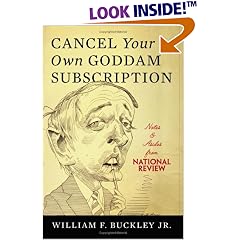
Charlie Rose, as he is wont to, did a retrospective on William F. Buckley Wednesday night, running together conversations from the many interviews he had done with him over the years. The show, and the passing of Buckley, made me reflect on my own dilemma: How do I think about people who are both brilliant and insightful while at the same time embracing ideals that seem to be an affront on common sense.

Listening to Buckley talk is an absolute delight, but thinking of him as the intellectual father of modern American Conservatism is frightening, made ever so much more so because he, apparently, was proud to be seen that way.

The more urgent dilemma, however, may be why there is a dilemma at all. When stupid people say stupid things it does not bother me. I shrug it off as a curiosity or, if I am feeling particularly empathetic, try to understand how they might have arrived at those views. But when smart people say stupid things it bothers me. Instead of trying to understand how they arrived at their views, I try to understand what mistake they made in arriving at their views.

That intolerance is more than a product of getting grumpy and set in my ways. Public discourse, especially political public discourse, more and more looks for a one dimensional rating system. When Hillary Clinton claimed that Barack Obama was to the right of George Bush because he did not support freezing interest rates on subprime ARMs, I was astonished. I just can’t fathom in what sense picking a position on the best way to deal with foreclosures is a left-right choice, I would have hoped there would have been some talk of effective versus ineffective.

In the face of this one dimensional worldview, I think it is more important than ever to listen to the people you disagree with, especially when they are talking about the things you disagree about. It is true that some disagreements are big enough that all the understanding in the world won’t change anything. But there are lots of disagreements that are not like that and by listening more thoughtfully, we might get closer to the truth. If in doing this we end up needing seven dimensions by which to identify ourselves so be it.

So thank you Mr. Buckley for everything you have said that I disagree with. Perhaps it is time for me to read more of your 55 books.


Wednesday, February 27, 2008

Our Ancient Watchman

A very long driveway, I thought as we drove in to look at a suburban house. We had seen so many, but this one looked promising from the outside except for the ugly green utility box in front. Inside was much nicer than any place we had seen and, to my delight, there was lots of land for gardening.

In the end, we did buy the house. But the first time I commuted back from work, I was greeted by the ugly green box. Why the developer placed an eye-sore at the most conspicuous spot in front of a nice house, it was beyond my logic.

“You will get used to it,” my husband, Bob, said, “it’s just something that needs to be there.” A typical male attitude: ugliness overlooked and beauty taken for granted. I kept telling him we should do something about it, and he kept saying that it belonged to NStar Electric and we couldn’t put anything on it.

Then one day, I saw a small sculpture of a man dressed in Qing Dynasty clothing sitting and pondering in a garden catalog. That is it, I told Bob. “Only $89, okay let’s try it,” he said. Apparently it was about price all along.

Our Chinese Man came, and was put on top. A wonderful difference. When friends came to visit, they praised, "Where'd you find such a nice stand for your sculpture?" The ugly utility box, as intact as it can be, magically disappeared from everyone's eyes.

However every time I walked by I had to move our Chinese man. The wind would always make him face a different direction. Bob said that he was looking around to see the world, but I didn’t really like the directions he chose. One windy night he blew off altogether and I found him in the morning on the ground, broken to two halves at his middle. Almost in tears, I asked Bob what to do. “No problem,” he replied, “I will fill him up with sand and glue him back together.”

So that's what Bob did, turning a bad situation into a good one. The heavier man was now able to hold his position in any weather. He outlasted his original stand, which had started leaking oil, and happily sits on the new one. He is slowly turning green with moss, but remains as happy and unperturbed as ever. In the snow he even gets to wear an extra hat.

Monday, February 25, 2008

Another Kind of Movie Reviewer

On January 17th, a review of Terminator: The Sarah Connor Chronicles, was posted on the LanceReviews website. That review received over 1,000 hits in a single day from virtually every corner of the globe.

It is remarkable given that this website is only seven months old, and is one man's labor out of love for good movies and anguish over bad ones. In July 2007, Lance Berry launched his movie review site, on which he posts a new review every couple of days. He does not get paid doing this, and he does not run ads on his site; what he gets is the fun of reviewing and venting, plus an unexpectedly large readership.

Once a film critic/columnist for Latest Issue Entertainment, Lance Berry started his own site dedicated specifically to movie/TV/entertainment reviews, because he has a passion for film and believes that good movies should be praised and recognized, while bad films should be "drop-kicked to the furthest nether regions of hell whenever possible." The LanceReviews site receives daily hits from around the world, including places such as Japan, Russia, Australia, and the UK, in addition to the United States.

Lance is not your average movie reviewer who has to please some special-interest audiences, including the movie industry. He reviews things exactly as he sees them, which makes him a reviewer for the average person, rather an irony that "average" has such divergent meanings. And, unlike many reviewers trying hard to be entertaining for the sake of entertainment, Lance strives to be informative. That, I think, actually makes his reviews more entertaining than most.

And he is humorous and insightful. His headline on Vantage Point is “Disadvantage Point: New espionage thriller plays like another familiar film...but with half the charm.” For Jumper it is “Clunker: anywhere is possible. Teleportation flick goes nowhere fast.” Of course, not every movie is a dud. For The Spiderwick Chronicles, Lance says “Magically Enthralling: Spiderwick spins a web that ensnares its viewer...and doesn't let go!”

As you can see from the picture above, which I adapted from his website, Lance has a clever eye for layout, in this case with an ironic twist. He uses the medium of Hollywood presentation, to present Hollywood.

I don’t often go to see movies in theaters, but when I do it seems like about half the time I am disappointed. Lance, who does go to theaters a lot, seems to agree with me. In fact, he had it so strongly that he started reviewing as a way “to vent about bad movies that are foisted on an unsuspecting public.” But this is not venting in vain, not for the people who read his reviews. If you are lucky enough to read his review in advance, you are forearmed – you might instead curl up in bed with a book. If you see the review too late to save the evening, you can turn the disappointing event into a memorable laugh.

Though honest criticism might upset some people, it can also transcend that. After he saw Casino Royale, in which Daniel Crag plays James Bond, Lance posted what he called "the most honest review of Casino Royale you will read," with the headline "A Bond movie that ISN'T a Bond movie." Several people pasted copies of the review on pro-Craig sites, in order to allow bashing. Apparently some of those people still liked Lance's writing enough to come back for more.

After Lance allowed www.danielcraigisnotbond.com, a British-based site, to post his review of Casino Royale, as well as a link to his article on why Christian Bale should be the next Bond, his site began to get a lot of European hits.

I hope Lance's screenplay writing also benefits from his film reviews. Yes, he has been writing scripts seriously for the past 5-7 years. "I write well, I write fast. In the past, I have re-written 120-page screenplays literally overnight," he says, "I am versatile, writing all types of screenplays: drama, horror, science-fiction, etc. I have made several good connections within the industry recently, but I am still waiting for that 'big break'."

It is his intention to eventually produce a science fiction series, based on his screenplay and novels "The Reign".

Saturday, February 23, 2008

Michael Wood on Lust, Caution ("色戒")

Michael Wood, London Review of Books' movie reviewer, says:

"Lust, Caution
is billed as a film about sex and espionage, lots of both, and occasionally it looks like such a work. All its interesting moments, however, are about something else: style, masquerade, glances, silences. Each character in the movie has a movie running in his or her head, and when a young woman called Wong Chia-chi (played by Tang Wei), about to become a temptress setting up a collaborationist Chinese official for assassination, sits in a cinema and weeps copious tears, we know she will never be able to cry in this way outside the movie house."

Read the rest of the review here.

Thursday, February 21, 2008

"Cornerstone" of a Mystery


The Eye of Jade
by Diane Wei Liang
Simon & Schuster, 256 pp., $24.00

(Book Review by Xujun Eberlein)

1.
Diane Wei Liang's female detective protagonist, Mei Wang, is a character built up of conflicts between her mindset and reality. She is aloof, "an outsider who never wanted to be in" while in college, but her college friends turn out to be the only ones who truly care about her. Her longing for her mother's love manifests as resentment, and her mother suddenly has a stroke before there is a chance to reconcile. She desperately wants to cure her mother, but she has no money or connections, and those things can only come from the sister she looks down on. She detests "guanxi" (connecting with purpose) and people who are good at it, yet whatever clues she obtains for her investigation are through "guanxi." Wherever she exhausts her network of relations, her means of investigation also dry up. For the most part the novel leaves the reader wondering if the only way for Mei Wang to make progress in Chinese society is to embrace the opposite of what she values.

Yet this is a quite realistic depiction of the late 1990s' Chinese society, post Cultural Revolution, in the midst of the Reform-and-Open era. And Diane Wei Liang is at her best depicting it using multi-voice dialogue. Here is such a dialogue at a class reunion:

"I'm going to Shenzhen. I've had enough of Beijing and Xinhua News Agency," Sparrow Li declared.

"What?" Fat Boy shouted. "You didn't tell me! You are giving up the Steel Bowl for a private local newspaper? Are you out of your mind?"

"What's so great about Xinhua News Agency? We have no housing, and the pay is lousy. When we graduated, it was all about getting a job with the big ministries. Now it's about money. If you are rich, you are somebody. I'm going to be the chief editor and make a lot of money."

"Don't be naïve." Big Sister Hui popped open a can of Tsing-tao beer. "What's money compared to power? Mei had a beautiful one-bedroom apartment when worked for the Ministry of Public Security. She traveled in official cars and dined in the best restaurants. She wasn't rich, but didn't she live a good life! Look at your chief. He doesn't need to be rich. He gets everything he needs and more from his job."

"I don't need a car. But I would like to have a roof over my head." Fat Boy sighed. "Beijing Daily is much worse than Xinhua News Agency. It doesn't even give me a dorm room. I'm thirty years old and still living with my parents. So I told the matchmakers that I'm only interested in girls whose work units have housing."


This conversation is so real, I can almost see those people's lips moving and hear their voices, as if they spoke in Chinese, as if I were among them.

Dialogue is also an economic means deployed in The Eye of Jade to convey background information of supporting characters. In the example above, with less than a page, we get to know several friends of Mei, even something about Mei herself, without dragging on through long descriptions.

The intimate reflection on everyday life of contemporary China is a good quality of this novel. For a reader who knows about China, this quality is engaging. Too often I can't finish a novel set in China written by non-Chinese, because it turns me off when the author gets obvious things wrong.

For readers who are less familiar with China, The Eye of Jade provides a lens into Chinese society. The author picked a good starting time for the story. Between 1980 and 1997 there were amazing changes that took place, almost as amazing as the changes between 1997 and now. The central case that Mei is investigating takes us back in time: to the origin of the relics she is trying to locate, nearly 2,000 years ago; to the circumstances of its disappearance 30 years ago; and to Mei’s youth 10 years ago. Thus, without a complete recount of history we are given insights into it. One can reasonably predict that, as future cases come for Mei Wang, we will get a chance to see China develops more, and hopefully also to explore more of its past.

That said, there are some holes in the work. For one thing, the Ministry of State Security (analog of the FBI) did not exist until 1983, so some of the retrospective actions during the Cultural Revolution in late 1960s are not completely plausible. Still, compared with some other English fiction on China, the lapses are small.

2.
Ultimately, Mei Wang does not give in to the Chinese societal trap. Toward the end of the novel, Mei's true self, aloof and courageous as she is, does triumph. When her "guanxi" ends, she singular-handedly confronts each hypothesized suspect one by one, alone and determined. And sure enough, each confrontation takes her closer to the entire truth, until the case is solved.

At this point, however, this triumph should be read as the author's fictionalized ideal ending, rather than a depiction of the reality. After all, it is unlikely in reality that any private detective, not to mention a young woman apparently with no training in self-defense and no backup – would go to each (dangerous) suspect and point a finger at him, "You are the murderer, aren't you?" simply to see if he'll admit to it. A detective who relies on this approach wouldn't be the smartest one anyway.

So why does Diane Wei Liang make Mei Wang do this? One can find a partial answer from the author interview by her publisher, in which she explains:

"Guanxi is loosely translated as connections and networks of relations. But it means much more. It is a cornerstone of Chinese culture, as the society is operated according to it – people are introduced, things get done – or not – based on who they know."


Except guanxi is more like extra oil for an age-old societal machine than a cornerstone of Chinese culture. In any case "guanxi" is an external factor; the concept might assist a novelist to move forward a plot, but it can't enhance characterization, nor excite the reader. If Mei's entire investigation "operates according to it," the intricate behavior and actions would be absent. The final confrontations carried out by Mei Wang, therefore, are a last-ditch resolution for both the author and the central character.

3.

This raises a key question: is this novel really a detective story? The answer is both yes and no. It is what the author sets out to make; it is not quite accepted as such by readers.

For detective genre readers, the fun of reading is solving a puzzle with the author. It is the chase of logical inference that is thrilling. In The Eye of Jade, however, this element is largely missing. Sure, Mei Wang confronts the suspects with her hypotheses, but when we see this, the hypotheses are already made. We read the conclusions without being letting in the process of reasoning, and we don't know how she gets there. This thrill is not quite there.

Apparently, the author has a different idea about what this book should be. The Eye of Jade is the first in a series of "Mei Wang Mystery" novels, for which the author has a very interesting and intriguing concept. The interview mentioned above opens with the following Q and A:

Q: Why did you decide to tell your story of modern China through the lens of crime fiction?

A: Because crime fiction brings together different elements of a society and exposes their frustrations, conflicts and desires. I found it an ideal format to examine the social and economical changes that are at the center of modern life in China. I also wanted to paint an honest and authentic picture of life in Beijing. "The Eye of Jade" gave me such an opportunity, allowing me to move among its different neighborhoods and varied social and economical groups, to explore the inner life of that fascinating city.


That is exactly what she does in The Eye of Jade, and quite successfully. The social and economic aspects of life in Beijing are given equal, if not greater, emphasis than Mei Wang's case investigation. A reader who is not looking for a particular genre story could enjoy both threads. To a mystery/crime genre reader, however, the author's stated goals, however admirable and ambitious, do not provide the same thrill as logical inference.

On the other hand, would a romance novel bother its readers for its lack of logic? No. One would have to be bothered by something else. This is to say, the genre label pre-sets reader expectations. It is a double-edged sword. It helps us find the right category for reading pleasure; it can also stop us from being entertained.

Therefore, the author has options. The smart idea of conveying modern China's societal change to English readers through genre fiction (which has a much greater readership than literary fiction) might actually work, if she finds the right genre and executes in it well. If she (or her publisher) chooses to stick with the current label, then she will need to enhance the genre's "cornerstone": logical inference.